
Defense Patents: Securing Your Tech Edge and Winning Contracts Simultaneously in korea
The defense industry is a different breed from general manufacturing. A single technological breakthrough can snowball into long-term national projects, large-scale procurement, follow-up upgrades, overseas cooperation, and tech transfers. If you fail to protect your core technology during this lifecycle, your company risks losing both its market advantage and negotiating power, leaving the fruits of your R&D vulnerable.
This is exactly where the strategic value of defense patents shines. A defense patent isn't merely a procedural registration; it is a structural shield for your technological assets and a strategic tool to elevate your business competitiveness. Because the defense sector integrates highly complex technologies—ranging from sensors, radar, and unmanned systems to navigation, electronic warfare, and software-based control systems—the caliber of your patent portfolio's design directly dictates your company's future value.
5 Reasons Why Patents are Critical in the Defense Industry
1. Prevents Technology Leaks and Imitation
Defense technology is an area where high sensitivity meets high economic value. Because immense time and capital are poured into R&D, there is always a risk that competitors will quickly copy your innovations or that ideas will leak during collaborations. Here, a patent acts as a legal boundary that deters unauthorized use by others. For defense firms, a patent is not a descriptive document; it is a defensive perimeter.
2. Boosts Competitiveness in Bidding and Evaluations
Defense contracts are awarded based on a comprehensive evaluation of technical prowess, reliability, execution capability, and differentiation. In this process, your patent portfolio serves as an objective metric of your technological leadership. Companies with clearly protected, proprietary technology hold a much stronger position in proposals and negotiations. Simply put, defense patents protect your tech while expanding your business opportunities.
3. Clarifies Ownership in Joint Development and Collaborations
Rather than isolated development, the defense sector relies heavily on industry-academia cooperation, joint research, system integration, and complex supply chains. Without a solid patent strategy, disputes over "who owns what" are inevitable. Designing the direction of patent filings and ownership structures in advance ensures stable collaborations and smoother tech transfers later on.
4. Increases Investment, Valuation, and Tech Transfer Potential
Because the defense industry has high barriers to entry, proven technology retains high value for a long time. Patents are the primary means of quantifying that value. Registered patents, pending portfolios, overseas filing strategies, and histories of dispute resolution all positively impact a company's valuation. Furthermore, a well-organized patent portfolio drastically simplifies discussions around tech transfers, licensing, and strategic alliances.
5. Provides a Powerful Weapon During Disputes
Given the large scale of contracts and the number of stakeholders involved, the risk of disputes in defense is constant. Whether facing similar competing products, the copying of core structures, software algorithm infringement, or unauthorized tech use after a partnership ends, responding effectively without patents is nearly impossible. A proper patent portfolio enables proactive measures, including formal warnings, injunctions, and claims for damages.
Key Practical Points for Filing Defense Patents
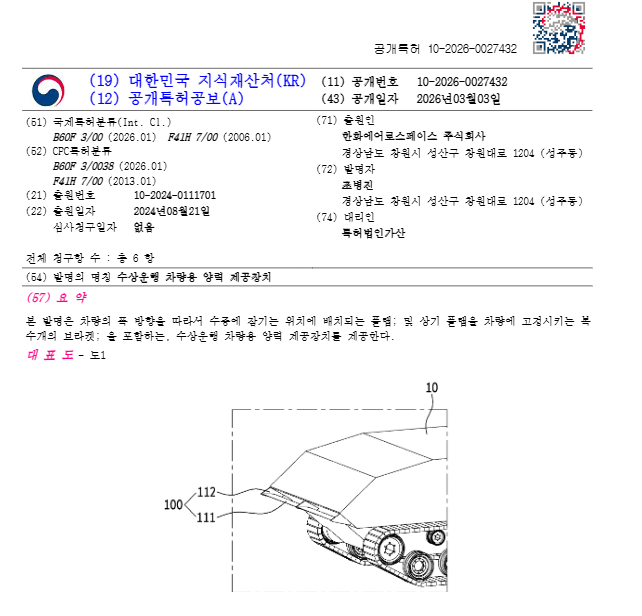
Defense patents require a fundamentally different approach from general tech patents. Simply summarizing your invention and filing it is not enough.
Controlling the Scope of Disclosure
While disclosing your technology broadly can help secure broader rights, it also increases the risk of exposing core know-how. You must strategically separate what to patent and what to retain as trade secrets. Patents and trade secrets are not alternatives; they are parallel strategies. Even major domestic defense contractors use a tailored approach, revealing specific structural features in their patents while hiding other critical components.
Layering System and Element Patents
Take unmanned systems, for example. You shouldn't just patent the overall system structure. You must strategically design a hierarchy of patents covering specific elements: sensor placement, control methods, communication architecture, navigation algorithms, and operational interfaces. This layered approach makes it incredibly difficult for competitors to design around your technology.
Reviewing Overseas Patentability Early
Defense technology rarely stays confined to the domestic market. If there is any potential for exports, joint development, or overseas collaboration, you must integrate an international filing strategy from day one. A domestic patent alone offers zero protection in foreign markets.
Managing Inventors and Ownership Rights
Projects involving joint development, outsourcing, consulting, or research grants require crystal-clear inventor identification and ownership terms. Failing to resolve these details before filing can lead to patent invalidation, equity disputes, or messy contract battles down the line.
Who Needs a Defense Patent Strategy Right Now?
You should not delay your patent strategy if your company falls into any of these categories:
- Companies currently executing national defense R&D projects.
- Firms possessing technology in UAVs, drones, surveillance, sensors, communications, or battlefield software.
- Companies participating in the localization of military components or the development of upgraded equipment.
- Firms engaged in joint development with partners, research institutes, or universities.
- Defense contractors considering overseas expansion, technology transfers, or seeking investment.
If you have the technology but lack the patents, the market may severely undervalue your capabilities. Conversely, a precise patent strategy transforms that same technology into a formidable corporate asset.
Pine IP Firm's Proposition: Strategy Must Precede the Filing
Many companies think, "We'll file a patent once we have good technology." In the defense sector, that order must be reversed. You need to design what technology to protect, in what scope, at what time, and where (domestically and internationally) before you move forward.
In defense patents, the architectural structure of your portfolio matters far more than the sheer number of registrations. To wield real power in the market, you must strategically design claims that protect core technologies while securing peripheral tech, applied tech, and even competitor-blocking claims.
Pine IP Firm offers battle-tested patent strategies tailored to the unique technological characteristics and business structures of the defense sector. We don't just file paperwork; we partner with you to protect your technology, prevent disputes, design your scope of rights, build your portfolio, and connect it directly to commercialization.
If you want to achieve sustained growth in the defense market, your technology development must run parallel with your patent strategy.