
A structure where patents (IP) become real money in government-supported projects
Looking at the government support project announcements for 2024 and 2025, many representatives still ask whether having patents means they get extra points, or whether having a certain number of patents is advantageous.
To share the actual analysis results, this perception is only half correct. Holding patents or intellectual property (IP) is still Bonus ElementsThere are certainly businesses that operate under this system, but now it goes beyond just points. Required qualifications, strategy tracks, and qualitative evaluation criteria for VCsThis is because its role is expanding to include
Based on the key announcements for 2024–2025, Pine IP Firm has developed IP (Patent) Points and Incentives Strategy Maphas been organized. In this column, we'll explore the core from the perspective of actual selection possibilities.
1. Four Formulas That Affect Patents
Recently, in government-supported projects, it's not just about how many patents there are, In what structure does it work?is important. To summarize, there are four points.
1. Direct Points
Certifications for outstanding company in job invention compensation, attracting investment in the Mother Fund patent account, joining intellectual property (IP) deductions, graduation from global IP star companies, and awards for IP-R&D excellence are explicitly added to the evaluation form. For example, under the "2025 Patent R&D Strategic Support Project (IP-R&D)," you can secure up to 4 IP-related preferential points alone. Once you have it, it can be used repeatedly across various businesses. Recurring Point AssetThat's how you can think of it.
2. Required Qualifications.
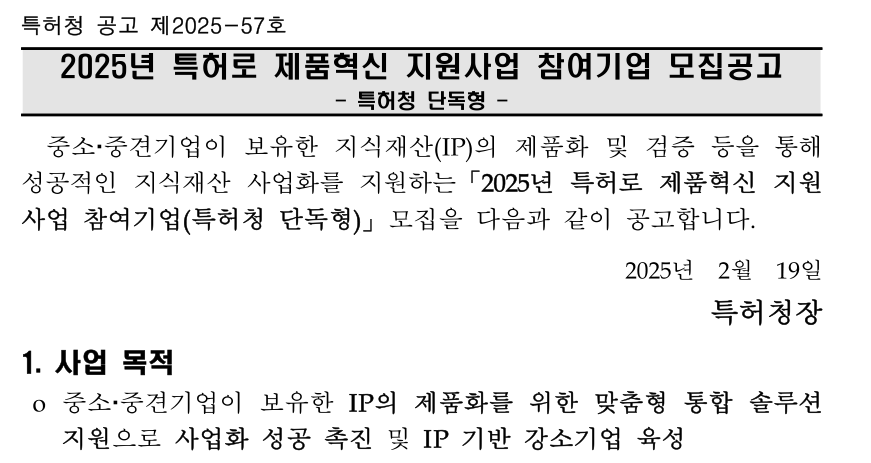
Some businesses are limited to companies holding at least one registered patent, utility model, or design patent. In this case, the patent is no longer an additional point but an entry ticket. A representative example is the "2025 Patent Product Innovation Support Project." Companies without patents simply cannot receive support, so companies that already hold even one patent will have a significantly reduced number of competitors.
3. Strategy Track
Even within the same business, cases of handling advanced technology patents separately are increasing. Companies holding general patents compete in the basic track, while those holding national strategic or advanced technology patents are assigned to a separate focused support track to receive more support. The 'Product Innovation Support Through Patents' track for companies holding advanced technology patents, and preferential points for national strategic technology projects under the 'R&D Strategic Support Program' are in the same vein.
3. Qualitative Core Evaluation (VC·TIPS Perspective).
In structures like TIPS, where private investors select first, even if the announcement does not mention ○ points for holding patents, patents serve as a key basis for evaluating company value (Valuation) and technological exclusivity (Defensibility) during investment reviews. From the VC's perspective, patents block competitors' entry, boost corporate value in future M&A or IPOs, and protect the company from technology theft disputes. Real assetsThat's it.
In this way, patents in government-supported projects are limited to points, qualifications, Fast Track, and investment review criteria. Three-dimensional roleWe are doing this. Therefore, from a company's perspective, designing which tracks and businesses can be opened with our IP is the starting point of strategy, rather than just a few patents.
2. Representative Examples of 'Direct Extra Points'
The question many people are most curious about is still where to directly award patent points.
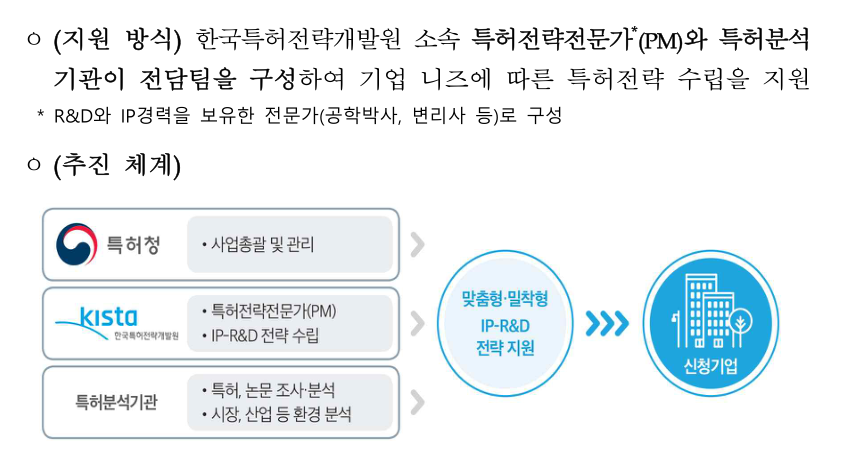
A representative example is the "2025 Patent R&D Strategic Support Project (IP-R&D)" led by the Korean Intellectual Property Office. This program supports patent big data analysis, patent mapping, and the establishment of strategies for responding to core patents, and in the selection evaluation, IP-related Preferential PointsThis is clearly established. Projects related to national core technologies, certification as an excellent company for job invention rewards, attracting investment from the Fund's patent account, enrollment in intellectual property (IP) deductions, graduation from a global IP star company, and awards as an excellent IP-R&D company all serve as quantitative points.
Here, the point that deserves particular attention is Certified as an Excellent Company for Employee Invention Compensationand Intellectual Property (IP) DeductionThat's it.
The Certificate of Excellence in Employee Invention Compensation is a certification granted by the Korea Invention Promotion Association, and once obtained, it can be used in various government projects. Repeatedly recognized as a bonus itemThis is often the case. It has also been confirmed that this is included as one of the bonus points for performance within the past three years in the presentation evaluation (PPT review) of specific R&D projects. In other words, once prepared, it can be effective in completely different ministries and projects, Universal Bonus AssetIt becomes so.
The same applies to enrolling in the intellectual property (IP) deduction. It allows for relatively low costs and clearly signals to the government and evaluators that companies are interested in IP risk management. In the IP-R&D business, the very fact of joining serves as the basis for the preferential points.
In summary, if you are a small business that already holds patents, Rather than firing one more patent, securing portable bonus points such as the employee invention compensation system, excellent company certification, or IP credit enrollment first may yield higher investment efficiencyThat's the point.
3. Where patent-holding companies should target first: 'Qualification Type' and 'Advanced Technology Fast Track'
As mentioned earlier, the 'Product Innovation Support Project by Patent (Seongnam City Collaborative Type)' requires holding at least one registered patent, utility model, or design. EligibilityThis is what we demand. In this structure, companies without patents cannot compete at all.
This type of business Qualification-based IP businessIt can be called that, and for companies that already hold patents, it actually presents an opportunity. Because the competition rate itself decreases. Instead of competing in a red ocean for 1~2 extra points, companies with IPs are competing in a blue ocean.
In addition, companies holding advanced technology patents can take it to the next level. If you hold patents in technology fields classified as national strategic technologies, AI, semiconductors, bio, batteries, etc., you can have patents in a separate track from the general track. Intensive Support Track or Tracks dedicated to advanced technologyThe number of cases where you are subject to such a system is increasing.
Therefore, companies must The process of dividing our patent portfolio into two directionsis necessary.
Patents related to general BM and services are classified as patents corresponding to advanced technologies such as the 12 major national strategic technologies; the former is linked to qualification-based support projects, while the latter is linked to strategic tracks and advanced R&D projects. Dual Government Support Project StrategyIt is effective to set it up.
4. How are patents evaluated in TIPS and early-startup packages?
The business that many early-stage startups are most interested in is TIPSand the Early Startup Package (First Startup Pack). The role of patents in these two businesses appears somewhat differently.
In the case of TIPS, the bonus points for holding patents are often not clearly displayed on the official evaluation table, but in reality, IP is a key qualitative evaluation factor in the investment review process for private investment firms (VC·AC)It functions as such.
From the investor's perspective, patents answer three questions.
Whether competitors can easily catch up and later through M&A and What corporate value can be expected at the time of an IPO, and can it be defended in case of technology theft disputes? What supports all three of these is Patent Portfolio and Free-to-Use (FTO) StrategyThat's it.
Therefore, when preparing TIPS IR materials, it is important not only to list the number of patents but also to logically present which competitors our patent portfolio will block, secure exclusive positions in which markets, and contribute to the exit process.
On the other hand, in the early-startup package, holding patents Direct Scoring Factors in Selectionoften does not clearly show up. Related materials actually specify intellectual property applications and registrations as the use of commercialization funds. In other words, after selection, the budget secured is used to file and register patents. In the Chochang Plae→, it's more practical to understand the process of securing commercialization funds → patents → selection rather than selecting the patent holder.
5. IP Support Business Value Chain: A structure where patents are created with government funds and then received government funding from those patents
If government support projects and intellectual property strategies are well designed, a kind of IP virtuous cycle can be created.
First, at the stage where there is no IP at all, local governments such as Daejeon, Seongnam, and Gyeonggi Province Intellectual Property Rights Acquisition Support ProjectBy utilizing this, you can secure your first patent while receiving subsidies for application costs. This is the first step.
Next, the patents obtained in this way are used like entry tickets, and holding a patent is required as a qualification requirement. IP Qualification Type ProjectsYou will be challenged. Programs like Seongnam City's patent-based product innovation project require at least one patent as a condition for support. From this stage onward, the government invests its budget directly in companies that own IP.
In subsequent stages, while conducting the business, Regulations on Employee Invention CompensationIntroduced it, Certified as an Excellent Company for Employee Invention Compensationand Intellectual Property (IP) Deduction EnrollmentWe are preparing for this. From this point on, the company is no longer just a simple patent-holding firm, Companies with IP Management SystemsIt is switched to.
Finally, the patents, qualifications, management certifications, IP mutual aid enrollment record, graduation record from global IP star companies, and awards for excellent IP-R&D companies have since been recognized in the "Patent R&D Strategic Support Project" and various R&D and commercialization support projects. Points Incentives, Incentives, and Strategic Entry Tracksis repurposed.
In other words, government support projects → securing patents→ establishing IP management systems→ leading to selection for government-supported projects. virtuous cycle structureEntering is the most efficient IP strategy in the long run.
6. Practical IP Strategy for After 2025: Three Checkpoints
To clarify, I will focus on just three points.
First, you must categorize the IPs you hold.
Just distinguishing whether patents are related to general BM, services, or platforms or advanced technology patents such as the 12 major national strategic technologies clarifies which government-supported projects and Fast Track to target.
Second, don't wait for announcements. Recurring Point AssetYou need to prepare from the beginning.
Certification as an excellent company for job invention compensation and enrollment in intellectual property (IP) deduction should not be prepared when the announcement is released, but should be secured before the announcement is made. This way, you can continue to enjoy the bonus effect for 2~3 years afterward.
Third, not individual projects, Designing a HistoryIt must be done.
Graduates from global IP star companies, excellent IP-R&D companies, or participation in local government IP support projects are not one-off supports, but IP careers that can be converted into new points in your next business. Rather than focusing on how much you receive this time, you should plan together how well your history of this project will benefit you in future projects.
It's time to build an IP management story, not just a few patents
The key words running through government-supported projects are clear.
Simple Patent HoldingBeyond that, focusing on patents IP management system, market value, strategic technology positioningHow it is designed is what creates an invisible score for companies.
Pine IP Firm provides consulting within a single flow, covering everything from building patent, design, and trademark portfolios, designing employee invention compensation regulations and preparing for excellent company certification, strategies to utilize intellectual property deductions, and designing IP storylines for TIPS, government R&D, and early-stage startup packages. If you can share your current list of patents and the names of government-supported projects you are interested in, Customized IP Points and Incentives Strategy MapWe will design it together in detail.