
Assessment of Korean Patent Prosecution Quality
An allowance rate does not establish the quality of Korean patent prosecution. A high rate may result from strong drafting and prosecution, favourable cases or claims narrowed beyond their commercial purpose. Average cost and pendency are also incomplete measures because they do not show the scope or durability of the resulting rights.
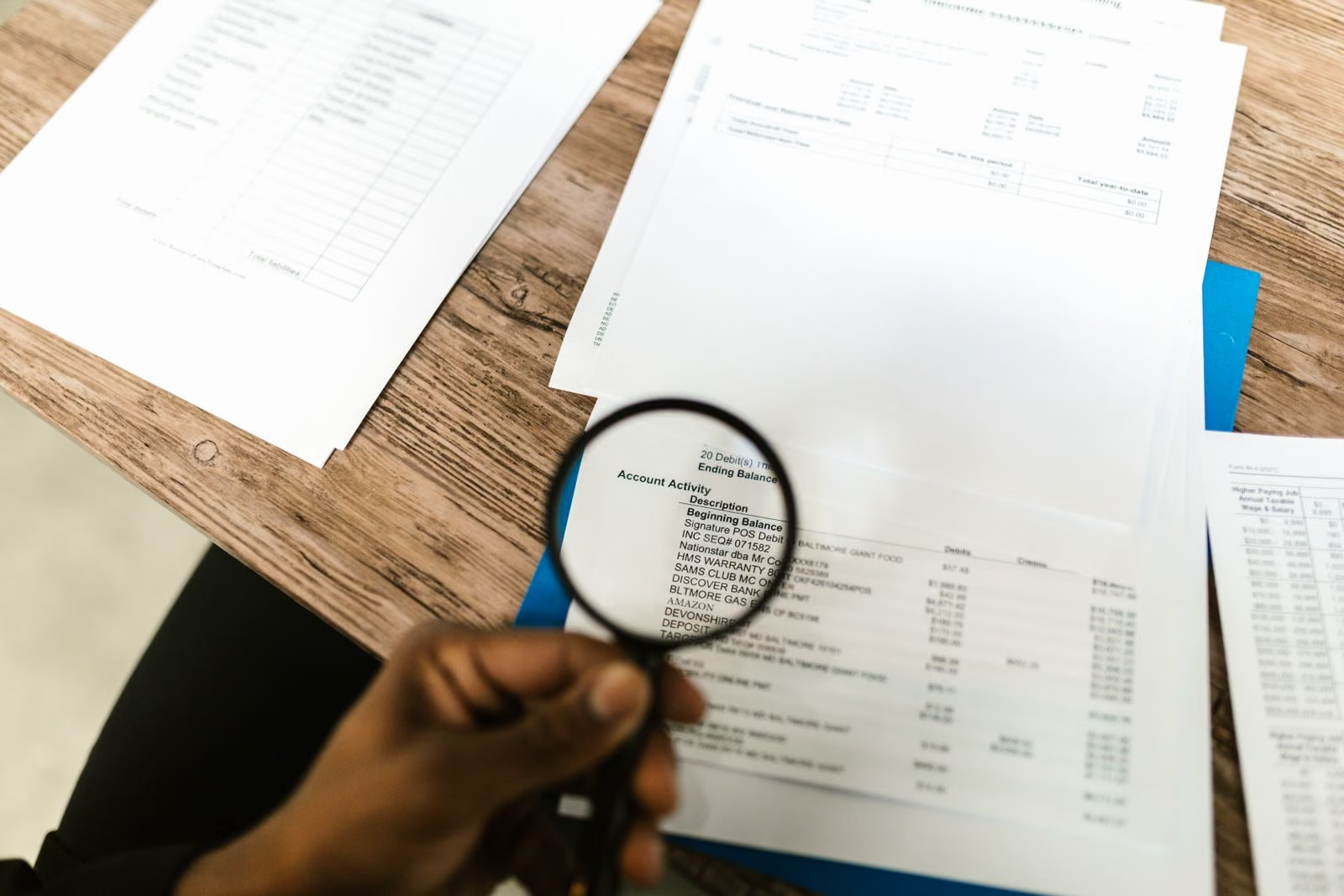
A useful review examines representative files for legal and technical quality and then considers service and portfolio data over time.
Commercial purpose of the claims
For each material case, the reviewer should identify what the Korean patent is expected to protect. The subject may be a product architecture, manufacturing step, software process, formulation, use, component or competitor design-around.
The pending or granted independent claims should then be compared with that objective. A formally valid claim may still omit the feature that accounts for the product's commercial value.
The review should determine:
- whether at least one claim covers the commercial embodiment;
- whether a claim also covers foreseeable competitor alternatives;
- whether examples or foreign claims introduced unnecessary limitations;
- whether appropriate claim categories were used; and
- whether dependent claims or a divisional filing preserve useful alternative scope.
Korean translation and terminology
For a foreign-origin application, a technical sample of the Korean specification and claims should be compared with the source text. The comparison should cover key components, relationships, ranges, negative limitations, antecedent basis, reference signs and repeated technical terms.
A translation error may affect amendment support or later claim interpretation. The reviewer should distinguish a stylistic difference from a mistranslation or inconsistency that changes scope or creates ambiguity.
Office Action analysis
A response should accurately state the examiner's position, assess the cited art and legal basis, and recommend a course that remains consistent with the commercial objective. Withdrawal of the rejection is not sufficient if the amendment removes the commercially relevant scope.
The file should show whether counsel:
- analysed each cited reference against the relevant claim elements;
- applied Korean examination law and practice;
- considered argument before amendment;
- explained the scope surrendered by a proposed amendment;
- confirmed support in the Korean specification;
- considered an examiner interview where useful;
- identified available divisional, re-examination or appeal options; and
- coordinated material positions across the patent family.
MOIP's Patent Examination Guidelines state the current examination standards. The quality review should assess how those standards were applied to the claims, disclosure and cited art in the file.
Granted claims and enforcement
A granted patent should be tested against the use for which it was obtained. An important independent claim can be charted against the company's product and, where information is available, a competitor product or process.
The review should identify claim-construction uncertainty, proof problems, divided performance, relevant prior art and statements or amendments made during prosecution. These points show whether the granted claim can support an infringement position and withstand a validity challenge.
Reporting and administration
Substantive work may be adequate while poor reporting creates avoidable work for the in-house team. Relevant service measures include:
- timely receipt and analysis of official communications;
- a clear recommendation and explanation of alternatives;
- accurate deadlines and matter data;
- reliable budget estimates;
- compliance with billing instructions;
- timely answers to questions;
- escalation of urgent or unusual issues; and
- continuity when the responsible attorney is unavailable.
Performance measures should not reward avoidable claim surrender. A low average response cost can discourage necessary analysis or interviews, and a short time to allowance can reflect premature narrowing.
File-review criteria
| Category | Evidence reviewed |
|---|---|
| Commercial coverage | Comparison of claims with products and foreseeable alternatives |
| Legal and technical quality | Claim drafting, disclosure support, prior-art analysis and response reasoning |
| Translation quality | Comparison of selected Korean text with the source text |
| Family consistency | Positions taken in related cases and divisional or appeal decisions |
| Service quality | Reports, deadlines, budgets, invoices and response times |
The sample should include different technologies, responsible attorneys, prosecution stages and outcomes. Findings should identify the affected files and the change required in future drafting, translation, response or reporting practice.
Related Korean IP guidance
- Selection of Patent Counsel in South Korea
- Korean Patent Portfolio Management: Deadlines and Costs
- Patent Enforcement in Korea
Legal and editorial review: July 16, 2026. Korea's current patent authority is the Ministry of Intellectual Property (MOIP), formerly KIPO.
This article provides general information and does not constitute legal advice. Korean law and MOIP practice may change, and the appropriate review depends on the facts and prosecution record of each case.