
The Importance of Construction Patents and New Construction Technology Certification
Today, the construction industry is undergoing rapid changes worldwide. Amid various trends such as the Fourth Industrial Revolution, the rise of eco-friendly and smart construction technologies, and the demand for high-quality, efficient construction, construction companies must secure competitiveness through continuous technological innovation. In this process, 'construction patents' and 'construction new technology certifications' play a crucial role. Both systems can serve as key strategies for companies to establish technological superiority and gain trust in the market. In this column, we will explore the key features, necessity, and utilization strategies of construction patents and new construction technology certification.
What is a construction patent?

The patent system is designed to promote research and development (R&D) and promote economic and industrial development by legally protecting new technologies or inventions. A construction patent refers to securing exclusive rights to the technology by having an original idea or technical solution related to construction methods, equipment, materials, or construction processes recognized as an invention and registered with the Patent Office.
- Securing technical rights: Companies holding patents have the exclusive and exclusive right to use the technology for a certain period (usually 20 years after registration). This enables them to gain a competitive edge and generate additional revenue through technology royalties.
- Strengthening Market Competitiveness: By preventing other companies from arbitrarily copying or using similar technologies, you can steadily expand your business area.
- Enhancing Corporate Value: Holding patents visibly demonstrates a company's technological capabilities, greatly aiding investment attraction and external promotion.
Strategies for Securing Construction Patents
- Pre-research and technology trend analysis
- We monitor competitor patent trends, government and private R&D projects, academic papers, and more to identify market and technology trends.
- Clearly defined scope of rights
- When drafting a patent specification, you must ensure that not only the core idea of the invention but also the areas of improvement and modification are broadly protected.
- Collaboration with Public Research Institutions and Academia
- Through research achievements at public research institutions, universities, or collaborative studies, invention ideas can be refined and patent portfolios expanded.
What is Construction New Technology Certification?
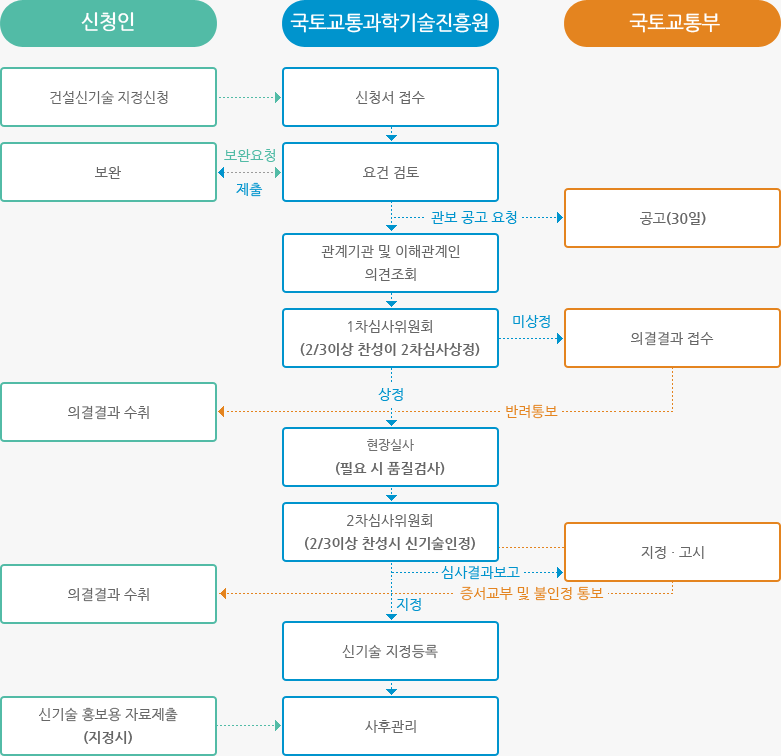
Construction New Technology Certification is a system in which new technologies developed in the domestic construction sector are comprehensively evaluated for practicality, cost-effectiveness, and constructability, and are granted official certification from the government (Ministry of Land, Infrastructure and Transport). Unlike general patents, this adds credibility to the fact that the technology is useful in real-world applications.
- Technical Certification: By certifying the technology from a government ministry, it is officially guaranteed that the technology meets a certain level in terms of safety, efficiency, and cost-effectiveness.
- Securing Market Confidence: When the client (public or private) adopts technology that has obtained construction technology certification, they can be trusted in terms of construction quality and performance.
- preferential policy: Technologies certified as new construction technologies can enjoy preferential policies such as bonus points and maintenance projects during bidding, making them advantageous for market entry.
Construction New Technology Certification Acquisition Process
- Check technical requirements
- To obtain new technology certification, it must meet technical originality, field applicability, and economic and safety requirements.
- Submission and Review of Materials
- Various materials such as conceptual design, construction performance, economic analysis, and technical verification reports are submitted for document review and on-site evaluation.
- Pilot Construction and Performance Evaluation
- We apply technology on a limited scale in actual sites to verify quality, efficiency, and safety. If the technical validation test results are positive, you can obtain final certification.
- Certification Acquisition and Post-Management
- Even after obtaining construction new technology certification, you must continue to monitor the application status of the technology and submit any additional necessary documents to maintain the validity of the certification.
Differences and complementarities between construction patents and new technology certifications
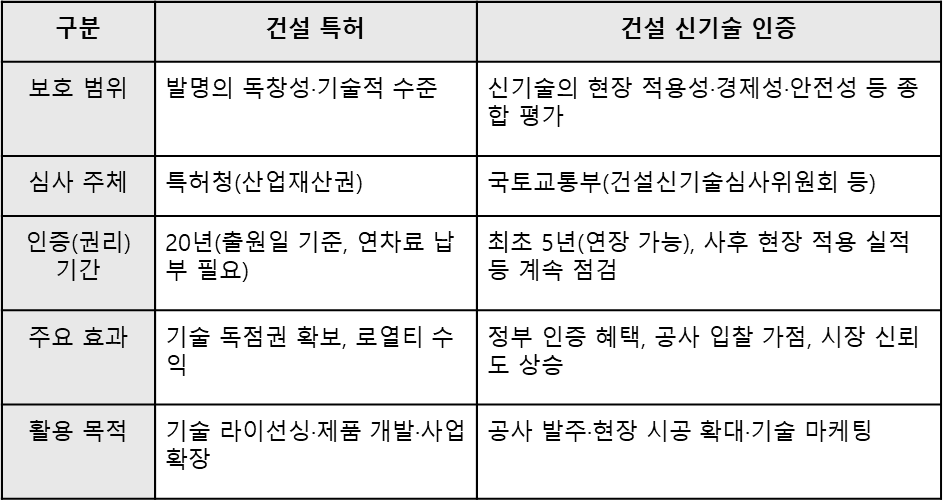
The two systems are not mutually substitutive concepts; rather, it is important for companies to use them complementarily when developing construction technology development strategies. For example, by protecting the originality of the technology itself through patents, and proving through new construction technology certification that the technology is safe and economically applicable at actual construction sites, companies can secure a stronger competitive advantage in the market.
Why companies should pay attention and strategies for utilization
- Market Capture Effect
- By obtaining construction patents and new technology certifications, you can simultaneously secure exclusivity and credibility over your technology, gaining a competitive edge in the market.
- Creating new businesses and increasing sales
- By utilizing patented technologies, businesses can expand through licensing or joint research and development, and newly certified technologies can be applied to various projects to generate additional revenue.
- Strengthening the foundation for overseas expansion
- Our portfolio of technology certifications and patents accumulated domestically is highly persuasive even when expanding overseas. When contracting with overseas clients or partners, you can further enhance your technology credibility by presenting domestic new technology certification achievements along with international patent applications (PCT).
- Investment and talent acquisition
- Patent applications and government certification records objectively demonstrate technological and innovative capabilities, making them advantageous for attracting investment from venture capital or financial institutions and securing outstanding R&D talent.
Conclusion
As the construction industry becomes increasingly complex and advanced, the importance of technological innovation is growing even more. Companies can further enhance their trust and competitiveness in the market by not only developing construction methods but also securing intellectual property rights (construction patents) and having proven credibility (new construction technology certification). In particular, it is essential to build a solid patent portfolio through external cooperation and R&D investment, and to create high added value by obtaining new technology certifications verified through actual construction cases.
Through this, the entire domestic construction industry will benefit from a 'win-win' effect by strengthening competitiveness in the global market alongside technological innovation. If the government, private sector, and academia work closely together to expand various support programs and R&D infrastructure, and actively utilize construction patents and new construction technology certifications, a safer and more efficient future for the construction industry can be opened.
Contact 'Pine IP Firm' now to get everything from construction patents to new technology certification all at once! We provide all the legal and technical advice necessary for safe and efficient construction innovation. From discovering technological ideas and building a systematic patent portfolio to developing strategies for acquiring new construction technology certifications, Pine IP Firm will maximize your company's future value based on expertise and experience.