
Madrid Trademark Application Guide
The following article provides a detailed guide on the process by which Korean companies and individuals can apply for and obtain trademark protection internationally through the Madrid System, operated by the World Intellectual Property Organization (WIPO). Korea joined the Madrid Protocol in 2003, which enables efficient trademark protection in multiple countries based on domestic applications (primary applications). This guide sequentially explains the advantages of the Madrid system, the application process, precautions, costs, and schedule.
Introduction to the Madrid System
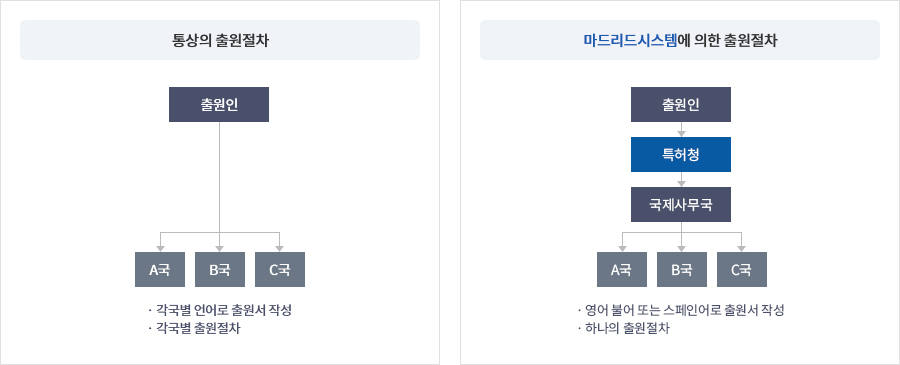
The Madrid system is a treaty-based system designed to provide trademark protection in multiple countries through a single international application. WIPO oversees this process, and each member state conducts its own review, but a single international application allows protection to be extended to multiple countries. Currently, the Madrid Union covers more than 80% of global trade, including 115 member countries (covering 131 countries).
By joining the Madrid Protocol in 2003, Korea has made it much easier for domestic companies and individuals to secure international trademark rights based on Korean applications. This is a major advantage for many Korean companies expanding globally, as it significantly reduces the need to prepare separate applications for each country and allows centralized portfolio management.
Advantages of international registration through the Madrid system
- Single application, single language, single fee
- You can apply for trademark protection in multiple countries using a single application (submitted through the Korean Intellectual Property Office or KIPO), in one language, and in one currency.
- The hassle and paperwork of submitting applications separately for each country are greatly reduced.
- Cost efficiency and administrative streamlining
- The Madrid system incurs lower administrative and administrative costs compared to filing separately for each country, and can also reduce translation and local agent fees.
- Broad international applications
- It has a broad coverage spanning 115 member countries (131 countries), including major markets such as the United States, the EU, China, and Japan.
- At the time of application, you can select the country (or region) you wish to specify and simultaneously seek trademark protection in that region.
- Centralized portfolio management
- After registration, a single registration number and renewal date apply to international registrations, allowing renewal to be processed all at once through WIPO.
- All procedures such as updates, information changes, and additional protection designations are handled easily through the WIPO system (reducing the need to respond individually by country).
In conclusion, the Madrid system is a "one-stop" international trademark protection tool that offers convenience and extensive geographic coverage to Korean companies looking to expand overseas from domestic entrepreneurs, startups, and large corporations. Below, we look at the specific procedures for utilizing this system through the Korean Intellectual Property Office (KIPO).
Step-by-Step Guide for Korean Applicants
To utilize the Madrid system, you must first meet the following basic requirements.
- The applicant must have Korean nationality, residence, and a substantial place of business.
- You must have a trademark (the 'basic trademark') that is already being applied for (or registered) in Korea with the same trademark.
- Madrid international applications must not exceed the same scope (marks and designated goods/services) as Korean registered trademarks.
If the above requirements are met, Korean applicants can proceed with the international application by following the steps below.
Preparing for domestic application (basic trademark)
- Since Madrid international applications are based on the domestic base trademark, the same trademark must be filed with (or registered) with the Korean Intellectual Property Office.
- For example: If you filed an application in Korea for clothing (heading 25) with a 'logo', you can only file an international application with the same logo and the same product (clothing).
Preparation of international application documents (submission by KIPO)
- Preparation of Application Form (MM2)
- Submissions are made through the KIPO electronic application system (KIPOnet), and English is usually used as the language.
- You must accurately fill in the basic trademark information (Korean application number and filing date) and applicant details (name, address, nationality, etc.), and prepare the mark (logo, text), goods, and services within the same scope as the domestic application.
- If it is a Hangul mark (or a mark that includes other non-Latin scripts), Transliteration and, if possible, semantic translation.
- Select designated country
- You can select your preferred Madrid member country, such as the United States, China, the EU, or Japan. Since separate fees apply for each country designation, select the countries you need strategically.
- Submit additional forms
- Example: If you wish to be designated in the United States, you must also submit the MM18 (Use Declaration).
- If this is missed, an 'irregularity notice' may be issued from WIPO or USPTO, causing delays.
- Payment of fees
- The basic fee (base fee + designation fee) to WIPO must be paid through the Korean Intellectual Property Office (KIPO) (basic fee for black and white trademarks: 653 CHF, color trademark: 903 CHF, etc.).
- An additional individual fee (or standard complementary fee of 100 CHF) is charged by designated country, and if there are more than three product classes, an additional supplementary fee of 100 CHF may also apply.
- KIPO may charge a separate handling fee (small amount).
KIPO Certification and WIPO Submission
- KIPO checks whether the international application matches the underlying trademark (whether the mark, applicant, and designated goods are identical) and that there are no issues with the format, then proceeds with 'certification.'
- If all is in order, KIPO forwards the documents to the WIPO International Secretariat.
- If there are discrepancies or missing documents, you will receive a request for correction or supplementation at the KIPO stage.
WIPO Formal Examination and International Registration
- Formality Examination
- WIPO verifies whether the application and fees have been paid, the appropriateness of the designated product classification (N ice classification), and the quality of the mark image.
- If there are no issues, the registration will be registered in the WIPO International Register and an international registration number will be assigned.
- Irregularity Notice
- If there are issues with documents or fees, WIPO will notify both the KIPO and the applicant.
- Examples: insufficient fees, incorrect product classification, missing translations, etc.
- Typically, corrections can be made within three months, and once corrected, the international registration process will resume.
- International Registration and Publications
- Upon meeting all requirements, WIPO issues a Certificate of International Registration and publishes it in the WIPO Gazette.
- From this point, the country is considered internationally "registered," and the designated country is officially notified of a Notification of Designation.
Designated Country Review (Substantive Examination)
- Each designated country conducts substantive examinations in accordance with its own laws. Generally, a decision on refusal must be made within 12 months, up to a maximum of 18 months.
- If there is no refusal
- If there is no refusal notice within a certain period (12~18 months), or if an explicit approval notice is issued, protection is confirmed in that country.
- When Notification of Provisional Refusal
- Grounds for refusal may be raised due to conflicts with existing trademarks or lack of distinctiveness.
- In this case, you must submit an opinion or amendment or file an objection within the specified period according to the laws of the respective country (usually handled through a local patent attorney or legal representative).
- If you fail to overcome rejection, you will not be protected in that country, but your rights in other countries will remain intact.
- If there is no refusal
Follow-up care
- If protection is recognized in the designated country, its effect in that country grants legal status equivalent to domestic registration.
- To check the status of international registration or the review stages of each country, you can conveniently use tools like WIPO's "Madrid Monitor."
- It is valid for 10 years after registration and can be renewed collectively through WIPO every 10 years.
By following these procedures, you can efficiently secure overseas trademark rights without having to file separate applications in multiple countries. However, when responding to refusal of substantive status, the laws of each country must be applied, so it is necessary to collaborate with local experts to develop response strategies if necessary.
Common mistakes and prevention methods
The Madrid system greatly simplifies the application process, but the following mistakes can lead to rejection, delays, and additional costs.
- Mismatch with the basic trademark
- If the international application does not exactly match the Korean basic application, problems may arise at the KIPO certification stage or during WIPO examination.
- The trademark (logo/text), applicant's name, and the scope of designated goods/services must be 'identical.' If even one is missing or added, the application may be rejected.
- Prevention Methods: Thoroughly verify Korean applications and record 100% identical information (design, product types, etc.).
- Inaccurate classification or ambiguous product names
- If the N ice classification is misapplied or ambiguous expressions considered "too broad" are used, WIPO may issue a non-compliance notice.
- Prevention Methods: From the Korean application stage, ensure accurate classification and use WIPO's 'Madrid Goods & Services Manager' and other tools to confirm whether the term is internationally accepted.
- Use of unofficial languages or omissions in translation/transliteration
- The language for international applications must be one of English, French, or Spanish, and English is commonly used through KIPO.
- If you submit the Korean mark without the Romanized transliteration or leave some explanations in Korean, you may receive a cancellation notice.
- Prevention Methods: The entire application must be written in English, and if the mark is in Korean, a transliteration and meaning translation must be included.
- Mispayment of fees (underpayment) and calculation errors
- Fees vary by designated country, and additional fees apply for products exceeding 3 items.
- Prevention Methods: Accurately calculate and pay using WIPO's 'Madrid Fee Calculator'. The payment confirmation process for electronic KIPO applications is also carefully managed.
- Missing additional requirements from specific countries
- For example: If you want to be designated in the United States, you must attach the MM18 form. If you miss it, you will receive a notice of refusal (or non-payment).
- Prevention Methods: Check in advance whether the designated country has special form requirements, and carefully review the guidance provided by the electronic application system.
- Insufficient trademark searches by designated country
- Since Madrid applications undergo examination in various countries, they may be rejected if similar or identical trademarks already exist locally.
- Prevention Methods: Before filing, prior trademark searches are conducted in major designated countries (e.g., the US, China, EU, etc.) to identify potential conflicts in advance.
- Overlooking the risk of Central Attack
- If the basic trademark (Korean application) expires within five years from the date of registration, the entire international registration may become invalid.
- Prevention Methods: Korean basic trademarks must be carefully managed to prevent rejection, cancellation, or invalidation, and if problems arise, the 'Transformation' procedure must be considered, but the costs are high.
- Lack of understanding of substantive laws and practices in each country, and lax local responses
- Although the formal process is unified with Madrid applications, when responding to substantive refusals, patent attorneys may still be required by country.
- Prevention Methods: Familiarize yourself with local laws, review practices, and document requirements in major markets, and seek immediate assistance from local experts if you receive a rejection.
By recognizing and preparing for these errors in advance, you can proceed with your Madrid application more smoothly and quickly. It is crucial to double-check that the base trademark matches perfectly and to thoroughly calculate the requirements and fees for each country.
Cost, duration, and key requirements
Cost structure
- Basic Fee
- Basic fee payable to WIPO: 653 CHF for black-and-white trademarks, 903 CHF for color trademarks (as of now).
- Designation fees (by country)
- Some countries set a standard Complementary Fee (100 CHF), while others set individual fees (major countries like the US, EU, China, and Japan generally have higher individual fees).
- If there are more than three classes, an additional Supplementary Fee (100 CHF) may be charged for each extra class (however, in some countries, individual fees already include additional classes).
- KIPO handling fee
- A small handling fee may be charged as compensation for the Korean Intellectual Property Office delivering the application to WIPO.
- Costs for Designating Additional or Expanded Items
- If you wish to add another country ('Subsequent Designation') after the initial application, you must pay a separate fee at that time.
Therefore, the final cost is the sum of "basic fee + (by designated country) individual fee + (excess class fee) + KIPO handling fee." It is important to estimate the approximate total amount in advance using the WIPO website's "Madrid Fee Calculator" and make sure to pay without any mistakes.
Estimated Duration
- KIPO Phase
- It typically takes several weeks to up to two months from KIPO to review and certify international applications and send them to WIPO.
- If the basic trademark (Korean application) is in normal condition, there is no significant delay.
- WIPO Formal Examination and International Registration
- WIPO usually completes the formal examination within 1~3 months, and if there are no issues, issues the international registration certificate.
- If a cancellation notice occurs, it may take several additional months to resolve it.
- Substantive examinations by country
- The designated country must notify of refusal within a maximum of 12~18 months.
- If there is no refusal, protection is automatically granted (the "silence = approval" principle).
- If a rejection is made, it may take longer to resolve it.
Overall, if proceeds smoothly, registration confirmation (or automatic confirmation) is made in most countries within about one year~one and a half years after filing. If a refusal or objection is made, it may take longer for the country itself.
Key Requirements and Documents
- Basic Trademark (Korean Application/Registration) Information
- The number, filing date, and applicant's name must be the same as the international application.
- Applicant Information
- Name (or company name), address, nationality/type of corporation.
- If you have a representative, include the agent's information.
- Trademark Image/Spelling
- The design, text, and color must be exactly the same as the basic trademark.
- Submit according to quality requirements such as JPEG.
- If non-Latin characters such as Hangul are included, the transliteration and translation must be specified.
- Product/Service List
- Use the same N ice classification and naming as Korean applications.
- Do not include additional goods/services or other categories.
- List of designated countries
- Select a country from Madrid member states where you want protection.
- You can also request additional assignments later, but a separate fee will be charged at that time.
- Priority Claims (Optional)
- If you file a Korean application for the first time, it generally proceeds without a priority claim.
- If you filed in Korea within six months after filing first in another country, you may also claim priority over earlier applications.
- Special Forms/Signatures
- For example: submitting the MM18 form for U.S. designation, etc.
- Certification and signing procedures are carried out for electronic KIPO applications.
- Fee payment confirmation
- You must pay the exact amount by the deadline.
All these requirements must be met for KIPO's certification and WIPO's registration procedures to proceed smoothly.
Legal Considerations and Strategic Tips
In addition to obtaining international registration, establishing a proper management and utilization strategy afterward is essential to maintain and protect trademark rights as effectively as possible.
Classification and Scope Strategy
- Selecting the right product categories
- Considering not only your current business but also future expansion potential, it is best to include all necessary classes, but avoid categories with no plans to use them at all (in some countries, unintended applications may be grounds for rejection or cancellation of use).
- Overly broad terms like "machinery" are likely to be rejected by international review or some countries. Use as specific and clear item names as possible.
Selection of designated countries and post-country expansion
- Priority Market Selection
- Priority is given to countries where you plan to actually enter business or countries with a high risk of trademark disputes (such as China).
- Rather than spending a lot of money specifying every country worldwide, it is more efficient to strategically determine the scope around core markets.
- Subsequent Designation
- The scope can be expanded later with additional designations when entering new countries.
- Within five years from the initial international registration date, there is a dependency on the basic trademark, so it must be maintained stably during that period.
Exercise and Maintenance of Rights
- Incident response
- Once registration is confirmed in each country through international registration, it can be protected as an independent trademark in that country.
- If infringement occurs, actions such as lawsuits, objections, and warning letters must be taken according to local laws (local patent attorney required).
- It is advisable to monitor the market in parallel to prevent unauthorized domain registrations and counterfeit products.
- Proof of Use and Cancellation of Non-Use
- If a trademark is not used for a certain period (3~5 years) in many countries, a cancellation of non-use may be requested.
- In the United States, even if the Madrid registration is present, actual use cases must be submitted to the USPTO in the 5th~6th year (declaration and evidence).
- Strategy Tips: Apply intensively in countries where the use will actually be used, or defensively in countries with future plans for use, while preparing to ensure proof of use.
- Updates and Information Changes
- International registrations are renewed in bulk through WIPO every 10 years (not country-by-country, but through a single procedure).
- If your address or name changes, you can register them collectively with WIPO for management, greatly reducing the need for individual notifications to each country.
Understanding Local Systems and Utilizing Local Agents
- The Madrid system only streamlines the application formality stage, while substantive examination and refusal responses are governed by the laws of each country.
- In particular, the U.S. enforces strict 'user discretion,' while countries like China and Japan have their own screening standards, so if a refusal is made, you must respond professionally through a local agent.
- Due to cultural and linguistic differences, trademarks may unintentionally carry negative connotations or be classified as illegal or restricted terms, so it is important to identify risks by market.
Ultimately, international registration is a "bundled right" that spans between countries, but actual exercise still depends on each country's system. Therefore, it is necessary to fully understand the local market environment and laws.
Conclusion
Brand influence in the global market is growing stronger, and securing trademark rights is a key starting point. The Madrid system provides Korean companies and individuals with an efficient and powerful means to acquire trademark rights in multiple countries simultaneously. However, for successful international registration, careful preparation is essential, including accurate matching with the underlying trademark, meeting the requirements of each designated country, preventing fee payment errors, and searching for prior trademarks.
As the world becomes increasingly connected, Korean companies are gaining opportunities to expand overseas, but the risk of brand theft is also growing. By utilizing the Madrid system, you can receive trademark protection in an "integrated manner" across "multiple countries" with a "single application," greatly aiding in building strong brand power in the global market. Through thorough preparation and strategic use, we hope you maximize the convenience and broad protection offered by the Madrid protocol. This will serve as a stepping stone to further elevate your brand and corporate value internationally.
From international applications in Madrid to handling examination procedures in various countries, consult with the expert patent attorneys at Pine IP Firm.
Contact us now to develop a systematic and prompt trademark protection strategy.