
SK Telecom Patent Filing Data: Filing Years, Jurisdictions, IPCs, and Legal Status
This column analyzes 24,118 SK Telecom-related records collected as of July 6, 2026. Filing-year and jurisdiction counts use 15,034 records deduplicated by country code and application number. IPC analysis uses 16,419 application-IPC records.
The filing-year count is highest in 2004-2006. The 2022-2024 main-IPC records include transportation systems, network resources, video processing, AI, and sensing alongside telecommunications classifications. These counts describe the published dataset and do not establish the applicant's filing intent.
| Analytical item | Main figure | Method note |
|---|---|---|
| Source-document count | 24,118 records | The source includes publication, registration, and country-level family documents. |
| Application-number-based analysis set | 15,034 applications | Year and jurisdiction analysis used records deduplicated by country code and application number. |
| SK Telecom-related share | 14,440 applications, 96.0% | Most applicant names include SK Telecom or an SK TELECOM-related designation. |
| Peak filing year | 2005, 1,674 applications | The annual count is highest during 2004-2006. |
| Main filing jurisdictions | KR 80.1%, US 7.4%, CN 5.0% | Korea accounts for most records in the deduplicated set. |
Filing-year distribution
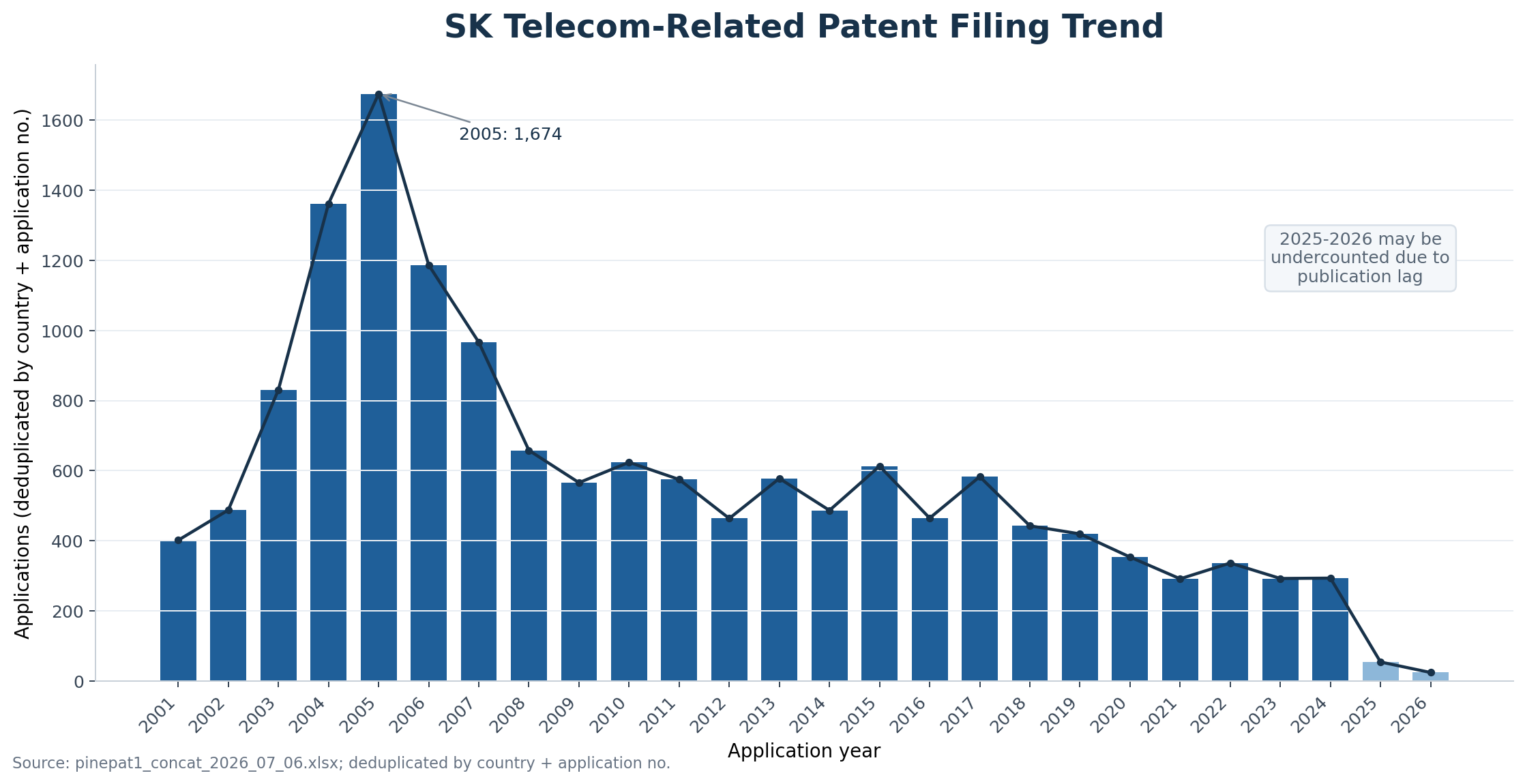
On an application-number basis, filings rose from 402 in 2001 to 1,361 in 2004, 1,674 in 2005, and 1,186 in 2006. Records from this period concern mobile terminals, wireless networks, content transmission, and mobile services.
After 2007, the annual count declined. The dataset records 613 applications in 2015 and 583 in 2017, including wireless-communication standards, network control, data processing, media transmission, and platform services.
The 2025 and 2026 counts are incomplete because applications may not yet have been published when the data was collected. Recent-year comparisons should therefore use publication-date and filing-date controls.
Jurisdiction distribution
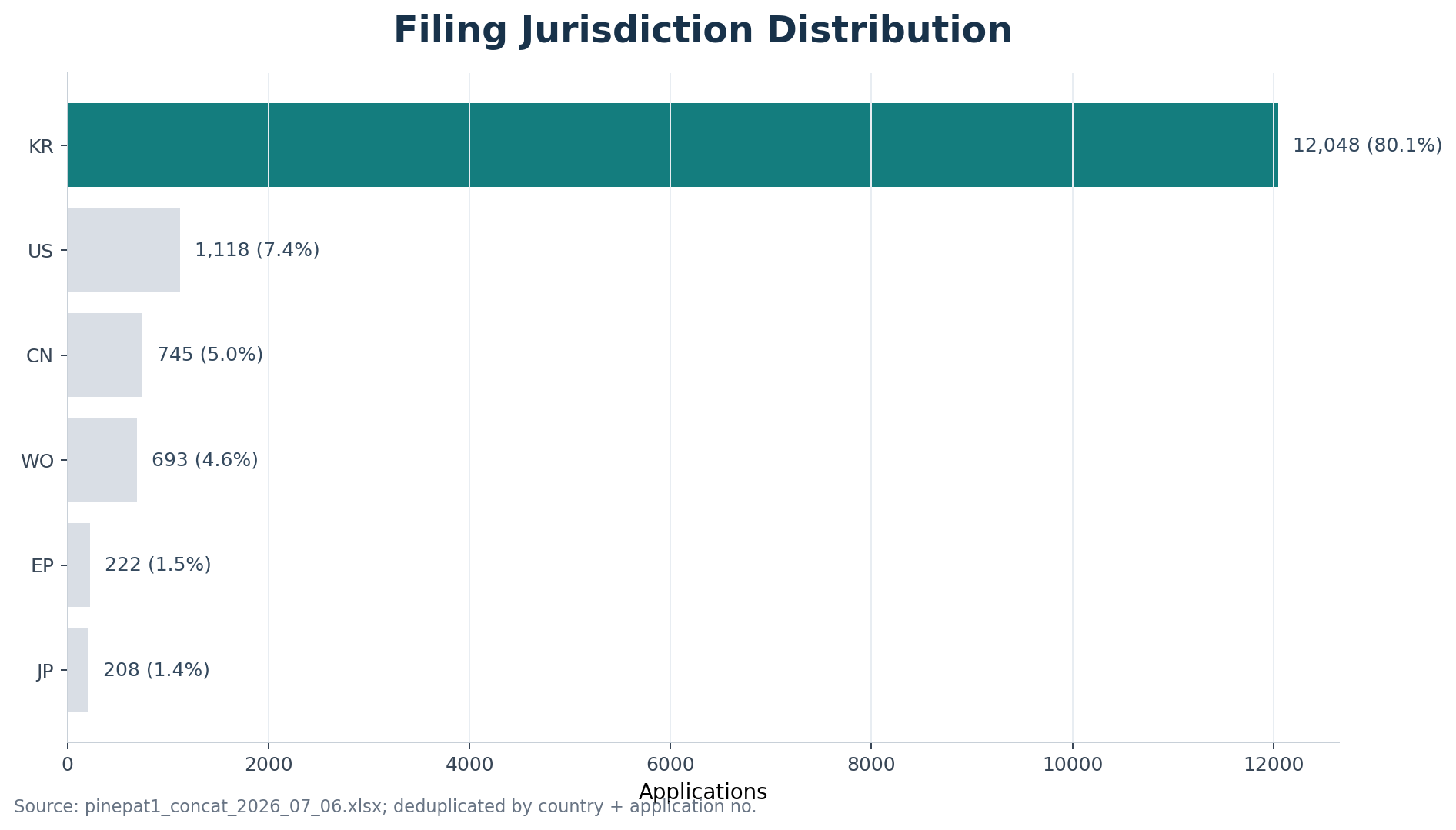
Korea accounts for 12,048 applications, or 80.1% of the total. The United States follows with 1,118 applications, China with 745, and PCT international applications with 693. Europe and Japan account for 222 and 208 applications, respectively.
The median family-country count for all applications is one. Applications entering EP and JP have an average family-country count of approximately seven. Family size should be reviewed together with claim scope, legal status, standards relevance, product coverage, and target markets.
Korean-only protection may be appropriate for domestic services and network operations. Technologies involving standards, terminal or equipment interoperability, or cross-border services require a separate foreign-filing assessment.
Main IPC distribution
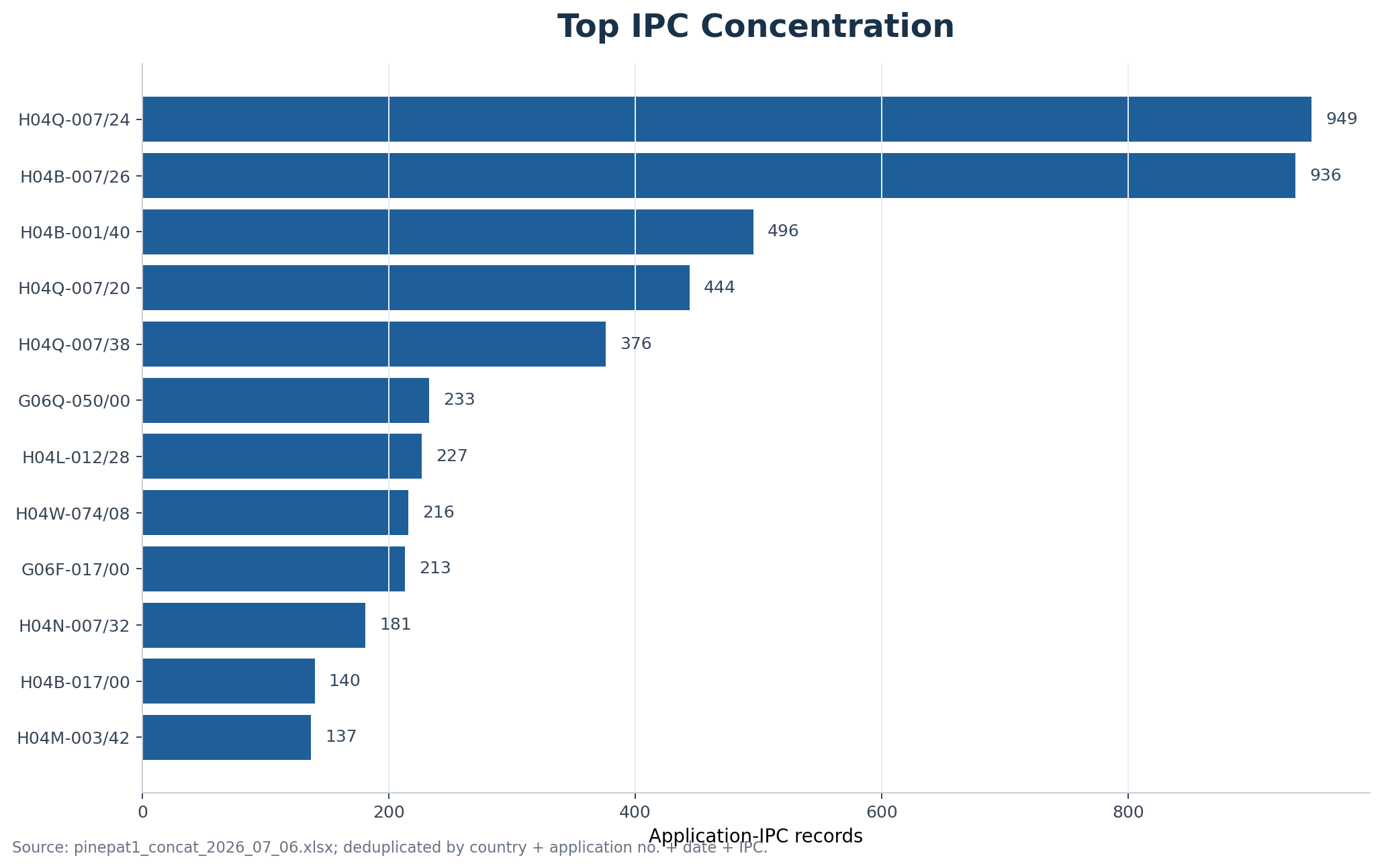
H04Q-007/24 is the largest group with 949 records, followed by H04B-007/26 with 936. H04B-001/40, H04Q-007/20, and H04Q-007/38 follow. H04B, H04Q, H04W, and H04L cover wireless transmission, selection and control, wireless networks, and digital communications.
The H04Q and H04B records include mobile networks, terminal control, wireless links, service-connection structures, service control, network operation, and data transmission.
G06Q-050/00 and G06F-017/00 are also frequent in the dataset. These records concern payment, content, platforms, user-data processing, and service operations.
Main IPC distribution for 2022-2024
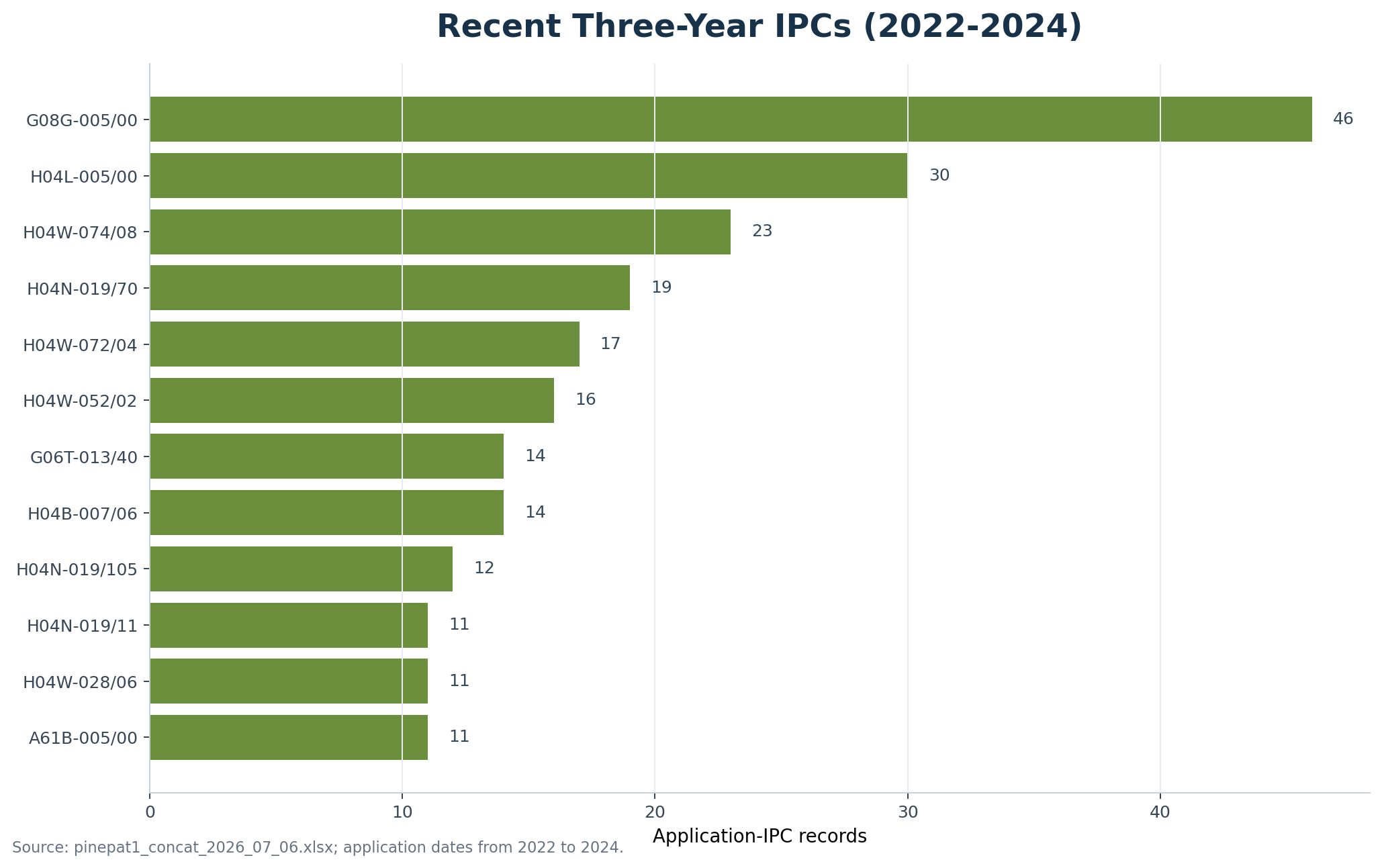
G08G-005/00 is the largest group in the 2022-2024 subset with 46 records, followed by H04L-005/00, H04W-074/08, H04N-019/70, and H04W-072/04. G08G concerns traffic control and traffic systems; H04L and H04W concern network resources and wireless-communication control; and H04N concerns video coding and processing.
The recent records combine mobility and traffic data, network-resource allocation, video processing, AI-based recognition, and analysis with telecommunications classifications.
G06T-013/40 and A61B-005/00 indicate records involving graphics or image processing and biometric or healthcare sensing. Reviews of recent applications should include the relevant service-application classifications as well as traditional H04 classifications.
Legal-status distribution
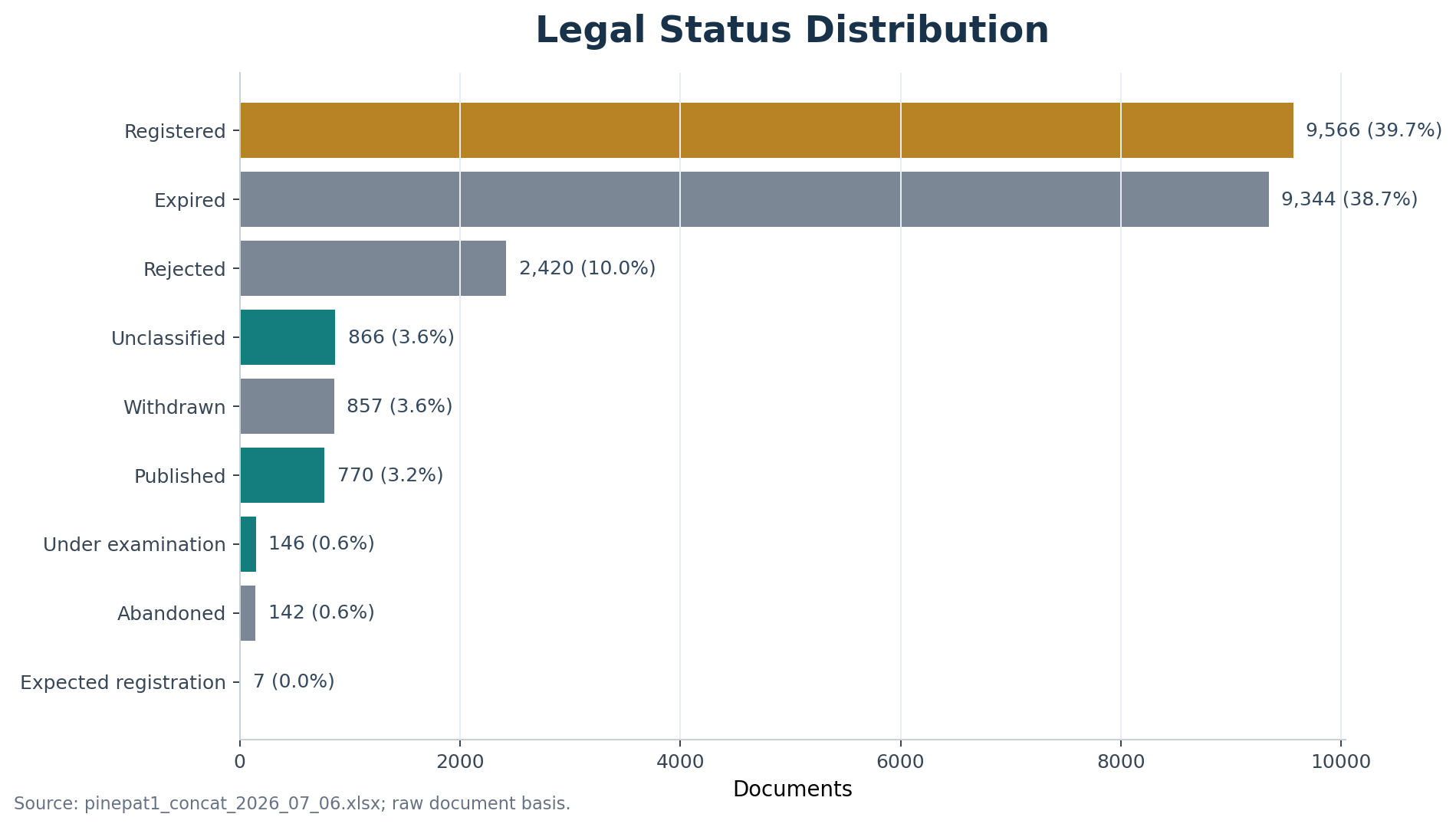
Registered records number 9,566 and expired records number 9,344. Rejections total 2,420, withdrawals 857, publications 770, and pending-examination records 146. Legal status is counted by source document, so publication and registration records for the same application may both appear.
Current portfolio analysis requires case-level review of enforceable claim scope, remaining term, standards or product coverage, foreign-family status, and pending applications. Aggregate status counts do not establish the value of individual rights.
Recent service areas such as AI, mobility, media, and healthcare should be compared against both H04 telecommunications claims and claims classified in the relevant application fields.
Portfolio review criteria
- Current coverage: identify claims connected to current products, services, standards, and revenue.
- Foreign protection: compare Korean rights with target markets and foreign-family coverage.
- Legal status: review enforceable rights, pending cases, remaining term, and maintenance decisions at the case level.
- Recent subject matter: monitor newly published applications in both telecommunications and service-application classifications.
Registration, expiration, rejection, and withdrawal data can identify filing periods and technology groups that require further review. The resulting decisions may include maintenance, abandonment, foreign filing, or follow-on applications.
Dataset limitations and review priorities
The dataset records substantial mobile-communications and wireless-network filing activity in the mid-2000s, a predominantly Korean jurisdiction distribution, and a high concentration of H04 classifications. The 2022-2024 IPC records also include mobility, network resources, video processing, AI, and sensing.
Review priorities are newly published applications, effective claims, remaining term, foreign-family coverage, and alignment with current products and services. The dataset supports those reviews but does not by itself establish filing intent, commercial value, or infringement risk.