Startup CEOs and passionate members! What does 'patent' mean to a startup challenging the market with innovative ideas and technologies? More than just a protective shield for technology, it can become a powerful strategic asset driving business growth and shaping its future. Today, at Pine IP Firm, we aim to present the key strategies for how startups can effectively leverage patents to secure competitive advantages and achieve sustainable growth.
1. Why are patents more important for startups?
For startups, patents hold value beyond mere legal rights.
(1) The Key to Attracting Investment
Investors objectively assess a startup's technological strength, market potential, and exclusive position through patents. A well-built patent portfolio increases corporate value and significantly increases the likelihood of attracting investment. Research shows that startups holding patents have a 47% higher chance of attracting VC investment.
(2) A shield and window for market competition
Strong patents prevent competitors from recklessly copying technology, build barriers to market entry, and provide opportunities for early market capture. Furthermore, it acts as a shield protecting our business from patent attacks by competitors.
(3) Strengthening negotiation power and enhancing brand image
In various negotiations such as technology licensing and business alliances, exclusive patents serve as a powerful bargaining chip. Additionally, holding patents itself signifies that the company's innovation and technological capabilities have been recognized, thereby enhancing brand value.
(4) Stepping stone for utilizing government support and policy funds
Many government-supported projects grant additional points or priority to patent-holding companies. This leads to securing R&D funding and tax benefits, easing the financial burden on startups.
2. What is the right patent acquisition strategy for our company?
Once you recognize the importance of patents, now is the time to develop an effective acquisition strategy.
(1) Patent application based on in-house R&D
This is the most fundamental way to directly license the innovative ideas and technologies a startup holds. From the business concept stage, it is important to keep patents in mind, increase the likelihood of registration through prior art searches, and, if necessary, use priority examination systems to quickly secure rights.
(2) Strategy for Introducing External Patents
When self-development alone has its limits, external resources are utilized. You can choose strategies suited to your situation, such as 'patent acquisition' to quickly secure necessary technology, 'patent licensing' (carefully check contract terms!) to utilize technology at relatively low cost, 'technology transfer' to receive excellent technology from universities and public research institutions, and 'acquisition through M&A' to acquire technology, market, and talent all at once.
Category
Proprietary R&D-based patent applications
Purchased Patent
license-in
University/Public Technology Transfer
Securing through M&A
Advantages
Securing customized rights for core technologies, internalizing technology, and making it easy to utilize government support
Rapid rights acquisition, reduced R&D time and costs, immediate market availability
Reducing R&D costs/time, leveraging proven technologies, and avoiding disputes
Access to excellent technologies, linking government support, and enhancing technology trust
Securing technology, market, and talent simultaneously, strengthening market dominance, and creating synergy
Disadvantages
Time-consuming, high initial costs, technology disclosure, registration uncertainty
High purchase costs, technical integrity issues, hidden rights defects
Idea~Registration takes several years (can be shortened during priority screening)
Contract immediately
Contract immediately
Several months~years (negotiation and procedural period)
Several months~several years (due diligence and negotiation period)
Key Considerations
Technology Core, Marketability, Prior Art, and Claims Design
Validity/Scope of Rights, Remaining Period, Valuation, Business Synergy
Scope/Duration/Territory of License, Royalty Terms, Improved Technology, Termination
Technology maturity, commercialization potential, transfer conditions, and co-ownership issues
IP Portfolio Value, Synergies, Integration Strategies, Legal Risks
3. Active Patent Utilization Measures
How you utilize the patents you secure can change the fate of your company.
(1) Defensive Use
To protect its core technologies, it builds a patent portfolio, making it difficult for competitors to enter the market. Additionally, before launching new products, you can analyze third-party patent infringement (FTO) to prevent disputes and, if necessary, seek mutual cooperation through cross-licensing with competitors.
(2) Aggressive Use
By securing core technology patents to prevent market entry by latecomers, or if patent infringement is suspected, we actively exercise our rights through warning letters and litigation (using punitive damages systems) to maintain our market advantage. We should also monitor trends in patent monsters (NPEs) and develop counter strategies.
(3) Monetization Strategy
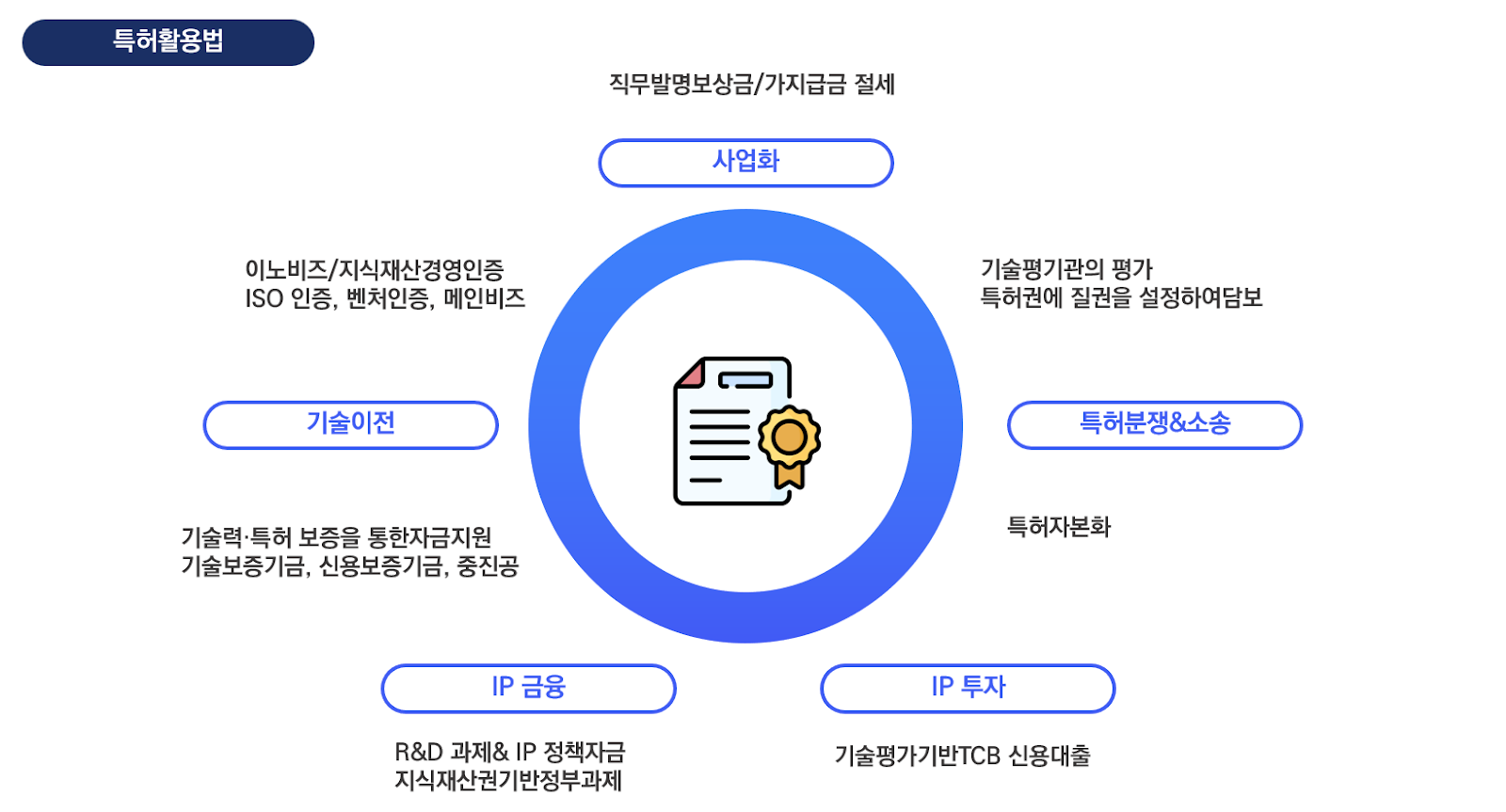
Direct profits can be generated through 'patent licensing out,' where you license owned patents to other companies and receive royalties; 'patent sale,' where non-core patents unrelated to the business are sold to secure cash; and 'patent collateral loans (IP financing),' where the value of patents is used as collateral to raise business funds.
Category
License-out
Patent Sale
Patent-backed Loan
Feasibility
It depends on the marketability of the technology, the existence of potential licensees, and bargaining power
It depends on the value of the patent, market demand, and the ability to find buyers.
Varies depending on patent value, corporate creditworthiness, and financial institution policies
Expected Effects
Continuous royalty income, market expansion, and enhanced brand awareness
Temporary cash collection, R&D cost recovery, and non-core asset disposal
Securing working capital and facility funds, improving financial structure
Advantages
Generate revenue without additional investment, expand technological influence, and diversify risk.
Immediate liquidity acquisition, relief from management burdens, and focus on core businesses
Financing without tangible assets, potential for relatively low interest rates, policy support
Disadvantages
Uncertainty in revenue scale, weakened technology control, burden of licensor management, technology leakage
Loss of future potential value, one-time profits, full technology transfer, risk of selling at low prices
Interest burden, risk of patent loss if debt defaults, and appraisal costs
Key Risks
License City Business Failures, Contract Breaches, and Patent Invalidation Challenges
Failure in proper valuation, intensified competition after sale, and concerns over leakage of technical know-how
Loan screening rejection, low loan limits compared to high valuation amounts, interest rate fluctuations
Startup Considerations
Whether there is core technology, royalty terms, the licensee's commercialization capability, contract terms
Current/future value of patents, relevance to business portfolio, timing of sale
Urgent need for funds, repayment ability, loan terms, and the business contribution of patents
4. Patent management and external support for sustainable growth
A patent is not just secured once secured; continuous management is necessary.
(1) Strategic management of patent portfolios
Rather than simply increasing the number of patents, it is important to build a high-quality patent portfolio that aligns with business objectives, regularly reassess the value of unnecessary patents, and efficiently manage maintenance costs such as annual fees.
(2) Global Patent Strategy
If you aim for overseas markets, you should establish and prepare a customized global patent strategy (such as utilizing PCT international applications) from the very beginning of your business, considering the market characteristics and laws of the target country. This is because the principle of territorial landownership applies to patent rights.
(3) Dispute and Risk Management
If you receive a patent infringement warning letter from a competitor or a dispute arises, do not panic; quickly seek the best solution from a legal and business perspective together with experts such as patent attorneys.
(4) Actively utilizing the IP-supported ecosystem
Actively utilize various IP education, consulting, and cost support programs provided by the government and related organizations (such as IP Didimdol, IP Narae, Global IP Star Companies, Startup Intellectual Property Vouchers, etc.) provided by the government and related organizations (Korean Intellectual Property Office, Korea Intellectual Property Protection Institute, KISTA, KIPA, Korea Technology Finance Foundation, Regional RIPC, etc.). Additionally, it is important to establish an IP strategy aligned with long-term business goals with the help of startup-specialized patent law firms like our Pine IP Firm.
Organization Name
Main supported projects
Eligibility
Key Support Programs
Application Timing/Method, etc.
Patent Office (KIPO)
IP Stepping Stone Program (KIPA Link)
Prospective Entrepreneurs, Early-stage Startups
Idea Development, IP Rights Acquisition Support, IP Training and Consulting
Apply as needed through the Regional Intellectual Property Center
Nurturing Global IP Star Companies
Exporting (Planned) Small and Medium Enterprises
Overseas application fees, PCT international application fees, overseas IP consulting, brand/design development support
Early-year announcement, online application
Korea Invention Association (KIPA)
IP Narae Program
Small and medium-sized enterprises within 7 years of establishment
IP technology and management convergence consulting, strong patent creation strategies, and proposals for IP utilization
Several times a year, but varies by region
Startup Intellectual Property Voucher
Startups less than 7 years old and with sales under 10 billion KRW
Support for purchasing IP services such as patents, trademarks, and designs (in the form of vouchers)
Early-year announcement, online application
Support for intellectual property finance-linked evaluation
Small and medium-sized enterprises with IP
Support for IP valuation fees for guarantees, collateral, and investments
Scheduled until budget is exhausted
Korea Patent Strategy Development Institute (KISTA)
Intellectual Property-Linked R&D Strategy Support (IP-R&D)
Small and medium-sized enterprises, universities, and public institutions
Customized patent strategy, R&D directional design, avoidance design, and support for creating excellent patents
Check Announcements by Project
Supporting Industrial Innovation Based on Patent Big Data
Companies, universities, research institutions, etc.
Patent big data analysis, diagnosis of promising R&D fields, and provision of technology trend information
Check Announcements by Project
Korea Intellectual Property Protection Institute (KOIPA)
Support for Patent Dispute Response Strategies
Overseas Patent Disputes (Risks) Small and Medium-sized Enterprises
Support for patent infringement analysis, invalid/avoidance design, warning letter/litigation response, and license negotiation strategy consulting
Patent dispute risk grades by technology field, patent information on dispute risk, and NPE/competitor trends
Available anytime (free)
Korea Technology Finance Corporation (KIBO)
Kibo Venture Camp
Innovative startup SMEs and prospective entrepreneurs within 3 years
Comprehensive support including acceleration, customized guarantees, investment promotion, consulting, mentoring, and technology transfer
Recruitment 1~2 times a year (Online application via website)
IP Intellectual Property Assurance
Early-stage companies owning IP such as patent rights
Guarantee support based on IP valuation and preferential support
Ongoing consultation and application (digital branches or branches)
Regional Intellectual Property Center (RIPC)
IP Direct Support Service
Small and Medium Enterprises
On-site consultations, dispute prevention, domestic and international applications, design development, and urgent IP support
Apply after visiting or consulting the regional center
Conclusion
For startups, patents are no longer optional but essential. Strategically acquiring, managing, and utilizing patents will be a key driver for innovative growth, going beyond just survival. Pine IP Firm supports you in leading the market and growing into a global unicorn company through the powerful weapon of patents.
⭐ Want to learn more about startup patent utilization?
More detailed information and practical tips on how startups utilize patents 'Startup Patent Utilization Strategy Guide PDF' If you want to receive the file for free, email Pine IP Firm now (info@pinepat.com) We will help your company manage successful IP.