
Raising corporate funds through patent-backed loans
What is a patent secured loan?

Patent collateral loans (IP collateral loans) are those held by companies Intellectual Property (IP)It is a system where financial institutions raise funds using intangible assets such as patents as collateral.
Even if general collateral (real estate, movable property) is insufficient, Technology Innovation Companyor StartupThis one has Valuable PatentsYou can obtain a loan based on this Preferential interest rateand Easing collateral burdensThis advantage stands out.
Key advantages of patent secured loans
- Resolving the Issue of Collateral Shortages: Even without factories or real estate Loans using only owned patentsis possible
- Low interest rate benefits: Reduces financial costs with interest rates 2~6%p lower than general unsecured loans
- Expanded Policy Support: Governments and banks actively support IP valuation costs and risks of insolvency
Current Status of IP-Secured Loans in the Domestic Financial Sector
In Korea, since the late 2010s, Korean Intellectual Property Officeand Financial authoritiesWith support from commercial banks and regional banks, they are successively launching IP-backed loan products.
Representative examples include the following banks actively participating.
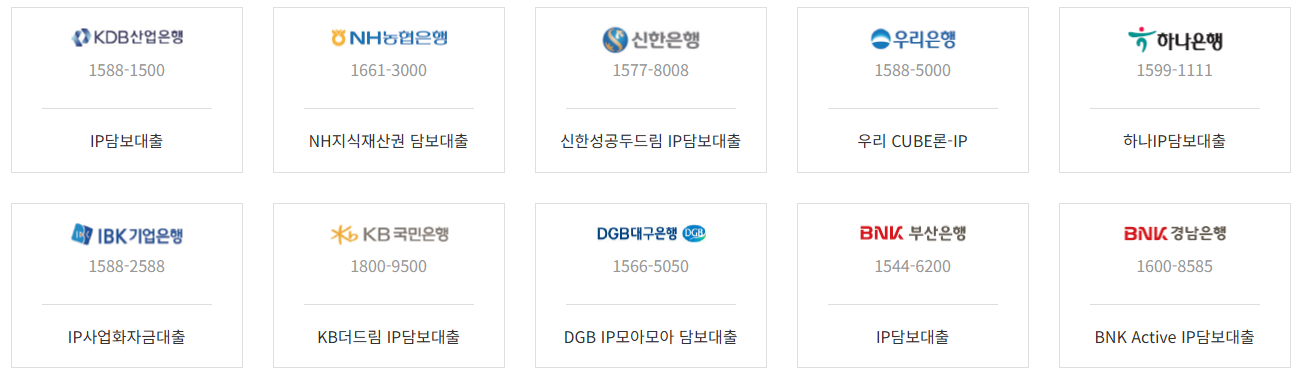
- Policy finance institutions: Korea Development Bank, Industrial Bank of Korea
- Commercial banks: NongHyup, Shinhan (Seongseongdudream IP collateral loan), Kookmin (KB The Dream IP collateral loan), Woori (Woori CUBE Loan-IP), Hana
- Regional banks: Busan, Daegu, Kyongnam Bank, etc.
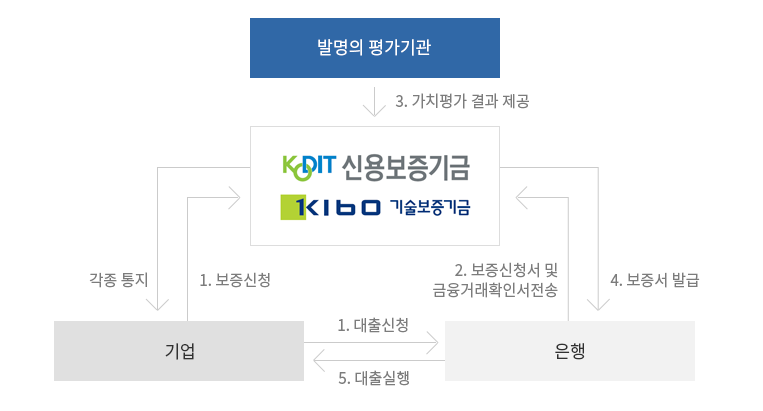
Additionally, the Korea Technology Finance Corporation (KLB) and the Korea Credit Guarantee Fund (KC) have Valuation ResultsBased on IP Evaluation GuaranteeBy providing it, when a company receives a loan, Certificate of Guarantee IssuanceThey do it.
Through this, Loan limit expansion and Condition reliefis possible, Small and Venture Companies with Weak Collateralhas also been able to significantly lower the funding threshold.
IP Secured Loan Application Process
If you are a business representative considering an IP-backed loan, it is important to understand in advance what preparations are required and how the process will proceed. Next is Practical Application GuideThat's it.
Preparation in advance
- Patent and Company Status Review
- Registered Patent (or Utility Model) Confirmation of ownership and rights holder (corporation vs. individual)
- Determining whether patents are likely to be linked to actual product or service sales
- Prepare basic credit conditions such as company financial statements, credit rating, and tax payment status in advance
- Choosing a financial institution/guarantee institution
- Direct loans from commercial banks: Suitable when creditworthiness and patent excellence are supported to some extent
- Collaboration with Korea Technology Finance Corporation (KLB) and Korea Credit Finance Corporation (KLB): If a company's credit is low or collateral is weak, the guarantee letter increases the likelihood of loan approval and the limit
Initial consultation & application
- Consultation with banks and guarantee institutions
- Visit the corporate finance representative at your bank to inquire about the IP-backed loan product
- If your credit rating is low, you can apply to the Korea Baseball Records or Credit Guarantee Reports IP Evaluation Guarantee Consultation Prior
- Submission of application form and basic documents
- Business Registration Certificate, certified copy of the registry, Financial Statements (3 years), Tax Payment Certificate etc.
- Patent registration records, specifications, and annual fee payment status
- If necessary, business plans, product brochures, test reports, etc. Patent FeasibilityAppeal
IP Valuation
- Commissioned by an evaluation agency
- Bank or Bulletin/Credit Card Evaluation Agencies Designated by the Korean Intellectual Property Officeat Valuationentrusted
- Generally takes 3~6 weeks, and part of the evaluation cost is covered by the government.
- Key Evaluation Factors
- Technical: Scope of patent rights, originality, and whether it is an alternative technology
- Marketability: Revenue generation potential, market size, competitor trends
- Business feasibility: Company financial status, CEO and management capabilities
- Once the appraised amount is determined, the bank will use it to calculate the loan limit (LTV 50~70%).
Guarantee Institution Connection Procedure (Optional)
- Guarantee Application
- Record & New Records IP Evaluation Resultsand company credit review followed by guarantee approval
- Usually up to around 1 billion won, with a guarantee ratio of around 90%.
- Bank loans → issuing guarantees
- Once a guarantee certificate is issued, bank reviews are streamlined
- Loan execution after final agreement on terms such as interest rate, limit, and maturity
Internal bank audits and approvals
- Credit Review Items
- Patent evaluation report (amount & rights information) + company financial statements + comprehensive credit rating review
- Also consider the possibility of patent collateral recovery (such as recovery support organizations)
- Conditions confirmed after approval
- Loan limit: 50~70% of the IP valuation amount
- interest rate: Many cases are 2~6 percentage points lower than unsecured loans
- Repayment terms: Usually extended after 1-year maturity, or repaid in installments over 3~5 years
Loan Execution and Follow-up Management
- loan execution
- After registering the pledge agreement, transfer funds to the agreed account
- Essential documents such as the representative's seal and corporate seal certificate are required
- Patent Maintenance
- Preventing Unpaid Annual Leave Registration Fees, Beware of Patent Expiration
- Prior bank consent required for license and transfer
- maturity extension
- Renewal possible through re-examination every year (or upon maturity)
- If the financial situation worsens, maturity extension may be refused, so advance measures should be prepared
Patent Secured Loan Terms
Loan limit
- A certain percentage of the appraised value
- Calculated by a patent evaluation agency (designated by the Korean Intellectual Property Office) IP ValuationThe loan limit is determined based on this.
- generally 50~80% of the appraised amountand if you are rated as an excellent patent, the rate can reach over 90%.
- Example) Appraised value 1 billion KRW→ Loan limit about 500 million KRW ~ 800 million KRW (varies by bank and company)
- Minimum and maximum handling amounts
- Commercial banks At least 300 million wonIt is common for some banks to issue IP-backed loans from that point onward, and some banks Small amount around 100 million wonWe also handle them.
- The maximum limit varies depending on the company's creditworthiness, financial condition, and the degree of patent commercialization, Up to 1 billion KRW when linked to Korea Technology Finance Corporation guaranteesThis happens frequently.
Interest Rates and Guarantee Fees
- interest rate
- Basically, market loan interest rates (COFIX, bank bonds, etc.) + additional interest rates Structure.
- Usually, 1~2 percentage points lower than unsecured loansand the actual applicable interest rate is Annual rate in the 4~7% rangeis common.
- corporate Credit rating, collateral recognition ratio, repayment abilitydepending on the situation, interest rate differences arise.
- Guarantee Fee (in connection with the Korea Technology Finance Corporation)
- When using a record guarantee certificate, an annual guarantee fee (about 0.5~1.2%) is borne as with a general technical warranty.
- If the preferential IP evaluation guarantee policy is applied, Partial Reduction in Guarantee Fees Alternatively, an additional preferential interest rate may be added.
Maturity and Repayment Method
- maturity structure
- mostly Lump-sum repayment for 1~2 years maturity It operates in a form.
- If the company is operating normally at maturity and has a good history of interest payments and debt repayments, it can be extended (renewed) annually (approved after re-examination).
- Repayment method
- Lump-sum repayment (full principal repaid at maturity) or installment repayment(partial regular repayment of principal) is available.
- For lump-sum repayment, monthly Izaman You pay the principal at maturity.
Eligibility and Conditions
- Registration of the patent to be secured
- definitely Registered PatentsGenerally, patents registered more than six months ago are preferred.
- The patent holder and the loan applicant corporation (or sole proprietor) are the sameto establish collateral (pledge registration).
- Corporate Creditworthiness and Financial Status
- Even if you have an IP, it can be difficult to handle if the company is excessively poor or has a long history of delinquency.
- Sales LinkageThe higher the loan approval rate for patents that already generate sales or are expected to arise soon.
- Loan-to-Value (LTV)
- Even if the valuation is high, banks must comprehensively consider the marketability of patents and the company's ability to repay 50~80% That's how much the discount will be applied.
- Therefore, even if the appraised amount is 1 billion won, the actual loan may be lower than that.
Additional Features When Linking with the Korea Technology Finance Corporation
- Issuance of guarantee → execution of bank loans
- Notator-in-law IP Valuationand Technology and Business Feasibility EvaluationAfter performing the procedure, the guarantee limit is finalized (e.g., within 1 billion KRW).
- Since banks use this guarantee as collateral to execute loans, companies can significantly resolve the problem of insufficient collateral.
- Preferential Benefits
- By using the IP evaluation guarantee, Guarantee Ratio (90% or higher) and Guarantee fee rate (10~30% discount compared to regular warranty) You will receive such special treatment.
- Banks may also lower interest rates further because their credit risk is low.
- Evaluation Fees and Procedures
- Fees from external evaluation agencies (patent evaluation costs) are generally around 3,000,000~5,000,000 KRW, Projects supported by the Korean Intellectual Property OfficeBy using it, you can receive over 50% support.
- Typically, after the evaluation and guarantee review process until final approval, 1~2 months It may take about as long as it takes (may vary depending on the company's data preparation status).
In summary
- limitis more than half of the IP valuation value (up to 90% is possible)
- interest rateis higher than regular unsecured loans. Low (approximately 4~7% per year)
- Maturity/Repaymentusually repaid in a lump sum of one year (can be extended annually)
- Evaluation Costsis only a few million won, Government support Save money by receiving
- When linking game records Additional benefits such as guarantee ratios around 90%, preferential guarantee rates, and interest rate reductions
In other words, if a company has technological capabilities but lacks collateral for tangible assets such as real estate, it can meet the above loan limits (around 50~80% of the assessed amount) and Preferential interest rate (1~2%p cheaper than unsecured loans), and Guarantee from the Guarantee AgencyUtilizing Smooth FundingYou can do it. However, the final condition is that the company Credit rating, degree of patent commercialization, financial stabilityIt should be noted that it varies depending on the situation.
Frequently Asked Questions (FAQ)
Q1. How much does the evaluation fee cost?
- Usually, it's 4 to 5 million won, but with government support, the actual burden is around 2 to 2.5 million won.
Q2. Can startups get loans?
- Even if sales or credit ratings are low, if the technology potential is high, there is possibility through guarantees from the record and credit guarantees.
Q3. After collateral is established, is the patent business free?
- Normally, product sales are possible, Assignment of rightsI Exclusive licenseBank consent is required.
Q4. What happens if I am unable to repay?
- The bank IP Recovery Support OrganizationSell patents or license them to other companies to cover losses.
- Consulting with banks and guarantee institutions before delinquency is the best approach.
Future Outlook and Advice from Pine IP Firm
Present IP Financial Marketshas been setting new records every year, and as of 2023, The outstanding balance of IP-backed loans has surpassed 2.3 trillion won. The government will support IP valuation costs, expand recovery support organizations, and strengthen cooperation with commercial banks. Activation of IP-backed loansWe are accelerating this effort.
[Pine IP Firm's One-Stop IP Financial Support]
- Patent specification preparation and Rights acquisition strategy Establishment
- Patent ValuationTechnical and Scope of Rights Consultation for
- Guarantee of Betting and Credit Guarantee IP Linked consultation and procedural agency
- Collateral Settings(Pledge) Related Legal Advice and Dispute Prevention Consulting
Companies that efficiently manage intellectual property (IP)In the end, Funding powerWe are also taking the lead. From small and venture companies to mid-sized enterprises, Core TechnologiesIf you have IP-backed loansWe hope you will seize the opportunity to secure business funds and enhance your competitiveness. In the era of the Fourth Industrial Revolution, where technological innovation is accelerating, Patents and Intellectual Propertygoes beyond simple rights protection, Capital for Corporate GrowthIt is established as a fixture.
Pine IP Firmis Patent Collateral LoanColorful IP Finance We present strategies and aim to help companies innovate and take the leap forward.