
What is Ultra-Fast Patent Examination? Latest 2026 Criteria, Application Requirements, Required Documents, and Differences from Priority Examination
In the fast-paced arena of technology commercialization, the value of a patent lies not just in securing a "robust right," but in securing that right at the exact right time. No matter how groundbreaking an invention is, if the patent registration process lags behind investment rounds, export negotiations, foreign filings, or competitor movements, its commercial utility drops drastically.
Today, in 2026, Korea’s Ultra-Accelerated Patent Examination System is no longer just a matter of administrative convenience. It has evolved into a critical bridge directly linking a company’s business timeline with its intellectual property (IP) strategy.
The Intellectual Property Office launched this ultra-fast track for patents and utility models on October 15, 2025. More recently, on February 23, 2026, the government expanded the system by introducing dedicated tracks specifically for early-stage startups in the AI and advanced biotechnology sectors.
The core value of this system is crystal clear: it aims to deliver the first examination result within just one month. According to official data, the average patent pendency times in 2026 speak for themselves:
- Regular Examination: 14.7 months
- Accelerated Examination: 2.1 months
- Ultra-Accelerated Examination: 1.0 month
In the real business world, this does not just save a few weeks—it creates a competitive advantage measured in years.
Ultra-Accelerated vs. Accelerated: What’s the Difference?
A common misconception in practice is equating "Ultra-Accelerated" with the traditional "Accelerated" examination. Under the current framework, the Ultra-Accelerated system is an entirely separate, high-speed track.
According to comparative data released by the Intellectual Property Office, the timelines differ significantly:
- Accelerated Track: Typically delivers the first office action by the end of the 2nd month, and final results by the end of the 4th month.
- Ultra-Accelerated Track: Engineered to deliver the first office action within 1 month and final results within 2 months.
Therefore, simply wanting a quick review is not enough. Your application must precisely meet the strict eligibility criteria.
While traditional accelerated examination serves as a general tool for speedy reviews, the ultra-accelerated track is heavily policy-driven—specifically designed to support exports, global expansion, cutting-edge technology, and early-stage startups. At Pine IP Firm, we view this distinction not merely as a difference in days, but as a strategic decision on which asset to place in which lane.
The 4 Pillars of Eligibility in 2026
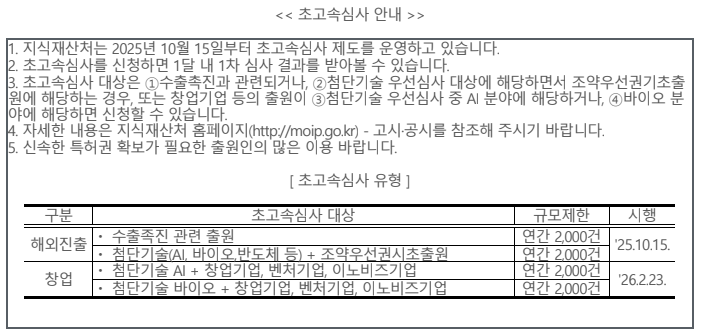
As of 2026, eligibility for the Ultra-Accelerated Track is divided into four distinct categories:
- Applications Directly Related to Export Promotion
- Cutting-Edge Technology Applications serving as the basis for a Convention Priority Claim
- AI Applications filed by early-stage startups, venture enterprises, or Inno-Biz companies (Added Feb 23, 2026)
- Advanced Biotech Applications filed by early-stage startups, venture enterprises, or Inno-Biz companies (Added Feb 23, 2026)
The Intellectual Property Office has set an annual quota of 8,000 cases for 2026, allocating roughly 2,000 cases to each of the four categories.
This means that outdated guides focusing only on the first two categories miss half the picture. AI startups, biotech innovators, certified ventures, and Inno-Biz firms must now actively evaluate these new pathways.
Furthermore, startup support criteria have broadened. In February 2026, the Intellectual Property Office announced that startups participating in the Ministry of SMEs and Startups’ global expansion programs automatically qualify for the export-promotion track. Additionally, pre-founders utilizing technologies owned by universities or public research institutes are now eligible for accelerated tracks. Early-stage companies should not prematurely assume they are disqualified just because they lack immediate export revenue.
Who Needs the Ultra-Accelerated Track Most?
This track is an invaluable tool for companies in the middle of active export negotiations or facing tight deadlines with overseas buyers. It is also highly recommended for firms planning to leverage a domestic filing for a PCT or individual foreign application within the one-year priority window, or companies in fast-evolving fields (like semiconductors, AI, and bio) where securing early global rights is paramount.
For early-stage startups, obtaining a rapid patent status is a powerful way to demonstrate IP traction to investors and partners. Furthermore, the Intellectual Property Office points out that securing a domestic patent quickly opens the door to using the Patent Prosecution Highway (PPH), significantly smoothing and speeding up subsequent foreign patent acquisitions.
Conversely, applying for ultra-accelerated examination solely out of impatience is counterproductive. The system requires ironclad eligibility and airtight evidence. At Pine IP Firm, we recommend triaging your portfolio at the pre-filing stage—categorizing applications into regular, accelerated, or ultra-accelerated tracks—and tailoring the specification and supporting documents accordingly.
Application Procedures and Basic Requirements
The ultra-accelerated mechanism operates on top of the existing accelerated examination framework. According to official guidelines, the underlying patent application must already have a request for examination filed (or filed simultaneously with the acceleration petition). It can be requested by the applicant or any interested party. The filing requires an application form, an explanatory statement, and definitive supporting evidence.
- For the Export Promotion Track: The core is proving an export connection. Official FAQs require export records for the invention, or proof of improvement on a product exported within the last three years. Alternatively, small and medium-sized enterprises (SMEs) can submit selection certificates from government programs, such as the Global IP Star Enterprise Program or the Patent Dispute Response Strategy Support Program.
- For the Tech + Priority Claim Track: Preparation must be highly precise. Applicants must submit proof of domestic production (or preparation for it) or evidence of executing a National R&D Project. To prove the priority claim, a copy of the application submitted to a foreign patent office or PCT receiving office is required, alongside transaction receipts or official notices showing that the foreign proceeding is validly active.
- For the Startup AI/Biotech Track: It is vital to cross-reference the specific patent classifications (IPC/CPC) and required documentation outlined in the February 23, 2026 operational guidelines.
Fees and Processing Constraints
The official petition fee for accelerated examination is 200,000 KRW for patents and 100,000 KRW for utility models.
However, the real cost consideration isn't the fee—it's document readiness. While normal accelerated paths yield results in 3 to 4 months, any official request for corrections or documentation flaws will cause immediate delays. The priority should always be confirming whether your case genuinely meets the criteria and ensuring the paperwork is flawless enough to be evaluated without pushback.
Practical Pitfalls to Avoid
1. It is a Guarantee of Speed, Not Registration
The Ultra-Accelerated track guarantees a first examination result within 1 month, not a guaranteed allowance. While some cases may be registered immediately without office actions, the essence of the system is the ultra-fast launch of the examination and the rapid initial assessment, rather than a shortcut past scrutiny.
2. Specification Quality is More Critical Than Ever
The faster the examination, the heavier the weight carried by the initial application documents. There is no time to fix sloppy drafting. At Pine IP Firm, we apply a much stricter standard to ultra-accelerated cases, rigorously reviewing claim structures, clarity of description, alignment with foreign filing strategies, and the seamless integration of supporting evidence before submission.
3. It is a Launchpad for Global Rights
As emphasized by the Intellectual Property Office, securing a domestic patent swiftly provides a massive tactical advantage abroad via the PPH. Ultimately, the ultra-accelerated track should be viewed not just as a domestic time-saver, but as the starting gun for your global IP strategy.
Conclusion
In 2026, Korea’s Ultra-Accelerated Patent Examination is far more than a "fast-track service." It is a sophisticated, policy-driven legal expressway spanning export promotion, deep tech, and the frontier of AI and advanced biotechnology startups.
For forward-thinking enterprises, the strategy must shift from simply prepping a patent application to looking at the bigger picture: Does this qualify for the ultra-fast lane? What evidence can we leverage? How does this align with our international rollout?
At Pine IP Firm, we believe that navigating this system requires more than just filling out a petition. Success hinges on a comprehensive design that aligns the invention, the evidence, and the global roadmap. After all, what matters more than a fast examination is an application that is perfectly prepared to handle the speed.
FAQ
Q. Can I apply for expedited patent examination at the same time as filing the patent application?
An examination request must be filed, and you can file both the examination request and the expedited examination application simultaneously.
Q. What is the application fee for expedited patent examination?
It's 200,000 won for patents and 100,000 won for utility models.
Q. As of 2026, can startups also receive expedited patent examination?
Yes, it is. Starting from February 23, 2026, a dedicated track for expedited examination has been established for applications in the fields of artificial intelligence and advanced bio-technology from early-stage startups, venture companies, and Inno-Biz companies.
Q. Is export performance mandatory?
While documentation proving export relevance is generally important for export-promotion types, official data indicates that companies selected for export or overseas dispute support projects within the last three years may also be eligible. Furthermore, the 2026 announcement expanded the scope to include companies participating in the Ministry of SMEs and Startups' overseas expansion support program for startups.