
Trademark Invalidation Trial Strategy
Disputes can arise if competitors or third parties register similar trademarks, or if a trademark lacking distinctiveness is mistakenly registered. In such cases, trademark invalidation trials can invalidate the registration of the problematic trademark itself. A trademark invalidation trial is a procedure to retroactively invalidate a registered trademark if there is a critical defect in it, thereby removing the right.
What is a trademark invalidation trial?
A trademark invalidation trial proves that a registered trademark has a critical defect, and the registration itself Retroactively nullificationThis is the procedure. This is not simply about blocking the other party's use through infringement lawsuits, Eliminating registration itself It is regarded as a powerful dispute resolution tool because it can completely remove trademark rights.
A company's brand value is the key weapon for securing a competitive edge in the market. However, if a trademark lacks distinctiveness or is registered as a copy of a prior trademark, the company must bear not only market disruption but also business losses. Trademark Invalidation TrialsThis is the issue of Fundamentally solvedIt's an effective way to do it.
Key situations requiring trademark invalidation trials
- Concerns about confusion due to similar trademarks
Competitors are looking at our brand and Registering trademarks so similar that they can be confusedThis is one case. For example, 'counterfeit trademarks' that imitate famous brands fall into this category. - Registration of Trademarks Lacking Distinctiveness or Harming Public Interest
This is a case where a mark that is inherently non-distinctive, such as technical terms, generic names, or idiomatic expressions, has been misregistered. Attempts to monopolize common words or technical terms are typical examples. - Trademark Broker (Preemptive Application) Issue
Malicious seizure of someone else's brand both overseas and domestically, Monetary BenefitThere are trademark brokers targeting them. They sometimes apply for multiple similar trademarks in bulk to induce negotiations, and can promptly file invalidation trials to extinguish their rights. - Trademarks with legal disqualification for registration
legally prescribed Reasons for Registration RejectionHowever, if the registration is not filtered during the review process, it can also be contested as an invalidation trial.
like this Trademark Invalidation Trialsnot only defends a company's brand but also addresses market confusion caused by incorrect trademark registrations. A system for public interest correctionThat's also the case.
Legal Basis and Main Grounds for Invalidation Trials
Basis under Trademark Law
- Article 34, Paragraph 1 of the Trademark Act: Stipulates absolute and relative reasons for denying registration
- Trademark Act Article 122: Stating the statute of limitations (general invalidity reasons must be within 5 years after registration) and exceptions when filing an invalidation trial
The Trademark Act of the Republic of Korea specifically stipulates the requirements and procedures for filing such invalidation trials.
Typical Grounds for Invalidity
- Grounds for absolute invalidity
- Lack of discernment (generic names, technical or idiomatic expressions, etc.)
- Violation of public order and good morals
- Marks that are essentially unregistrable
- Grounds for relative invalidity
- Already existing Confusion with Prior TrademarksIf there is a risk of causing
- Maliciously imitating another person's well-known or well-known trademark
- Imitation of well-known or well-known trademarks and improper purposes
- Trademarks widely recognized both domestically and internationally Unauthorized imitation
- Unjust enrichmentIf the application is filed with the intent to obtain or cause damage to the original trademark owner
Additionally, after five years, it is difficult to file an invalidation trial on general grounds of relative invalidity, Malicious Imitation Applicationor Confusion of Notable Trademarks Exceptional cases Without statute of limitations You can obtain invalidation.
Procedures and Precautions for Trademark Invalidation Trials
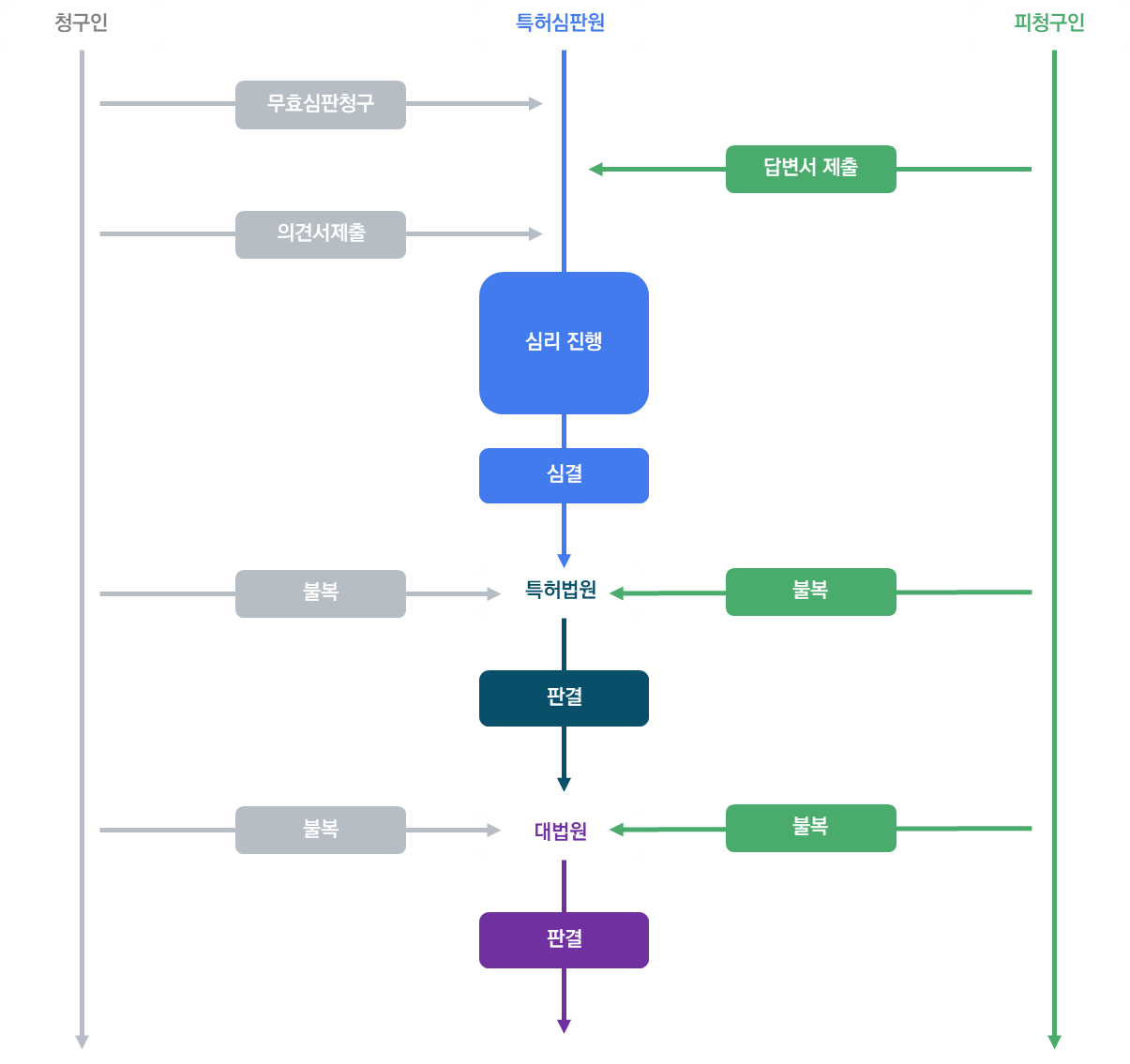
Flow of the Invalidation Trial Procedure
- Request for Appeal
- Include the registration number and reasons for invalidation (Trademark Act provisions) of the trademark to be invalidated
- Prove the qualifications of interested parties (such as prior trademark owners) and submit necessary evidence
- In the case of relative invalidity grounds Within 5 years after registration Compliance with the Exclusion Period
- Workshop Procedure
- The respondent (trademark owner) submitted a written response and rebutted
- Exchange of rebuttal writings between the claimant and respondent→ Summary of issues → submission of evidence
- Since the party asserting invalidity bears the burden of proof, there are concerns about confusion or lack of discernment, Sufficient supportmust
- Oral Examination and Judgment
- if necessary oral psychology After the proceedings, three judges Judgment(Cited/Dismissed)
- Quote The relevant trademark rights are retroactive to the date of registration.and thus invalidated
- Trademark Effect Becomes Even Stronger When Rejected
- Appeals and Lawsuits
- If you are dissatisfied with the decision, you may file a lawsuit to cancel the decision in the order of the Patent Court → Supreme Court
- Trademark invalidation trials Administrative + Judicial ProceduresThere is a possibility of prolonged combination.
The Relationship Between Infringement Lawsuits and Invalidation Trials
- When a trademark owner files an infringement lawsuit annulment judgmentcan be claimed as a defensive strategy.
- Courts tend to wait for the outcome of the invalidation ruling, Nullity Decisionit is common for infringement not to be recognized in lawsuits.
- However, if the court determines the outcome of the invalidation judgment, absoluteso it is not bound by it, Judgment StageIt is crucial to thoroughly seize the advantage
Notes during the process
- Deadline management: Written responses, rebuttals, etc. Submission deadlinemust be strictly observed.
- Evidence collection: To claim lack of distinctiveness, confusion with similar trademarks, or malicious imitation Objective evidenceis essential.
- Early dispute resolution Possibility Review: Through Settlement or License Agreement Maximizing business benefitsAlso consider.
Effective Nullity Judgment Strategies for Companies
Proactive Response (Utilizing Objections)
- Similar trademarks Application StageIf you found it there, Trademark Registration OppositionYou can block registration in advance.
- If you miss the objection period (2 months after the publication of the public gazette), annulment judgmentTherefore, Application Publication Make monitoring a habit.
Multiple routes in parallel
- Besides annulment judgments Unused Cancellation Judgment(Trademark Act Article 119) Also under Parallel Review
- Trademarks that have not been used for more than 3 yearsIf it's difficult, you can cancel even if it's hard to prove your distinction.
- especially Trademark brokerIf it is simply reserved and not actually used, Non-use cancellationis a valid method
Optimizing Proven Strategies
- Confusion of famous trademarks When making claims: Submit data such as brand awareness, advertising costs, market share, and consumer surveys.
- Lack of discernment When asserting: the mark in question Common Nameor Technical terminologyCollect industry use cases, definitions, media coverage, and more to demonstrate
- malicious imitation Claims: Brokers have filed numerous applications for identical and similar trademarks, no actual intention to operate, and concentrated applications for competitors' brands, etc. Improper purpose proof
Leveraging Experts and Departmental Collaboration
- Trademark Invalidation Trialssilver Legal and Technical A Field Where All Knowledge Is Needed
- In collaboration with patent attorneys and lawyers, Complex Case Law Analysis, Overseas Disputes Handling issues
- Inside the company Marketing Departmentand Legal DepartmentThrough collaboration Evidence of trademark use, market conditions Carefully prepare your materials
Negotiation and Conflict Combined
- If prolonged conflicts are burdensome, annulment judgmentAt the same time, with the other party and NegotiationYou can also proceed.
- As a condition for suspension of trademark use or transfer early settlementIf this is possible, from the company's perspective, Minimizing business lossesis an advantage
- However, even in negotiations, Trial procedurecan become a means of pressure, Cautious approachis necessary.
Measures companies should prepare in advance
Trademark Search and Clearance
- When planning new brands Search for prior trademarksProceed thoroughly to exclude disputed names from the initial stage.
- Through the Patent Office's trademark search service, specialized search tools, or consulting with patent attorneys, Minimizing risk
Pre-application and Pre-registration Strategy
- Before being used in the market, New Brand Nameis immediately Applicationto secure rights
- If you have plans to expand overseas Major MarketsAlso apply in advance Broker PriorityPrevent
Continuous Trademark Monitoring
- Our company's Core BrandRegularly monitor for similar applications
- Regularly check the Patent Office public gazette, trademark database, etc., → if an application exceeds the required scope Objection Immediate response
Accumulating Brand Usage Evidence
- Advertising, sales, market share, media coverage, etc. Trademark AwarenessRegularly organize evidence to prove it.
- Decisive in situations where you need to assert your knowledge or notability
Internal regulations and manual revision
- When introducing a new trademark Legal Review Procedures and in case of disputes Instant reporting system preparation
- Trademark training for employees (prohibition of unauthorized use of others' trademarks, precautions when using them, etc.)
Building an expert network
- In case of complex trademark disputes Rapid responseSecuring a network of patent attorneys
- If overseas disputes are expected, Local law firmEstablishing Preliminary Cooperation Channels
Solid preparation is the best defense.
Trademark Invalidation Trialsis a trademark that is either incorrectly registered or maliciously registered. Retroactive invalidityand companies Brand EquityIt is a powerful system that enables us to protect it. However, to win the case, Sufficient evidence, Accurate application of legal principles, Timely responseThis is essential.
Pine IP Firm, with extensive experience resolving trademark disputes, Customized Strategies for Companiesis being presented. From trademark investigations for brand protection to in case of disputes filing a nullity trial, furthermore Defending against infringement lawsuitsWe provide systematic support up to the next day.
Above all, the most important thing is Conflict preventionThat's it. Elector, Search for prior trademarks, Trademark Monitoring and in the event of a dispute, respond quickly and professionally to protect the company's vital assets, BrandPlease protect it.
Trademark invalidation trials are reassuring with Pine IP Firm.
If you need customized trademark strategies and dispute resolution solutions for your company, please feel free to contact Pine IP Firm at any time.
[FAQ Section – Frequently Asked Questions]
Q1. Which should be handled first, a trademark invalidation trial or a trademark infringement lawsuit?
A. Generally The other party sues for infringementIf we raised the issue, our company Trademark Invalidation TrialsYou can respond by using strategies to invalidate the trademark itself. Even if the infringement lawsuit started first, if you win the invalidation trial, the lawsuit loses its practical value.
Q2. If I discovered a trademark that is already five years old, is it impossible to obtain an invalidation trial?
A. General grounds for invalidity are difficult to assert after the five-year statute of limitations. However, malicious imitation, Notable Trademarks Plagiarism and similar items can be invalidated even after 5 years. Also, if the other party is not actually using the trademark, Unused Cancellation JudgmentYou can also aim for cancellation.
Q3. How long does the invalidation trial process take?
A. From appeal to decision About 6~12 months It takes about a certain amount of time. However, if the appeal process reaches the Patent Court or Supreme Court, it can take 2~3 years or more.
Q4. How much does an annulment trial cost?
A. It depends on the size of the company, the complexity of the case, and the scope of evidence collection and analysis. Includes patent attorney fees, appeal fees, etc. Evidence examinationI expert opinion Additional costs may also apply.
Q5. If you lose in an annulment trial, is there really no other way?
A. If you are dissatisfied with the tribunal's decision Patent Court → Supreme CourtYou can contest through litigation procedures that lead to this. However, even if the case reaches a higher court, if the existing invalidation grounds are not recognized, it is difficult to overturn the trademark rights.