
Patent Application and Registration Procedures
After a patent application is submitted to the Korean Intellectual Property Office, the patent rights are granted through the following steps. Our country's patent system has the following characteristics.
- first-to-file principle
If there are multiple applications for the same invention, the patent rights are granted to the first applicant. Therefore, it is important for inventors to file their inventions as soon as possible. - Publication of Application
After 18 months have passed since filing a patent application, the Patent Office publishes the application in the "Patent Publication." This occurs 18 months after the filing date, or 18 months after priority if priority is claimed. Published applications are open to everyone, which allows the invention to be widely disclosed. - Review Request System
To obtain a patent, the applicant must file an examination request within three years from the filing date. If no examination request is made, the application is automatically considered withdrawn. Once a request for examination is filed, the Patent Office examines the application and decides whether to grant the patent.
The utility model registration procedure is the same as for patents, except for some notice periods.
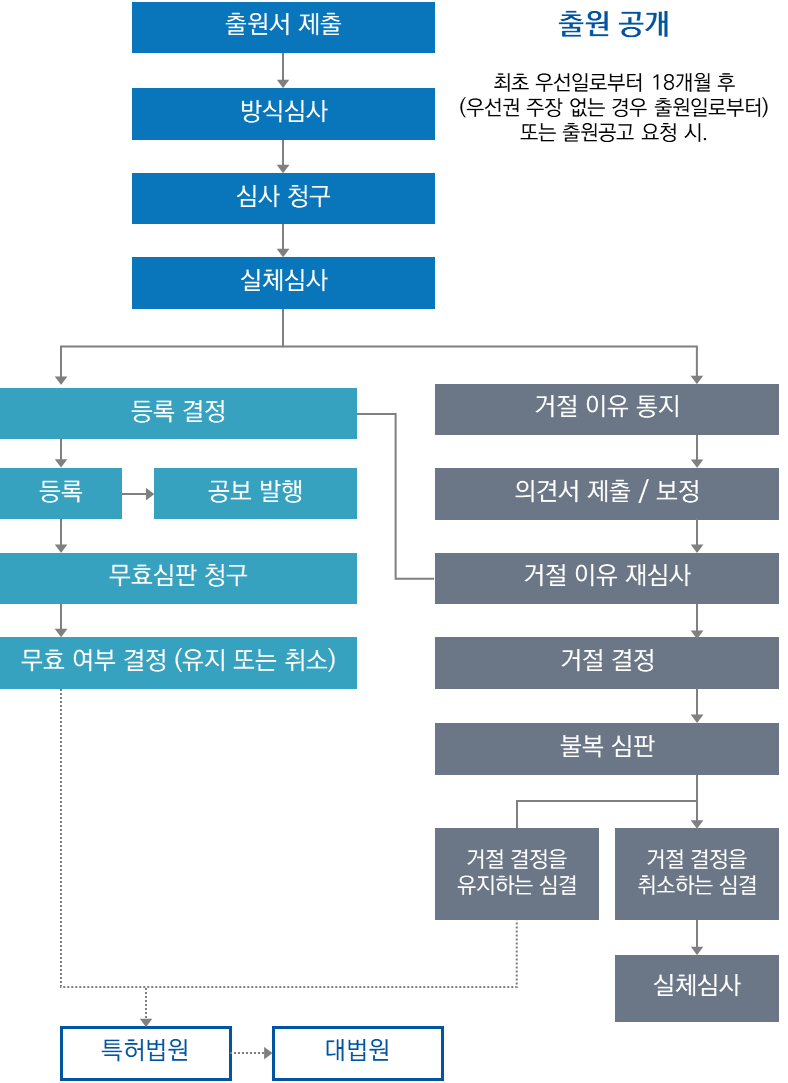
Application Procedure
- Applicant
An inventor or a person who has acquired rights from them can file a patent application with the Patent Office for the invention. Applicants can be individuals or legal entities. - Required Documents
Anyone wishing to obtain a patent must submit the following documents to the Commissioner of the Patent Office:- (a) Application including the names and addresses of the inventor and applicant, the title of the invention, and priority data (if priority is claimed);
- (b) A specification including the name of the invention, drawing descriptions (if necessary), a detailed description of the invention, and claims;
- (c) Drawings (if necessary);
- (d) Summary;
- (e) If priority is asserted, a notarized copy of the application forming the basis of the priority claim and its Korean translation (if submission of a Korean translation is required);
- (f) Power of attorney if necessary.
- Priority claim
To be granted priority, the application must be filed in South Korea within one year from the filing date of the priority claim. The priority certification documents mentioned above can be submitted within 1 year and 4 months from the priority date. If priority documents are not submitted within this period, the priority claim will be invalidated.
Method review
When a patent application is submitted to the Patent Office, it is confirmed that all requirements for the application date are met. According to Article 11(1) of the Enforcement Rules of the Patent Law, applications are returned without an application number assigned in the following cases and are considered unsubmitted:
- (i) If the type of application is unclear;
- (ii) The name or address of the person who initiated the application process (the applicant) is not provided;
- (iii) If the application is not prepared in Korean;
- (iv) If a specification (including a detailed description of the invention) or drawings (applicable only in the case of a utility model application) are not attached;
- (v) If a person without an address or place of business in South Korea submits the application without using an agent in Korea.
If the application meets the requirements, the Patent Office assigns an application number and examines whether other formal requirements under the Patent Act are met. If the Patent Office finds missing documents or information, it issues a request for correction within the specified period to make up for the matter. Applicants may request an extension of the specified period. If the applicant fails to comply with such requests within the designated or extended period, the patent application will be invalidated and considered unsubmitted.
Request for Review
A patent application can only be examined if the applicant or interested party files a request for examination within three years from the filing date. If the request for examination is not filed within three years, the patent application will be considered withdrawn. Once the request for review is lawfully filed, it cannot be withdrawn. Patent applications are examined in the order in which they request examination.
Publication of Application
Applications that have not yet been published will automatically be published in the official gazette called the "Patent Publication" 18 months after the filing date in South Korea, or 18 months after priority if priority is claimed. Applicants can request early disclosure up to 18 months in advance, which provides early protection in case of infringement. Once a patent application is published, all related documents are made public. Anyone can submit information related to the patentability of the invention to the Commissioner of the Patent Office (information can be provided even before the patent application is published). Patent law grants special legal effect to published patent applications:
Article 65(1) of the Patent ActAccordingly, if the applicant sends a warning letter to the injured party after the application has been published, the reasonable amount of compensation begins from the date the injured party receives the warning letter. You cannot exercise your claim for compensation until the relevant patent rights are registered.
Substantive examination
To be registered, a patent must meet the following requirements:
- (a) Must be an invention under patent law;
- (b) Must be novel, industrially viable, and innovative;
- (c) It must not be an invention that cannot be registered under Article 32 of the Patent Act.
Registration decision
If the examiner finds grounds for refusal of a patent application, they issue an initial refusal notice and give the applicant the opportunity to respond within the specified period. These periods can be extended upon the applicant's request. Applicants may submit an opinion by amending the specification and/or claims in response to the initial refusal. If the examiner determines that the opinion is unreasonable and the grounds for refusal are not resolved, a decision of refusal will be issued. If there are no grounds for refusal in the patent application, the examiner grants the patent right.
Patent registration
When a patent applicant receives a patent decision notice, they must pay the first three years' registration fees within three months from the date of receipt. If the applicant does not pay the registration fee within 3 months, they can complete the registration by paying double the fee within 6 months after the 3 months expire. Therefore, if the registration fee is not paid within 9 months from the date of receiving the grant decision notice, the patent application will be considered abandoned.
Publication of the Gazette
If the examiner cannot find grounds for rejection of the patent application, the patent office publishes the registration after the applicant pays the registration fee. Once a patent is published in the "Patent Registration Gazette," anyone can file for invalidation within six months after the patent is registered.
Notice of Reasons for Rejection
The examiner Article 62 of the Patent ActOnce the grounds for refusal are confirmed under the Act, the applicant will be notified of the reasons for refusal and given an opportunity to submit their opinions within the specified period.
Submission and Correction of Opinion Statement
The applicant may amend the specification of the patent application or the attached drawings until a certified copy of the grant decision is delivered. However, if the examiner receives a notice of reasons for refusal, the applicant may make corrections within the period within which they can submit an opinion based on the notice. Additionally, if a reason for rejection arises due to correction, correction or re-examination may be requested within the submission period for the opinion on the notification.
Amendments are only possible within the details originally attached to the patent application specification or drawings. If grounds for refusal arise due to correction, correction is only possible if it limits or deletes claims, adds to claims to reduce the claims, corrects incorrect statements, clearly states ambiguous statements within the specification or drawings, or restores the claims to their pre-amendment state.
Re-examination of Reasons for Rejection
If a reason for rejection is found through re-examination after the correction is submitted, the final reason for refusal will be notified. If there is notice of the final refusal after correction, the examiner will reject the correction and review the previous statement. However, if the examiner does not find a reason for rejection after reexamination, the application will be registered. If grounds for refusal still exist, the application will be rejected.
Decision to refuse
Re-examination results of the submitted amendment after notification of the reason for rejection, Article 62 of the Patent ActIf grounds for rejection still exist under the above provisions, the application will be rejected.
Appeal against the examiner's decision to refuse
If an applicant who has received a decision of refusal wishes to cancel that decision, they may file an appeal against the refusal decision with the Patent Trial and Appeal Board.
Decision to uphold rejection decision
If an appeal against a decision of refusal is filed, the administrative patent adjudicator of the Patent Tribunal may dismiss the appeal if it finds it invalid.
Decision to cancel the refusal decision
If an appeal is filed against a decision of refusal, the administrative patent adjudicator of the Patent Tribunal may cancel the decision of refusal if the appeal is deemed valid.
Patent court
If you are dissatisfied with the decision of the Patent Trial and Appeal Board or the dismissal decision against the trial or rejection decision, you may file a lawsuit with the Patent Court, which will determine the reasons for the claim.
Supreme Court
If you are dissatisfied with a patent court ruling in a patent lawsuit, you may appeal to the Supreme Court for legal violations.