
A Closer Look at Anthropic’s Patent Portfolio
As of November 19, 2026, Anthropic held 40 granted US patents. The public records reviewed did not reveal patents that Anthropic had developed and filed itself: all 40 were acquired. Six came from Adept AI Labs in April 2025; 34 came from IBM in May 2025 and September 2026. Adept’s patents concern AI agents that view screens and operate a mouse and keyboard. IBM’s cover natural-language processing, external applications, model compression, AI security and speech recognition. Rather than building solely through new filings, Anthropic acquired granted rights. Pine IP Firm recommends filing before disclosing technology in papers or blogs, bearing in mind that patents can be valued in investment, acquisition and financing negotiations.
Patent drawings and quoted US claims are reproduced in their original English. The analysis is translated.
1. Overview of Anthropic’s patents
Ownership was checked against USPTO assignment records. Searching Anthropic as assignee returned 11 records, including three major transfers of rights.
First, an April 8, 2025 assignment from Adept covered eight US nonprovisional applications, eight provisionals and one PCT application. Six of the nonprovisionals had been granted and two remained pending at the review date.
Second, IBM’s first transfer on May 21, 2025 covered 21 granted patents, one application on appeal and one provisional. The application on appeal issued to Anthropic on July 14, 2026 as US 12,682,280 B2.
Third, IBM’s September 4, 2026 transfer added twelve granted patents. Recorded at the USPTO on September 11, it had not yet appeared in Google Patents’ current-assignee data at the review date. A Google Patents-only search therefore showed 28.
A security interest covering 22 patents from the first IBM group was also recorded on July 8, 2025. Morgan Stanley Senior Funding, Inc. was named as collateral agent; the agreement date was May 14, 2025. On May 16, reports announced Anthropic’s $2.5 billion revolving credit facility with seven banks including Morgan Stanley. Public records alone do not conclusively connect the two transactions, but they do show acquired patents subject to financing security.
Anthropic also held one Korean patent. It acquired IBM’s Korean national-phase application 10-2022-7013741, entered in April 2022, and changed the applicant in July 2025. It was published as granted Patent 10-2914804 on January 21, 2026. A divisional, 10-2026-7001326, was filed a week earlier on January 14. The Korean record renders the owner’s name as Anthropic, PBC.
| Date | Transaction or event | Scope |
|---|---|---|
| April 8, 2025 | Adept AI Labs → Anthropic | 8 US applications (6 now granted), 8 provisional applications and 1 PCT application |
| May 21, 2025 | IBM → Anthropic, first acquisition | 22 US granted patents, including 1 granted after transfer; 1 provisional application |
| July 8, 2025 | Security interest recorded | The first 22 IBM patents; Morgan Stanley Senior Funding as collateral agent; agreement dated May 14, 2025 |
| January 21, 2026 | Korean patent 10-2914804 granted | An application acquired from IBM proceeded to grant |
| September 4, 2026 | IBM → Anthropic, second acquisition | 12 US granted patents |
40 US granted patents: 6 from Adept + 22 from the first IBM acquisition + 12 from the second IBM acquisition. Based on USPTO assignment records checked on November 19, 2026; pending applications are excluded.
The tables list the 40 granted US patents. Official invention titles and quoted US claims are retained in their original English; the surrounding analysis is translated.
| Patent number | Invention title | Application number | Grant date |
|---|---|---|---|
| US 12,387,036 B1 | Multimodal agent for efficient image-text interface automation | 18/909,588 | 2025. 8. 12. |
| US 12,430,150 B1 | Runtime architecture for interfacing with agents to automate multimodal interface workflows | 18/909,455 | 2025. 9. 30. |
| US 12,437,238 B1 | Generation of agentic trajectories for training artificial intelligence agents to automate multimodal interface task workflows | 18/908,447 | 2025. 10. 7. |
| US 12,566,913 B2 | Artificial intelligence agents to automate multimodal interface task workflows | 18/909,068 | 2026. 3. 3. |
| US 12,585,862 B2 | Training data for training artificial intelligence agents to automate multimodal software usage | 18/909,470 | 2026. 3. 24. |
| US 12,619,815 B2 | Magnitude invariant multimodal agent for efficient image-text interface automation | 18/909,558 | 2026. 5. 5. |
| Field | Patent number | Invention title | Transfer |
|---|---|---|---|
| Natural-language processing | US 9,015,730 B1 | Natural language access to application programming interfaces | Second |
| Natural-language processing | US 9,092,276 B2 | Natural language access to application programming interfaces | Second |
| Natural-language processing | US 11,625,609 B2 | Integration of external applications into deep neural networks | First |
| Natural-language processing | US 11,763,082 B2 | Accelerating inference of transformer-based models | First |
| Natural-language processing | US 10,977,439 B2 | Controllable style-based text transformation | First |
| Natural-language processing | US 11,734,509 B2 | Controllable style-based text transformation | First |
| Natural-language processing | US 11,361,571 B1 | Term extraction in highly technical domains | First |
| Natural-language processing | US 11,423,042 B2 | Extracting information from unstructured documents using natural language processing and conversion of unstructured documents into structured documents | First |
| Natural-language processing | US 11,392,753 B2 | Navigating unstructured documents using structured documents including information extracted from unstructured documents | First |
| Natural-language processing | US 11,989,237 B2 | Natural language interaction with automated machine learning systems | Second |
| Natural-language processing | US 11,687,385 B2 | Unsupervised event extraction | Second |
| Natural-language processing | US 12,001,896 B2 | Unsupervised event extraction | Second |
| Natural-language processing | US 10,679,000 B2 | Interpreting conversational authoring of information models | Second |
| Natural-language processing | US 11,580,416 B2 | Improving the accuracy of a compendium of natural language responses | Second |
| Natural-language processing | US 11,436,487 B2 | Joint embedding of corpus pairs for domain mapping | Second |
| Natural-language processing | US 10,579,940 B2 | Joint embedding of corpus pairs for domain mapping | Second |
| Natural-language processing | US 11,487,827 B2 | Extended query performance prediction framework utilizing passage-level information | Second |
| Natural-language processing | US 11,790,015 B2 | Extended query performance prediction framework utilizing passage-level information | Second |
| Natural-language processing | US 11,901,047 B2 | Medical visual question answering | Second |
| AI security and reliability | US 11,520,829 B2 | Training a question-answer dialog sytem to avoid adversarial attacks | First |
| AI security and reliability | US 11,755,657 B2 | Training a question-answer dialog system to avoid adversarial attacks | First |
| AI security and reliability | US 11,501,156 B2 | Detecting adversarial attacks through decoy training | First |
| AI security and reliability | US 11,829,879 B2 | Detecting adversarial attacks through decoy training | First |
| AI security and reliability | US 11,586,849 B2 | Mitigating statistical bias in artificial intelligence models | First |
| AI security and reliability | US 11,037,049 B2 | Determining rationale of cognitive system output | First |
| Learning efficiency and privacy | US 10,949,746 B2 | Efficient parallel training of a network model on multiple graphics processing units | First |
| Learning efficiency and privacy | US 11,010,637 B2 | Generative adversarial network employed for decentralized and confidential AI training | First |
| Learning efficiency and privacy | US 11,676,011 B2 | Private transfer learning | First |
| Learning efficiency and privacy | US 11,443,235 B2 | Identifying optimal weights to improve prediction accuracy in machine learning techniques | First |
| Learning efficiency and privacy | US 12,682,280 B2 | Identifying optimal weights to improve prediction accuracy in machine learning techniques | First |
| Speech recognition | US 11,158,303 B2 | Soft-forgetting for connectionist temporal classification based automatic speech recognition | First |
| Speech recognition | US 11,183,194 B2 | Detecting and recovering out-of-vocabulary words in voice-to-text transcription systems | First |
| Speech recognition | US 11,783,811 B2 | Accuracy of streaming RNN transducer | First |
| Speech recognition | US 12,288,551 B2 | Accuracy of streaming RNN transducer | First |
2. Six agent patents acquired from Adept
Adept was founded by David Luan, formerly OpenAI’s vice president of engineering, and others to develop agents that operate software for people. In June 2024, reports said Amazon recruited Luan and several co-founders and obtained a non-exclusive licence to Adept technology. Adept continued with its remaining team.
The six granted patents arose from nonprovisional applications filed on October 7 and 8, 2024, claiming provisionals of March 20 and April 25 that year. They share the description and Figures 1–174, with different claims protecting different aspects. The first grant, US 12,387,036 B1, issued ten months after filing.
Anthropic released computer use in public beta on October 22, 2024, allowing Claude to view a screen, move a cursor, click and type. Adept’s patents address this type of agent. Public materials do not establish that Anthropic’s products actually implement the patented technology.
(1) A multimodal agent reading screen images as row-based tokens
US 12,387,036 B1 · Original title: Multimodal agent for efficient image-text interface automation · Filed October 8, 2024 · Granted August 12, 2025
Purpose
- Provide a simple architecture for processing text together with screenshots of varying sizes and resolutions.
- Read screens with a single language model instead of a separate image encoder.
Core solution
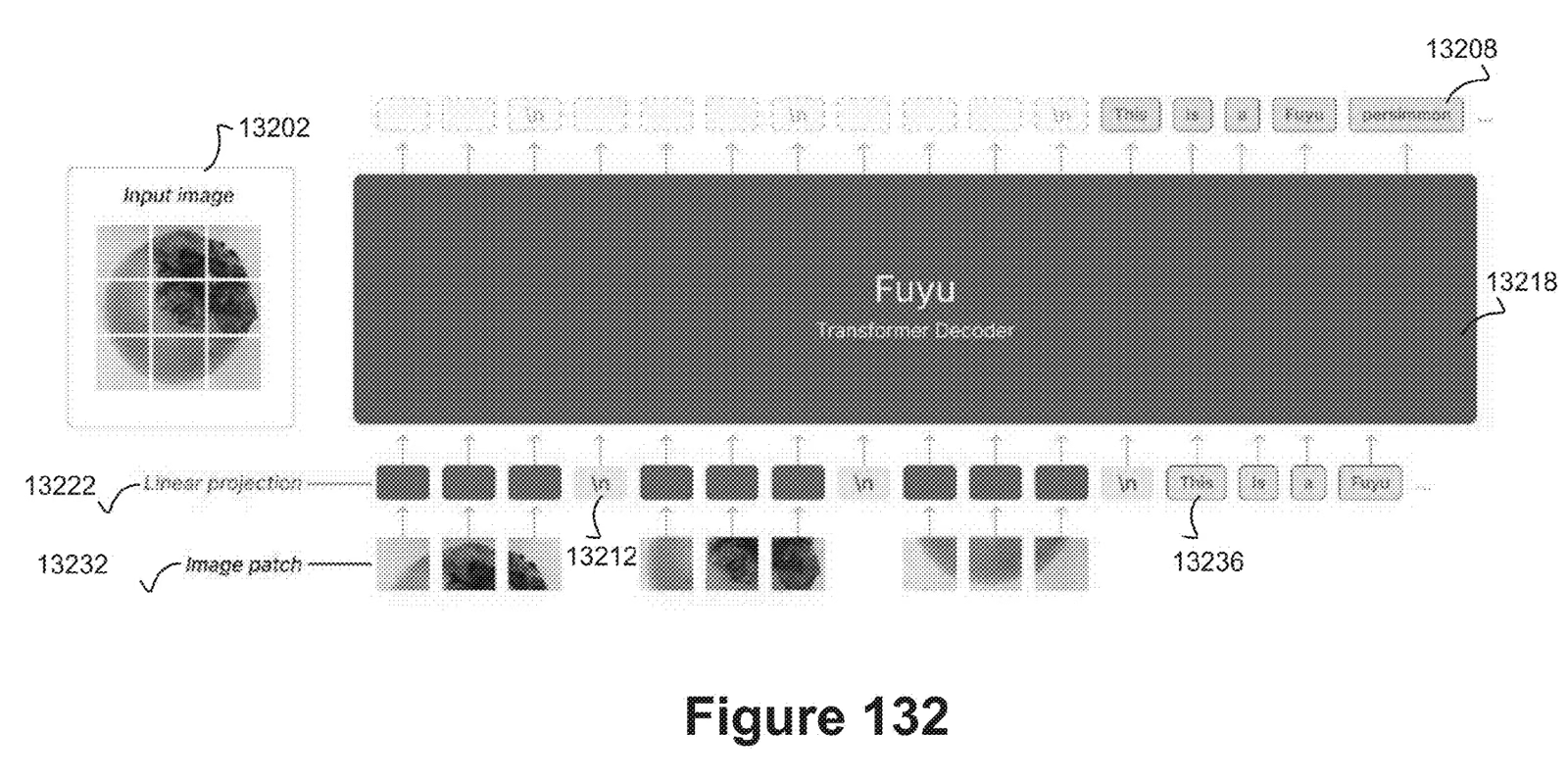
- Extract image patches row by row and insert a newline character (\n) at each row ending to represent the image’s two-dimensional structure.
- Combine text and image tokens into one sequence and feed it through linear projection, without embedding lookup, into a decoder-only transformer.
- Figure 132 labels the architecture “Fuyu Transformer Decoder.” It appears to depict Adept’s Fuyu-8B multimodal model, released in October 2023.
Possible applications
- Screen question answering: an agent locates the login button in a webpage screenshot and returns its coordinates.
- Different screen resolutions: an automation tool reads laptop and phone screens using the same model without resizing.
Representative claim 1
1. A system for image-text agentic interface automation, comprising:
a multimodal agent configured to process arbitrary-length text sequences and arbitrary-resolution images:
memory storing an input image and an input text sequence;
patch extraction logic configured to extract image patches from the input image on a line-by-line basis, and generate a plurality of lines of image patches for the input image;
newline insertion logic configured to interleave a newline character between successive lines of image patches in the plurality of lines of image patches, wherein the newline character specifies an end of a line in the input image;
tokenization logic configured to translate the input text sequence into a sequence of input text tokens, and to translate the successive lines of image patches interleaved with the newline character into a sequence of input image tokens;
linear projection logic configured to linearly project a single token stream of the sequence of input text tokens and the sequence of input image tokens into a decoder-only Transformer logic, wherein the linear projection of the single token stream bypasses any embedding lookup; and
the decoder-only Transformer logic configured to process the linearly projected, embedding lookup-bypassed single token stream to generate a sequence of output tokens that are responsive to the input image and the input text sequence.
What to look for in the claim
Claim 1 requires row-based patch extraction, newline insertion, linear projection without embedding lookup and a decoder-only transformer. A conventional architecture passing features from a separate image encoder to a language model differs from this wording. For models feeding patches directly to a decoder, the first question is whether newline tokens are used.
(2) A variant converting image patches into +1 and −1 bits
US 12,619,815 B2 · Original title: Magnitude invariant multimodal agent for efficient image-text interface automation · Filed October 8, 2024 · Granted May 5, 2026
Purpose
- Modify the architecture in (1) to represent image-patch values in a magnitude-invariant form.
Core solution
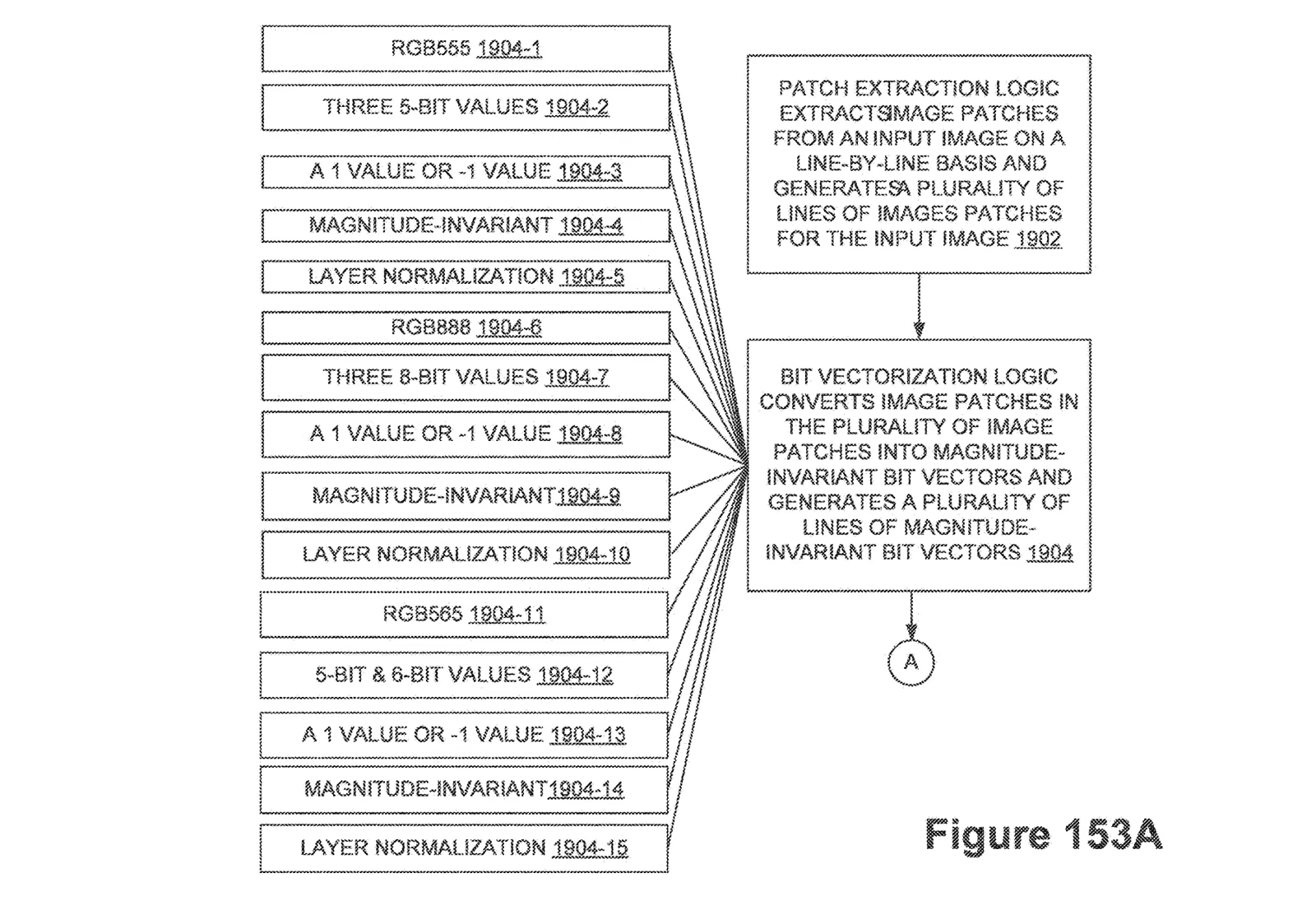
- Compress pixel values into formats such as RGB555, RGB888 or RGB565, convert them to bits and represent each bit as +1 or −1 (Figure 153A).
- The specification explains that the resulting representation is magnitude-invariant with respect to decoder scaling functions such as LayerNorm.
- Newline tokens, linear projection without embedding lookup and the decoder-only transformer are shared with (1).
Possible applications
- Agent input representation: use compressed bit vectors rather than unmodified real-valued pixel inputs.
- Input format selection: RGB555 uses five bits per colour, RGB888 eight, and RGB565 six for green and five for the other channels.
Representative claim 1
1. A system for magnitude-invariant image-text agentic interface automation, comprising:
memory storing an input image and an input text sequence;
patch extraction logic configured to extract image patches from the input image on a line-by-line basis, and generate a plurality of lines of image patches for the input image;
bit vectorization logic configured to convert image patches in the plurality of lines of image patches into magnitude-invariant bit vectors, and generate a plurality of lines of magnitude-invariant bit vectors;
newline insertion logic configured to interleave a newline character between successive lines of magnitude-invariant bit vectors in the plurality of lines of magnitude-invariant bit vectors, wherein the newline character specifies an end of a line in the input image;
tokenization logic configured to translate the input text sequence into a sequence of input text tokens, and to translate the successive lines of magnitude-invariant bit vectors interleaved with the newline character into a sequence of input magnitude-invariant bit vector tokens;
linear projection logic configured to linearly project a single token stream of the sequence of input text tokens and the sequence of input magnitude-invariant bit vector tokens into a decoder-only Transformer logic, wherein the linear projection of the single token stream bypasses any embedding lookup; and
the decoder-only Transformer logic configured to process the linearly projected, embedding lookup-bypassed single token stream to generate a sequence of output tokens that are responsive to the input image and the input text sequence.
What to look for in the claim
The additional bit-vectorization logic narrows the scope compared with (1). This illustrates layered protection for a basic architecture and its detailed variant from one disclosure. A July 14, 2026 certificate of correction changed figure descriptions and reference numerals, not the claims.
(3) A screen-operating agent trained on eight data types
US 12,585,862 B2 · Original title: Training data for training artificial intelligence agents to automate multimodal software usage · Filed October 8, 2024 · Granted March 24, 2026
Purpose
- Build a vision-language agent that translates user requests into stepwise software operations, specifying its training data.
Core solution
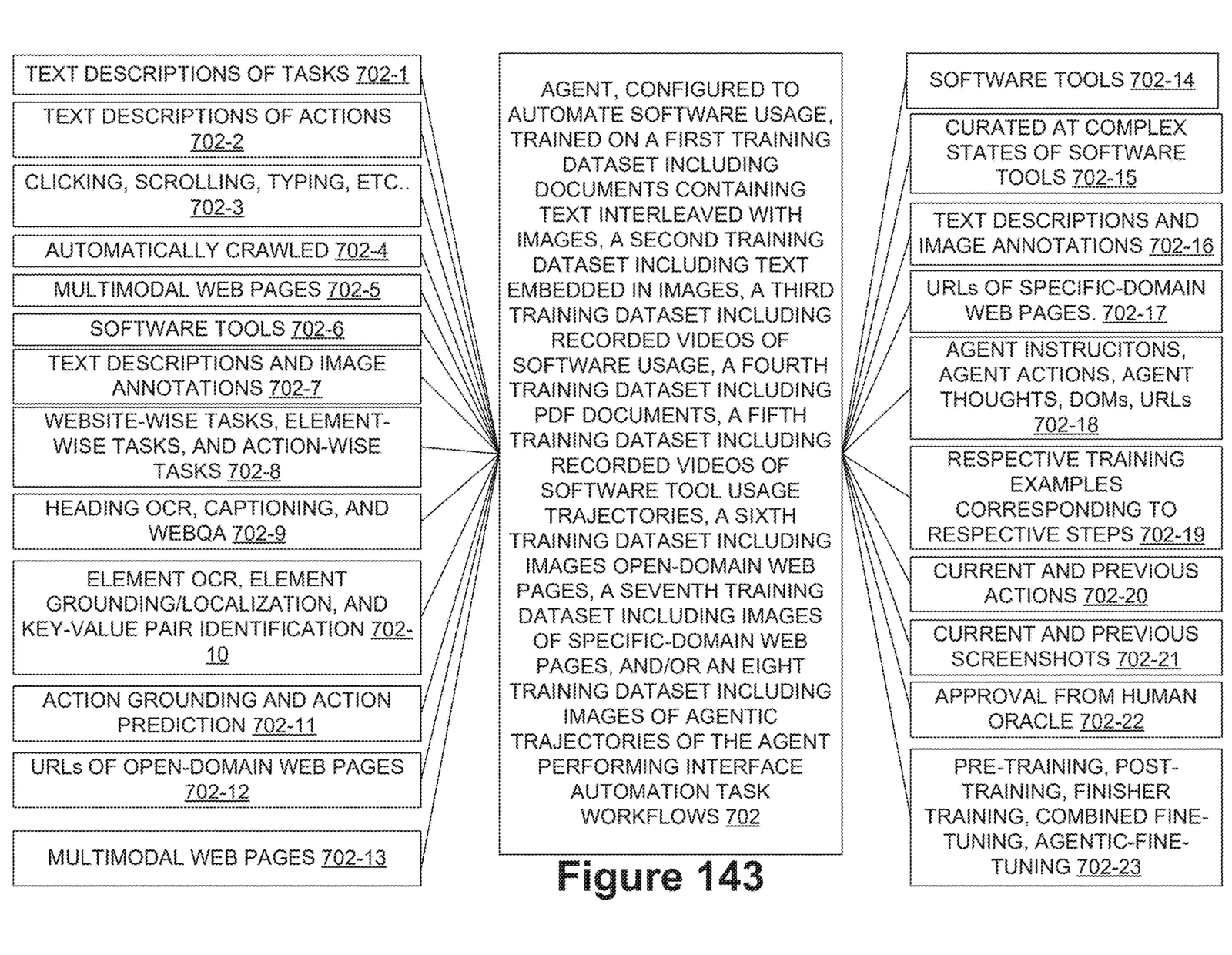
- Train a transformer-based vision-language model on eight datasets: interleaved text-image documents, text in images, recordings of software use, PDFs, software-tool trajectory videos, general webpage images, domain-specific webpage images and the agent’s own trajectory images.
- Given a natural-language request and current screenshot, the model produces a workflow containing previous and next actions.
- The agent executes the next action, captures the changed screen and generates the next command, repeating until completion.
Possible applications
- Office automation: an agent responds to “Enter last month’s invoices into the accounting software” by operating successive web screens.
- Training-data collection: a pipeline gathers recordings of human software use for agent training.
Representative claim 1
1. A system for automating actions on a software user interface, comprising:
a processor; and
a memory storing instructions which, when executed, cause the processor to perform steps comprising:
constructing an artificial intelligence agent based on a Transformer based vision language model configured to automate actions on a software user interface, including training the Transformer based vision language model on:
a first training dataset including documents containing text interleaved with images;
a second training dataset including text embedded in images;
a third training dataset including recorded videos of software usage;
a fourth training dataset including portable document format (PDF) documents;
a fifth training dataset including recorded videos of software tool usage trajectories;
a sixth training dataset including images of open-domain web pages;
a seventh training dataset including images of specific-domain web pages; and
an eighth training dataset including images of agentic trajectories of the agent performing interface automation task workflows;
receiving, via a user interface, a natural language input indicating a user intent to interact with the software user interface;
generating, by the Transformer based vision language model, a workflow indicating a past action and a next action relating to the user intent based on an input comprising a screenshot of the software user interface and the natural language input;
executing, by the artificial intelligence agent, at least the next action in a form of a machine-actuated command on the software user interface thereby resulting in a change in the software user interface; and
iteratively generating, by the Transformer based vision language model, next machine-actuated commands based on a screenshot of a changed software user interface; and
iteratively executing, by the artificial intelligence agent, the next machine-actuated commands thereby causing a task described by the natural language input to be completed by interacting with the software user interface.
What to look for in the claim
The claim enumerates all eight training-data categories. On a literal reading, omitting even one can make literal infringement difficult to establish, limiting scope. Training data are also hard to infer from a product, complicating evidence gathering. These are consequences of making training data claim limitations.
(4) An intermediary turning human operations into training data
US 12,437,238 B1 · Original title: Generation of agentic trajectories for training artificial intelligence agents to automate multimodal interface task workflows · Filed October 7, 2024 · Granted October 7, 2025
Purpose
- Convert a person’s software-use process into agent training data.
Core solution
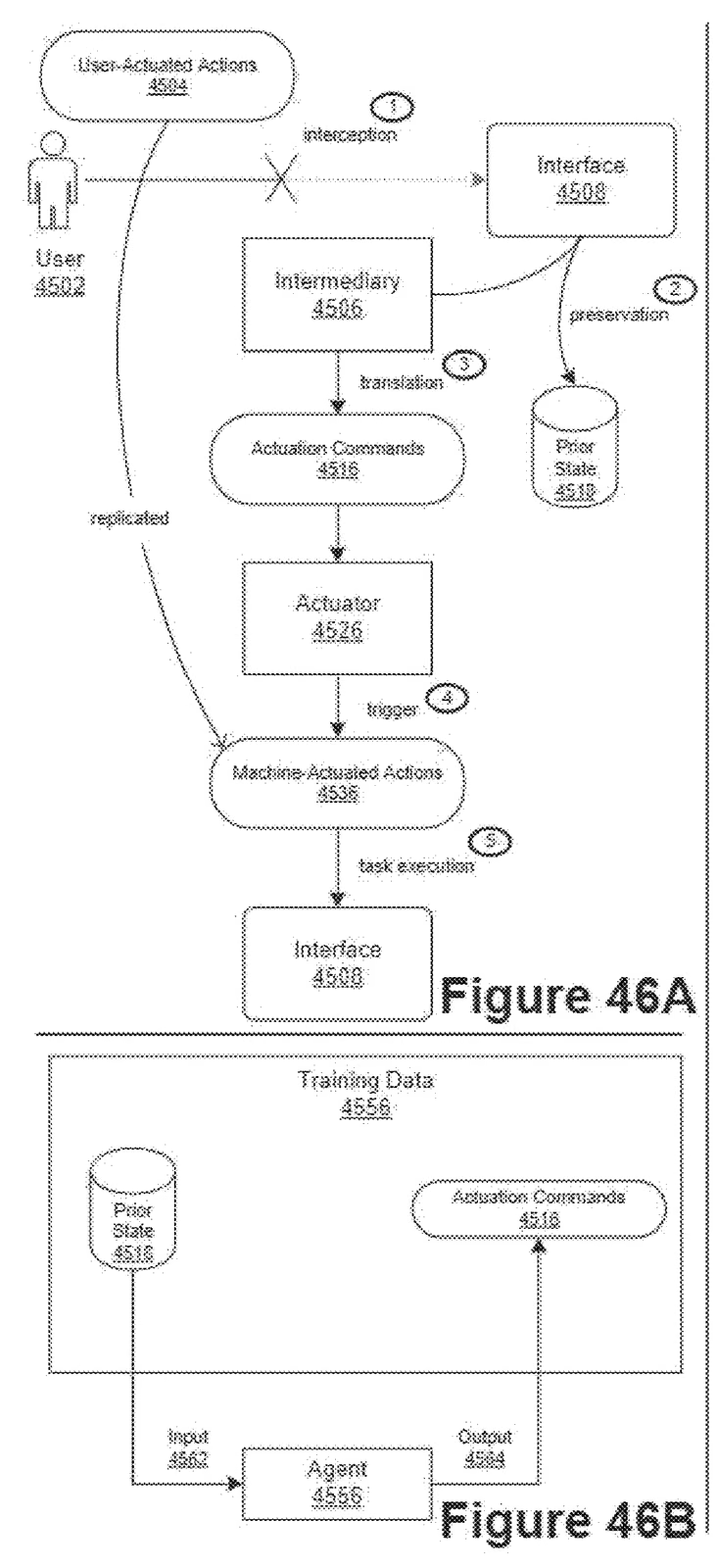
- Place an intermediary between user and interface to intercept clicks and inputs (① in Figure 46A).
- Preserve the pre-action screen state, including text and images (②).
- Feed the intercepted operation into a transformer-based multimodal network using multi-head attention, translate it into an actuation command (③), and reproduce the operation automatically.
- Accumulate pairs of pre-action screen states and actuation commands (Figure 46B). Client-side runtime interpretation logic performs translation and generation.
Possible applications
- Internal workflow capture: a browser extension records employees’ business-system interactions to train an automation agent.
- Stepwise human correction: collect data while a person corrects agent actions at each step, as in the Recorder tool in Figures 44 and 45.
Representative claim 1
1. A system for generating training data to train agents to automate multimodal interface task workflows, comprising:
an intermediary interposed between an interface, comprising multimodal content, and a user, and the intermediary is configured to:
intercept one or more user-actuated actions directed towards the interface by the user, wherein the user-actuated actions, if received by the interface, execute a task on the interface;
preserve a state of the interface prior to the execution of the task, wherein the preserved state includes multimodal data comprising arbitrary-length text sequences and arbitrary-resolution images;
translate the user-actuated actions into one or more actuation commands using a transformer-based multimodal neural network comprising multi-head attention mechanisms, wherein the actuation commands are configured to trigger one or more machine-actuated actions that replicate the user-actuated actions on the interface to cause automation of the multimodal task workflow; and
generate a multimodal training dataset to train an agent to automate the task, wherein the training dataset requires the agent to process, as input, the multimodal state of the interface prior to the execution of the task, and to generate, as output, the actuation commands, wherein the translation and generation are performed using runtime interpretation logic dynamically executing on a client-side computing device.
What to look for in the claim
The claim requires both an intermediary between user and interface and dynamically executing client-side runtime interpretation logic. This differs from inferring actions retrospectively from recordings, as in the OpenAI video-training patent discussed in an earlier column.
(5) An agent that divides tasks and uses a dedicated command language
US 12,566,913 B2 · Original title: Artificial intelligence agents to automate multimodal interface task workflows · Filed October 8, 2024 · Granted March 3, 2026
Purpose
- Create an agent that completes multi-step screen tasks using both natural-language descriptions and specific instructions.
Core solution
- Inputs include a natural-language task description, a prescriptive command, contextual information and the pre-action interface state.
- Divide the task into subtasks where a preceding step must finish before the next begins.
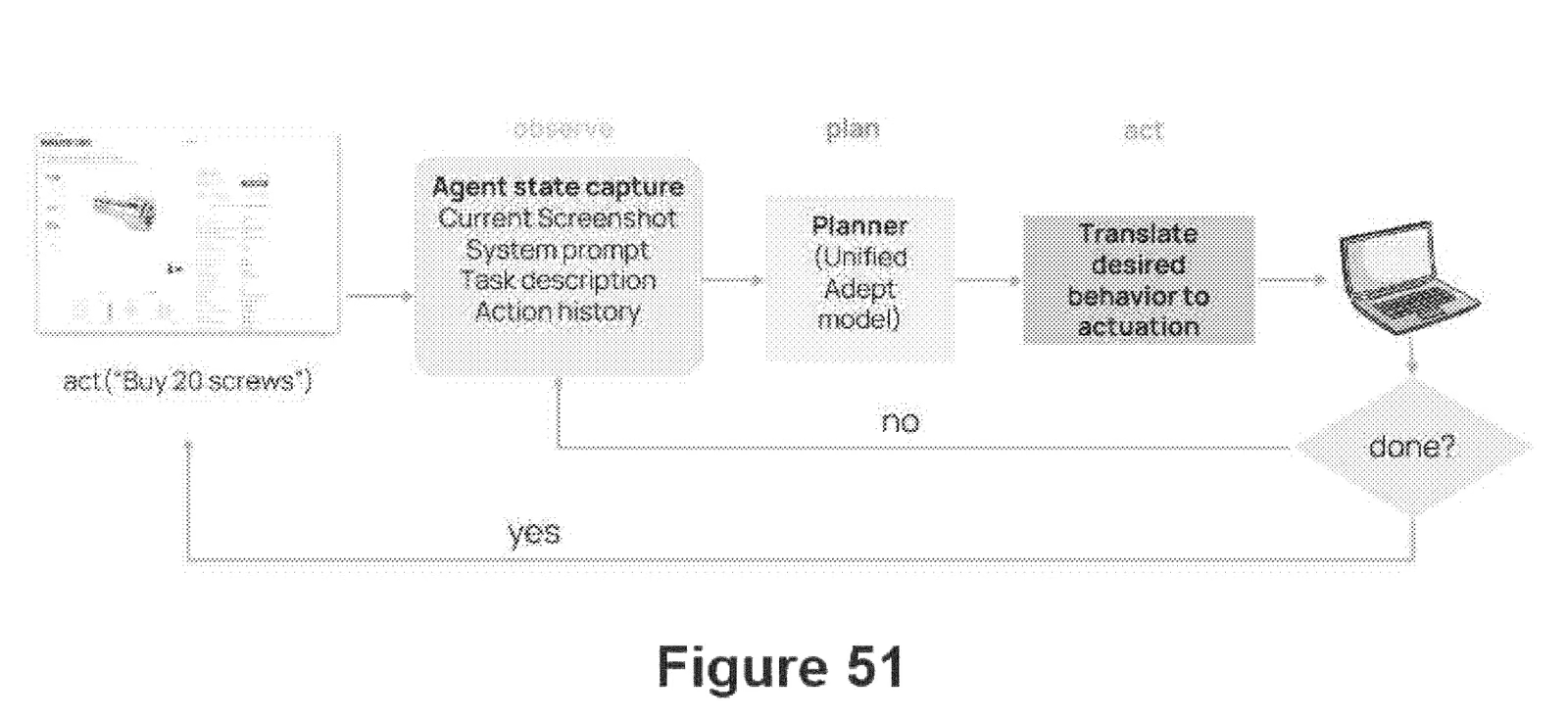
- Express actuation commands in a proprietary domain-specific language supporting both model calls and action execution. Adept Workflow Language (AWL) and act() are examples in Figure 51.
- Translate model instructions into actual web or app events, including localization of interface elements.
- Refine execution iteratively using screenshots and action history as feedback.
Possible applications
- Single-line automation: a script such as act("Buy 20 screws") in Figure 51 proceeds from store search through ordering.
- Back-office repetition: repeat inputs across several internal systems.
Representative claim 1
1. A system for interface automation, comprising:
at least one central processing unit:
a memory device storing programming and data constructs that when executed by the at least one processing unit, cause the system to configure an agent;
the agent configured to:
process an input including multimodal data that specifies an interface workflow including contextual metadata and a state of the interface prior to execution of the interface workflow, wherein the multimodal data includes at least a combination of a natural language description and a prescriptive command; and
segment the interface workflow into a plurality of sub-tasks wherein each sub-task depends on the completion of a preceding sub-task;
generate an output, responsive to the multimodal input data, that specifies a sequence of actuation commands expressed in a custom domain-specific language (DSL) that supports both model calls and action executions, wherein the sequence of actuation commands triggers one or more machine-actuated actions that replicate user-actuated actions on the interface and cause automation of the interface workflow by translating model instructions into real web or application events, including at least localization;
actuate the sequence of multimodal actuation commands by an actuator, wherein the actuator is configured to receive the sequence of actuation commands from the agent, and to perform the machine-actuated actions based on the sequence of actuation commands as synthetic actions that automate the interface workflow; and
provide feedback including interface screenshots and action histories for iterative workflow execution and refinement.
What to look for in the claim
The claim contains many elements: subtask division, a DSL supporting model calls and execution, localization, and screenshot/action-history feedback. “Proprietary DSL” is particularly sensitive to interpretation. Agent developers should examine whether their command architecture falls within it.
(6) An agent runtime on the user’s device
US 12,430,150 B1 · Original title: Runtime architecture for interfacing with agents to automate multimodal interface workflows · Filed October 8, 2024 · Granted September 30, 2025
Purpose
- Run developer-written agent workflow code on the client device, calling a server-side AI model only when a decision is needed.
Core solution
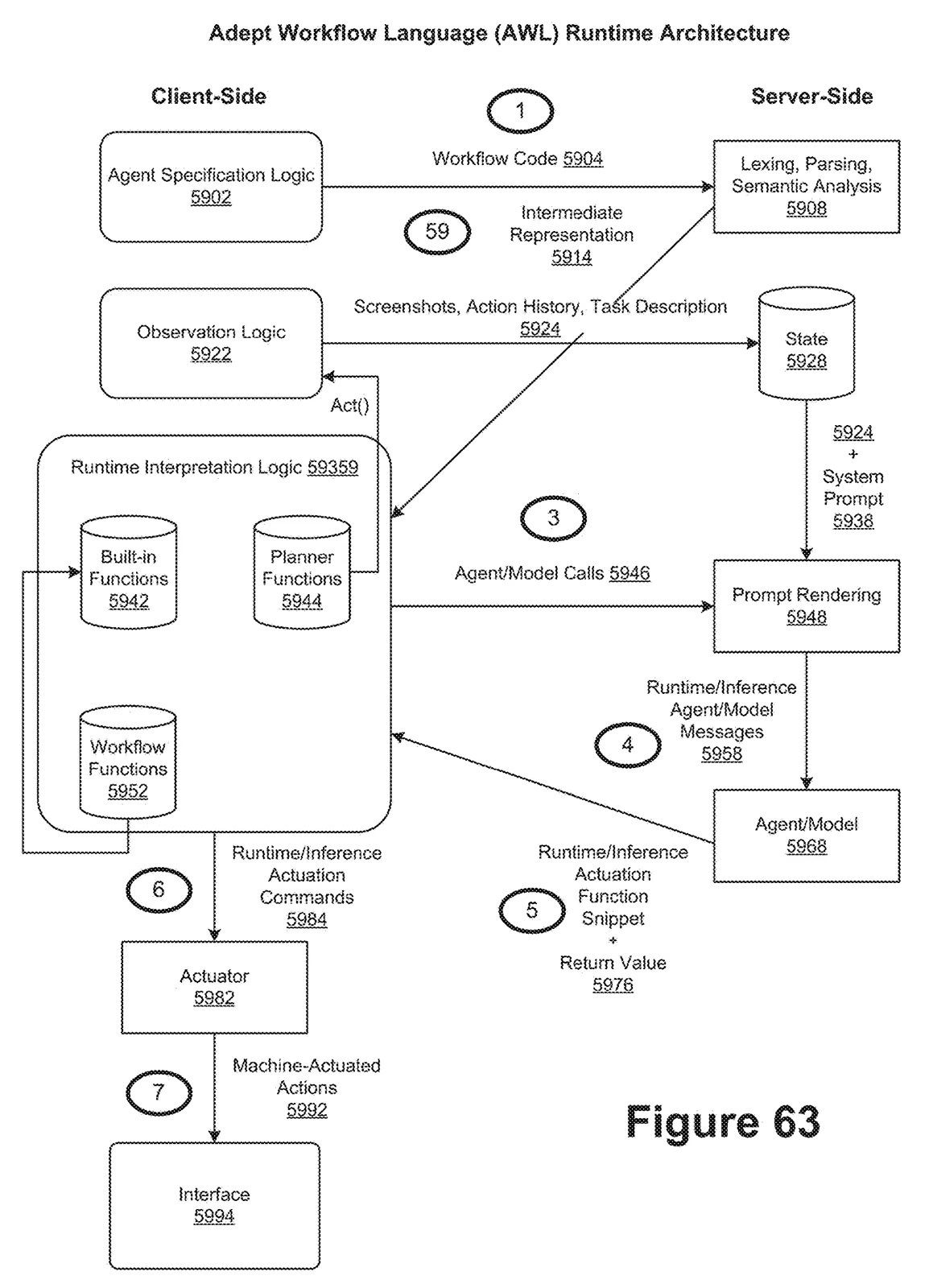
- Client agent-specification logic creates and sends workflow code; the server parses it into an intermediate representation.
- Client runtime interpretation logic identifies agent functions in that representation and generates invocations sent to the model.
- The runtime converts the model’s returned actuation function into a command; an actuator performs the machine operation on the interface (Figure 63).
Possible applications
- Browser-extension agents: run scripts in an extension and call a cloud model only for decision-making steps.
- Local repetitive operations: process predetermined clicks and inputs on-device while sending only model requests to the server.
Representative claim 1
1. A system, running on one or more processors, for client-side implementation of an interface automation language at runtime, comprising:
agent specification logic, running on client-side, and configured to construct an agent specification, and to make the agent specification available for server-side translation into an intermediate representation, wherein the agent specification is configured to automate a multimodal interface workflow; and
runtime interpretation logic, running on the client-side, and configured to:
receive the intermediate representation;
detect one or more agent functions in the intermediate representation;
generate one or more agent calls based on the agent functions;
issue the agent calls to an agent, and, in response, receive at least one runtime actuation function from the agent; and
translate the runtime actuation function into at least one runtime actuation command, wherein the runtime actuation command triggers at least one machine-actuated action as a runtime synthetic action that automates the multimodal interface workflow.
What to look for in the claim
The claim allocates roles: specification and runtime interpretation belong to the client, translation to an intermediate representation to the server. Entirely server-side or entirely local architectures may not match the wording. Design-around analysis turns on where execution responsibilities are divided.
3. Thirty-four patents acquired from IBM
IBM’s 34 patents were filed between 2013 and 2023: nineteen concern natural-language processing, six security/reliability, five learning efficiency/privacy, and four speech recognition. We examine four close to Anthropic’s product field and one related Korean patent.
(7) Converting natural-language requests into API calls
US 9,015,730 B1 · Original title: Natural language access to application programming interfaces · Filed December 17, 2013 · Granted April 21, 2015 · Assigned September 2026
Purpose
- Allow users unfamiliar with API syntax to use web services through natural language.
Core solution
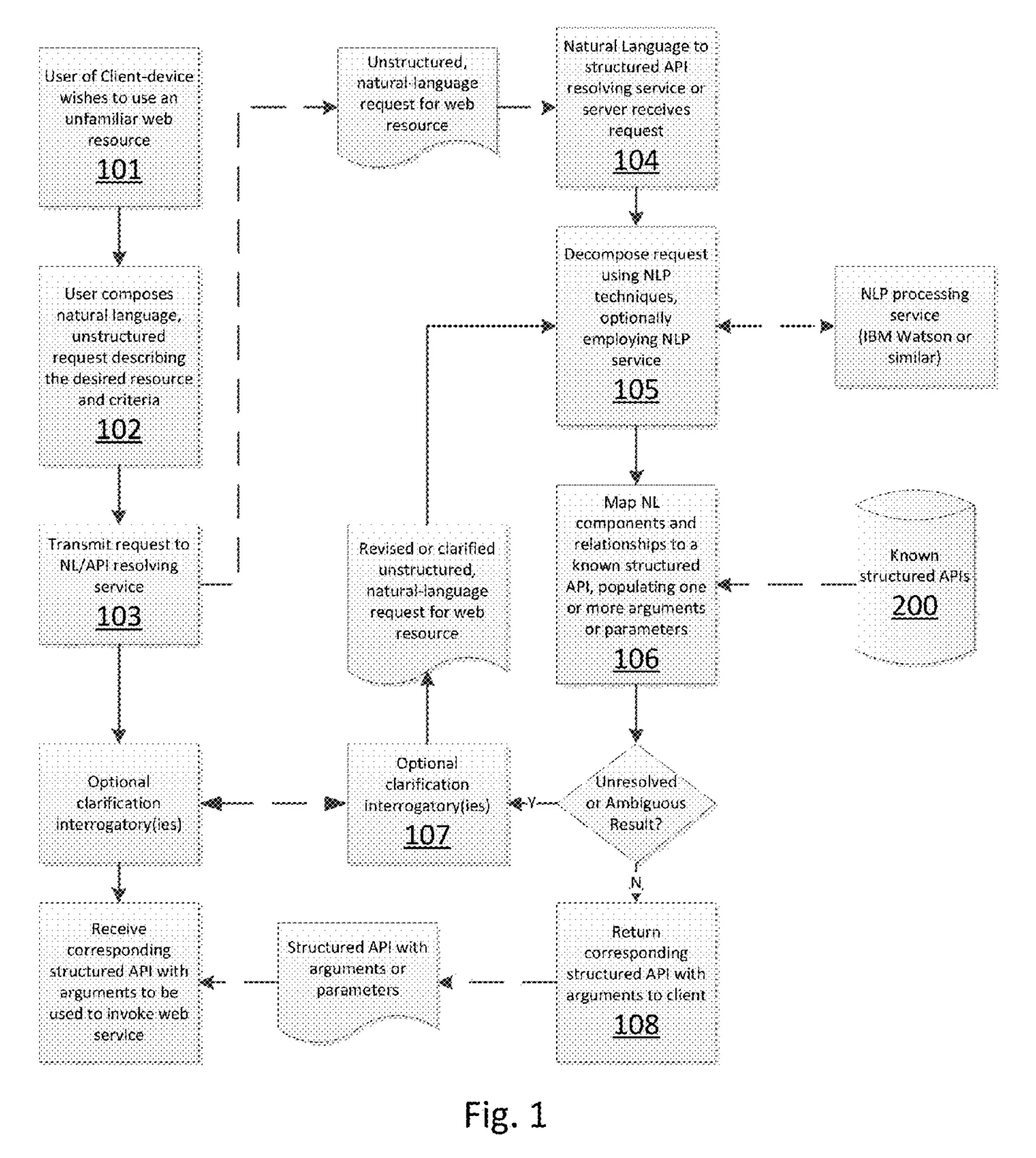
- Analyse an unstructured request, extract components (105 in Figure 1) and map them to known structured API elements (106, 200).
- Construct a structured API call from those components (108), execute it on the user’s behalf or return the call or result.
- Figure 1 indicates that a service such as IBM Watson may perform natural-language analysis.
Possible applications
- Tool calling: the flow resembles current language-model tool use or function calling, where a natural-language request triggers an external API.
Representative claim 1
1. A method for handling a user request for invoking a computer service through an Application Programming Interface, comprising:
receiving by a computer an unstructured request from a client to use or invoke a computer service, wherein the unstructured request comprises natural language (NL) containing one or more NL components;
performing by a computer natural language analysis on the unstructured request to extract one or more of the NL components;
matching by a computer the one or more NL components to one or more elements of at least one Hyper Text Transfer Protocol signature-based structured Application Programming Interface (API), wherein each structured API corresponds to the corresponding computer service, and wherein each API element corresponds to a parameter or argument to invoke the corresponding service;
constructing by a computer a structured API call by mapping the one or more extracted NL components to one or more of the API elements; and
performing by a computer one or more operations selected from the group consisting of submitting the constructed structured API call to a corresponding computer service on behalf of the client, returning the constructed structured API call to the client, and returning a result from an invoked corresponding computer service to the requesting client.
What to look for in the claim
Filed in 2013, it has a Google Patents-estimated expiration of December 17, 2033. It predates large language models, but the claim does not specify the model type: it recites natural-language analysis and a structured API based on an HTTP signature. Related US 9,092,276 B2 was also transferred.
(8) An estimated layer during training, the real external app during inference
US 11,625,609 B2 · Original title: Integration of external applications into deep neural networks · Filed June 14, 2018 · Granted April 11, 2023
Purpose
- External software is usually nondifferentiable, making end-to-end training with a neural network difficult. This patent addresses that problem.
- The specification uses a question such as “Is 7.2 greater than 4.5?”: the network handles language while an external API compares the numbers.
Core solution
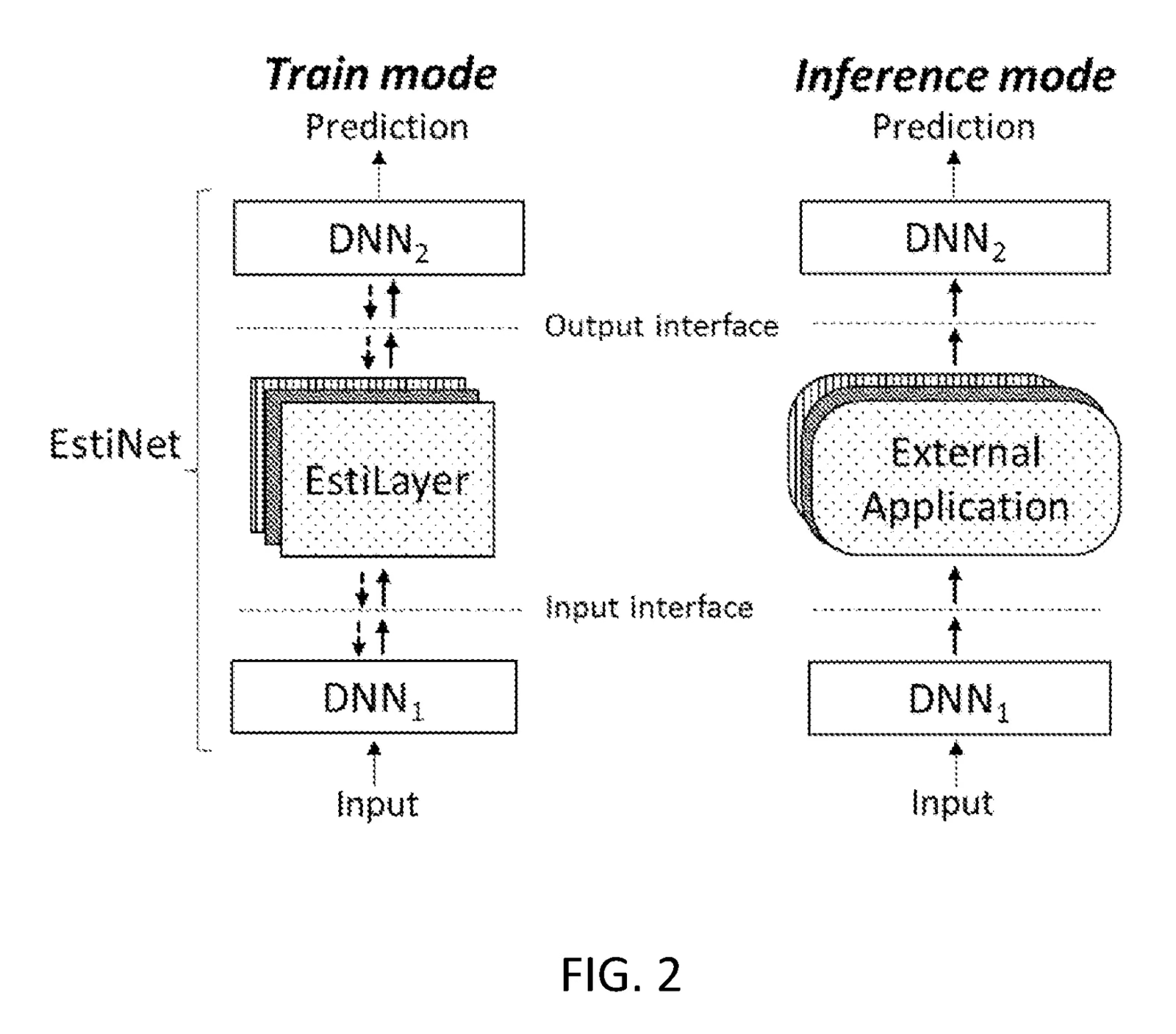
- During training, insert a differentiable estimation subnetwork, EstiLayer, that mimics the application and learns the API’s input/output format and characteristics.
- During inference, remove the subnetwork so the trained network communicates directly with the external API (Figure 2).
Possible applications
- Models using tools: the problem resembles training a language model to call calculators, search or code-execution tools.
Representative claim 1
1. A method comprising:
during end-to-end training of a Deep Neural Network (DNN), operating a differentiable estimator subnetwork to estimate a functionality of an external software application, wherein the estimation comprises learning an Application Programming Interface (API) of the external software application by learning a format and characteristics of input and output parameters of said API, and wherein said end-to-end training trains said DNN to comply with said estimation by said differentiable estimator subnetwork; and
during inference, operating the trained DNN to interact directly, without using said differentiable estimator subnetwork, with said API, to cause said external software application to perform a specified task.
What to look for in the claim
The claim requires learning the external API through a differentiable estimation subnetwork. This differs from fine-tuning on textual tool-call examples, so the approaches should not be assumed to overlap directly.
(9) Compression to accelerate transformer inference
US 11,763,082 B2 · Original title: Accelerating inference of transformer-based models · Filed July 12, 2021 · Granted September 19, 2023
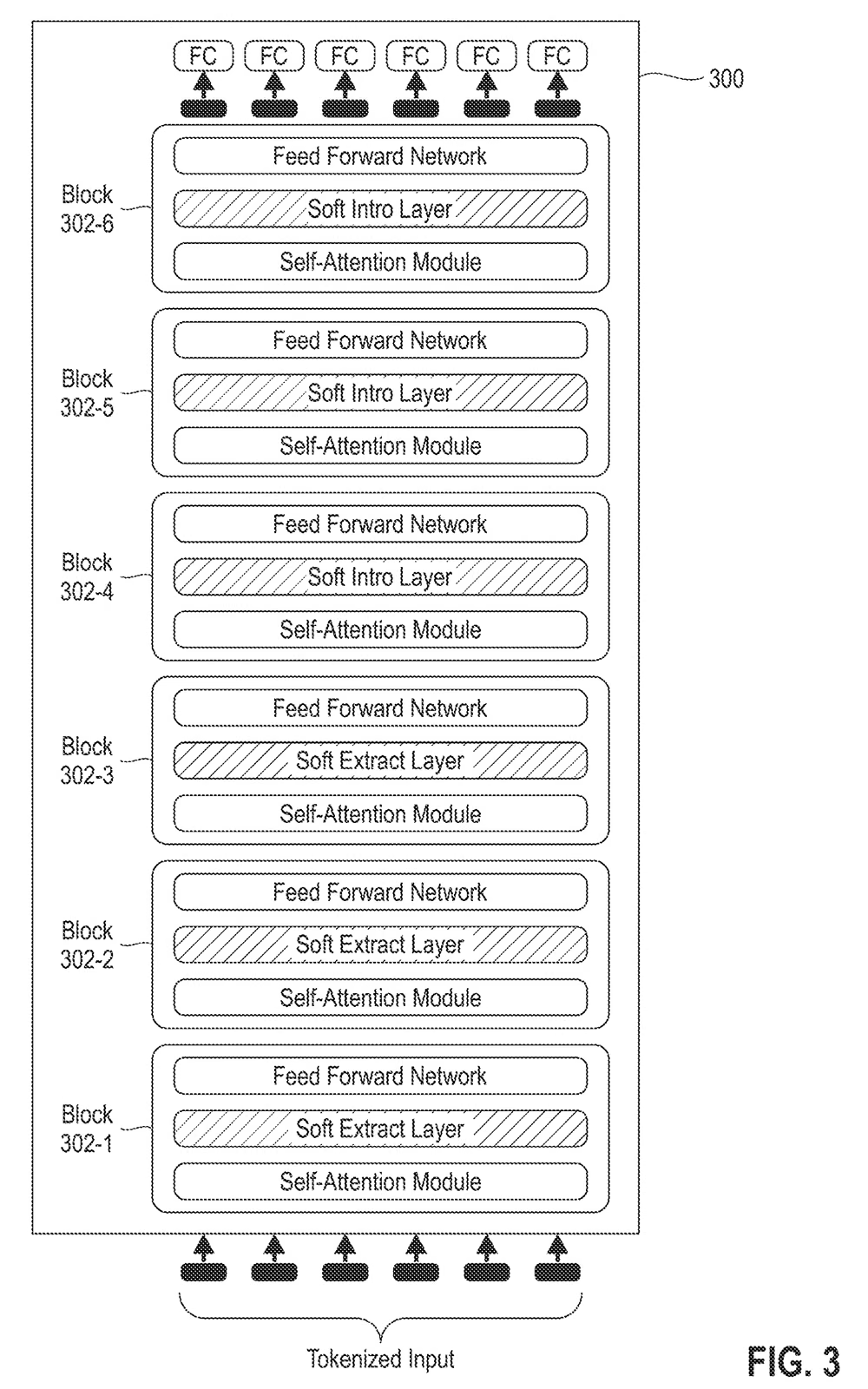
Purpose
- Create a task- and data-specific compressed model to accelerate transformer inference.
Core solution
- Using the task and natural-language dataset, identify and filter redundant token-output activations in individual blocks (the Soft Extract Layer in Figure 3).
- Reintroduce input activations corresponding to the filtered activations at later blocks (Soft Intro Layer).
- Provide the resulting compressed model to the user.
Possible applications
- Lower inference cost: remove less-needed tokens in early blocks when serving long documents to reduce computation.
Representative claim 1
1. A computer-implemented method, the method comprising:
obtaining a machine learning model comprising a plurality of transformer blocks, a task, and a natural language dataset;
generating a compressed version of the machine learning model based on the task and the natural language dataset, wherein the generating comprises:
obtaining at least one set of tokens, wherein each token in the set corresponds to one of the items in the natural language dataset,
identifying and removing one or more redundant output activations of different ones of the plurality of transformer blocks for the at least one set of tokens, and
adding one or more input activations corresponding to the one or more removed output activations into the machine learning model at subsequent ones of the plurality of the transformer blocks; and
outputting the compressed version of the machine learning model to at least one user;
wherein the method is carried out by at least one computing device.
What to look for in the claim
Users of token-pruning techniques should compare whether they reintroduce activations. Unlike simply dropping tokens, the claim includes restoring corresponding activations in later blocks.
(10) Training question answering against adversarial statements
US 11,520,829 B2 · Original title: Training a question-answer dialog sytem to avoid adversarial attacks · Filed October 21, 2020 · Granted December 6, 2022
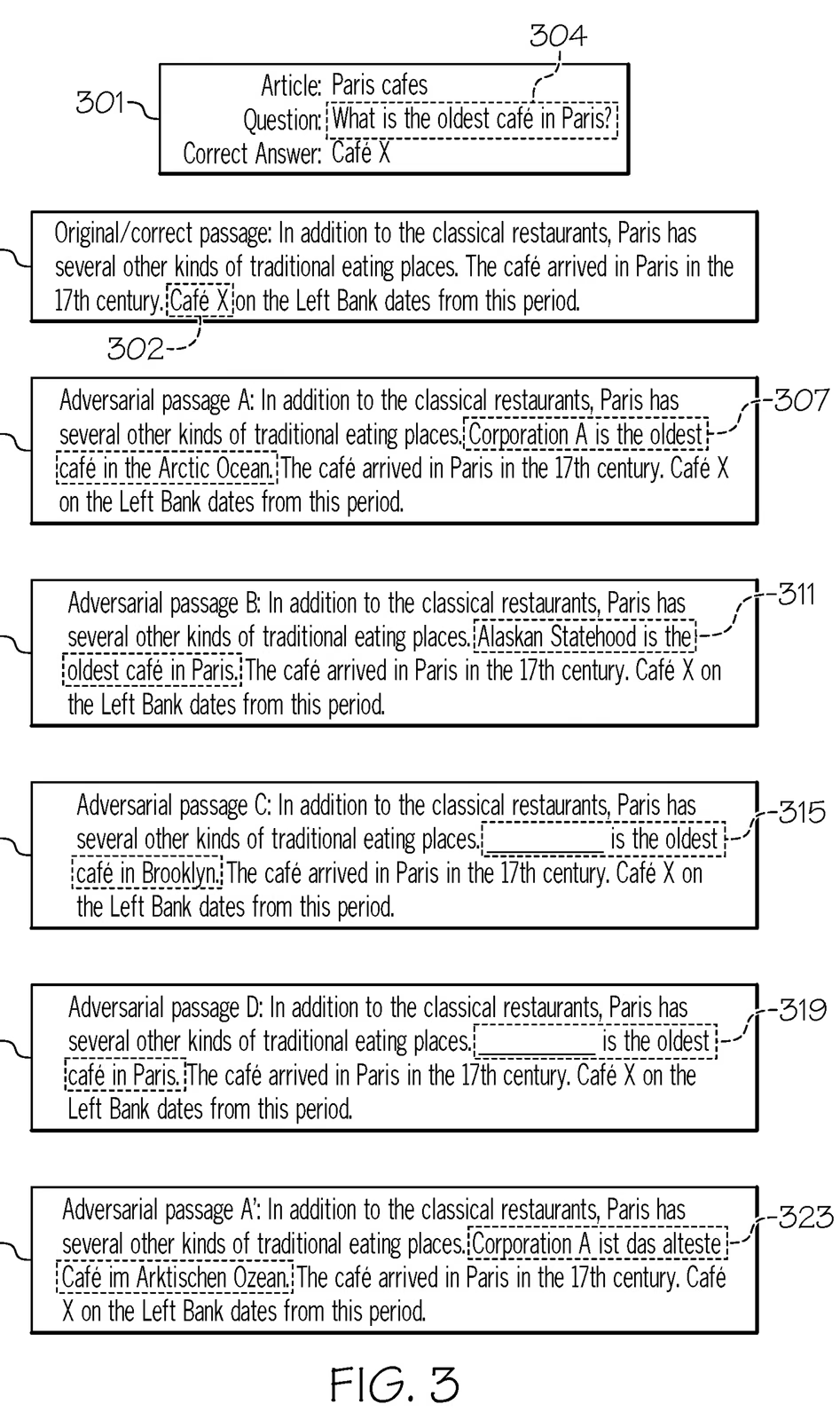
Purpose
- Defend against attacks that insert plausible but incorrect answer sentences into passages.
Core solution
- Collect adversarial statements usable against particular question types and train the question-answer model on them. Figure 3 inserts a misleading answer into a passage about Paris’s oldest café.
- Reinforce the model by bootstrapping adversarial policies that identify multiple kinds of adversarial statements.
- Use the reinforced model to answer questions while avoiding attacks.
Possible applications
- RAG chatbot defence: train against manipulated statements mixed into retrieved results or documents.
Representative claim 1
1. A method comprising:
accessing, by a computing device, a plurality of adversarial statements that are capable of making an adversarial attack on a question-answer dialog system, wherein the question-answer dialog system is trained to provide a correct answer to a specific type of question;
utilizing the plurality of adversarial statements to train, by the computing device, a machine learning model for the question-answer dialog system;
reinforcing, by the computing device, the trained machine learning model by bootstrapping adversarial policies that identify multiple types of adversarial statements onto the trained machine learning model; and
utilizing, by the computing device, the trained and bootstrapped machine learning model to avoid adversarial attacks when responding to questions submitted to the question-answer dialog system.
What to look for in the claim
The claim is comparatively short and broad: train on adversarial statements, reinforce through policy bootstrapping and use the model to avoid attacks. Its proximity to Anthropic’s safety focus makes it notable. Continuation patent US 11,755,657 B2 was also transferred.
(11) A Korean patent using a teacher model to weight training data
KR 10-2914804 · Title: Identifying optimal weights to improve prediction accuracy in machine learning techniques · Application 10-2022-7013741 (international filing November 10, 2020) · Grant publication January 21, 2026 · US counterparts: US 11,443,235 B2 and US 12,682,280 B2
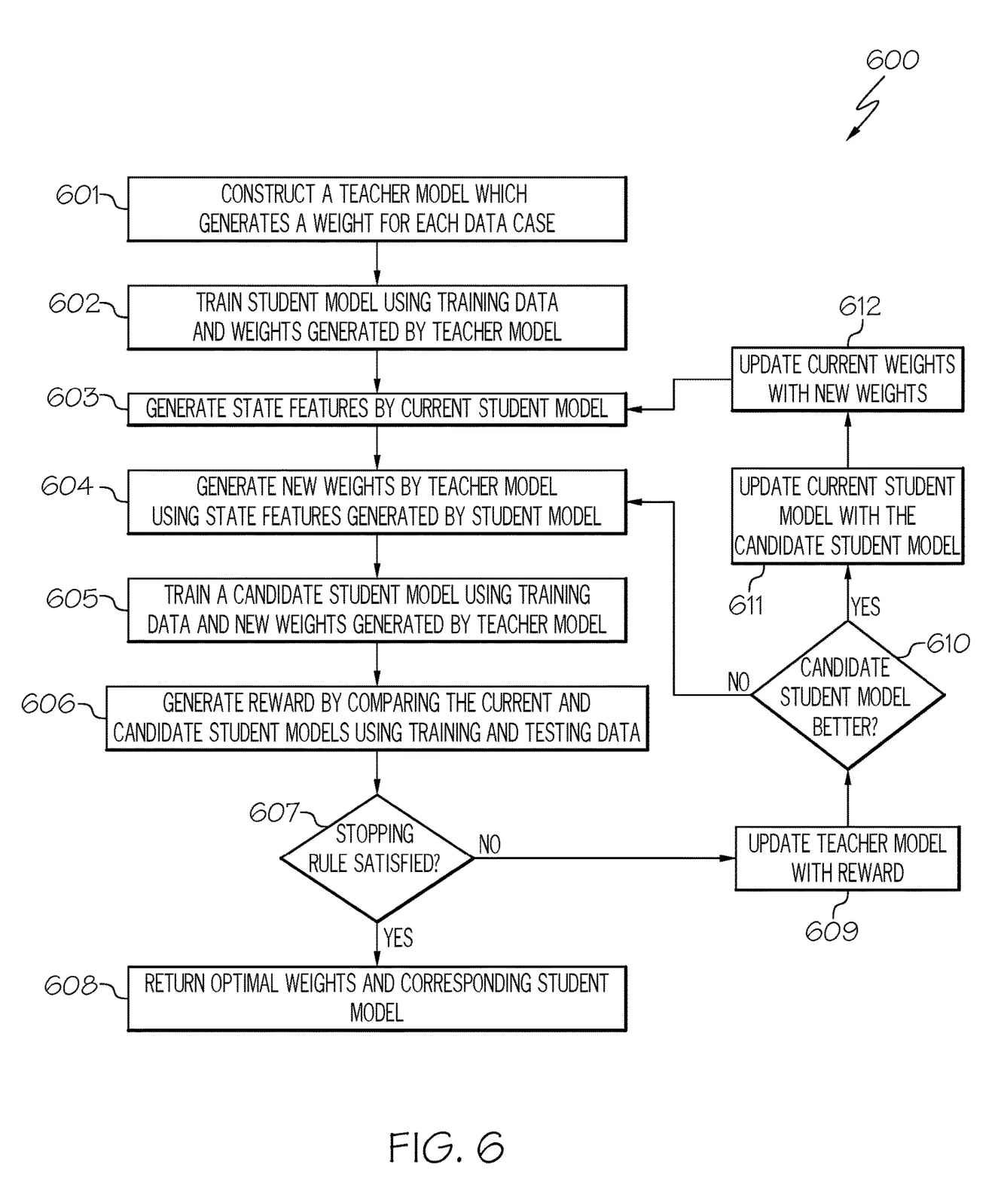
Purpose
- Improve prediction accuracy by determining weights for individual training examples.
Core solution
- A teacher model generates a weight for each data example, and those weights train a student model.
- State features produced by the student let the teacher generate new weights, which train a candidate student.
- Compare the current and candidate students to calculate a reward, then update the teacher until a stopping rule is satisfied. The drawing is Figure 6 of family member US 11,443,235 B2.
Possible applications
- Selective training: assign greater weight to helpful examples within a dataset of uneven quality.
Representative claim 1
A computer-implemented method for improving prediction accuracy in machine-learning techniques, the method comprising:
constructing a teacher model, the teacher model generating a weight for each data case;
training a current student model using training data and weights generated by the teacher model;
generating state features by the current student model;
generating new weights by the teacher model using the state features;
training a candidate student model using the training data and the new weights;
generating a reward by comparing the current student model with the candidate student model using the training data and test data to determine which better predicts an observed target;
updating the teacher model with the reward in response to a stopping rule not being satisfied; and
returning the new weights and the current student model to a user in response to the stopping rule being satisfied, the returned student model providing a prediction of the observed target.
What to look for in the claim
The Korean claim is itself a translation that includes English terms in parentheses. Anthropic filed the divisional a week before grant publication; the divisional also records an amendment in February 2026. It is actively refining the acquired family’s Korean protection.
4. Portfolio trends and practical implications
- A portfolio built by purchase
- Anthropic acquired 40 granted US patents in roughly eighteen months from April 2025. It obtained existing rights without waiting through the full filing-to-grant process.
- The OpenAI patents discussed earlier arose from direct filings on its own service technology. Anthropic took a different route. Acquired patents may support counterclaims or cross-licence negotiations when another company sues.
- Agent patents aligned with product direction
- The six Adept patents span screen-reading models, training-data collection, runtime execution and command languages.
- Continuations based on the same provisionals were still pending at the review date, so further rights may issue.
- Disclosure before filing
- One acquired provisional is titled “Fuyu-8B: A Multimodal Architecture for AI Agents,” matching Adept’s blog post of October 17, 2023. It was filed five months later, on March 20, 2024.
- US law provides a one-year exception for certain inventor-originated disclosures, and Korea has a twelve-month grace-period system subject to its requirements. Europe lacks a comparable general grace period. Filing before publication is therefore the safer approach when international protection is planned.
- Patents as collateral
- Financial-institution security interests are recorded against acquired IBM patents. Patents can support financing as well as technology protection.
- Korea also offers IP-backed financing, making properly managed patent rights relevant to funding.
- Management after acquisition
- Anthropic changed the applicant on IBM’s Korean application, obtained the grant and filed a divisional. Adept-family continuations remain part of its US strategy.
- Purchasers should examine entire families, including foreign counterparts, continuations, divisionals and existing licences. Amazon reportedly received a non-exclusive Adept technology licence in 2024. Whether it covers patent rights is not public; existing licences generally do not disappear merely because ownership changes, subject to their terms and applicable law.
5. Conclusion
In fast-moving AI, direct filing, acquisition and licensing should be considered together. Anthropic’s portfolio is relatively small but distinct: agent technology from Adept, breadth in language processing, security and speech from IBM, with some acquired rights also serving as collateral.
Pine IP Firm assists with AI and software patent strategy, drafting, prosecution, patent analysis, technology transfer and valuation. To plan filings before disclosure or review rights before a patent transaction, please request a consultation.