
Kakao-Affiliated Patent Records: Applicants, Jurisdictions, IPCs, and Status
This analysis covers 1,969 Kakao-affiliated application records after deduplication by jurisdiction code and application number. The records concern messaging and portal services, financial and authentication systems, mobility, content, workplace systems, and artificial intelligence.
Dataset and normalization
The source data was collected on July 8, 2026. It contained 3,320 document rows. Applicant-name filtering retained 3,098 Kakao-affiliated rows and excluded food, cacao, and other unrelated name matches. Deduplication of publication and registration rows by jurisdiction code and application number produced 1,969 application records.
| Item | Data point |
|---|---|
| Collection date | July 8, 2026 |
| Raw document records | 3,320 rows |
| Filtered Kakao-affiliated rows | 3,098 rows |
| Deduplicated application records | 1,969 |
| Application-year coverage | 2000-2026 |
| 2026 data | Partial count as of July 8 |
“Kakao-affiliated” is an applicant-name normalization used for this dataset. Current ownership and the chain of title for an individual application or patent must be verified in the official register. Separate applications in different jurisdictions remain separate records even when they concern the same invention.
Records by application year
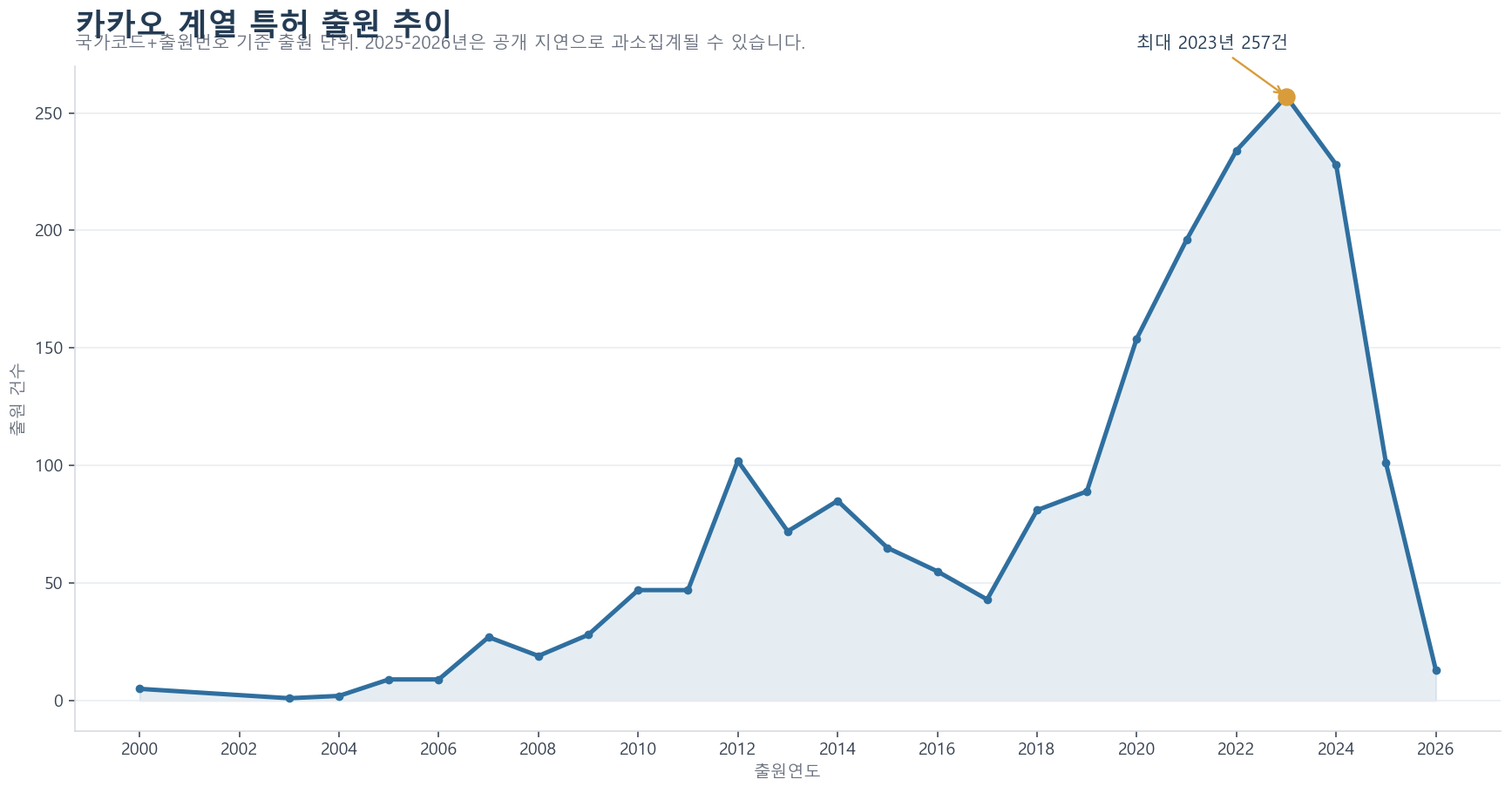
The dataset contains 102 records dated 2012, followed by lower annual counts from 2013 through 2017. Records from the earlier period include friend relationships, chat-room functions, message-server operation, user interfaces, and services connected to mobile messaging.
Annual counts increased to 154 in 2020, 196 in 2021, 234 in 2022, 257 in 2023, and 228 in 2024. The 2023 count is the largest in the dataset. Records from this period include finance, commerce, content, mobility, artificial intelligence, and healthcare in addition to KakaoTalk-related technologies.
The lower totals for 2025 and 2026 cannot be compared directly with complete years. Patent applications are ordinarily published after a delay, so many applications filed near the July 8, 2026 collection date were not yet available in public data.
Jurisdictions
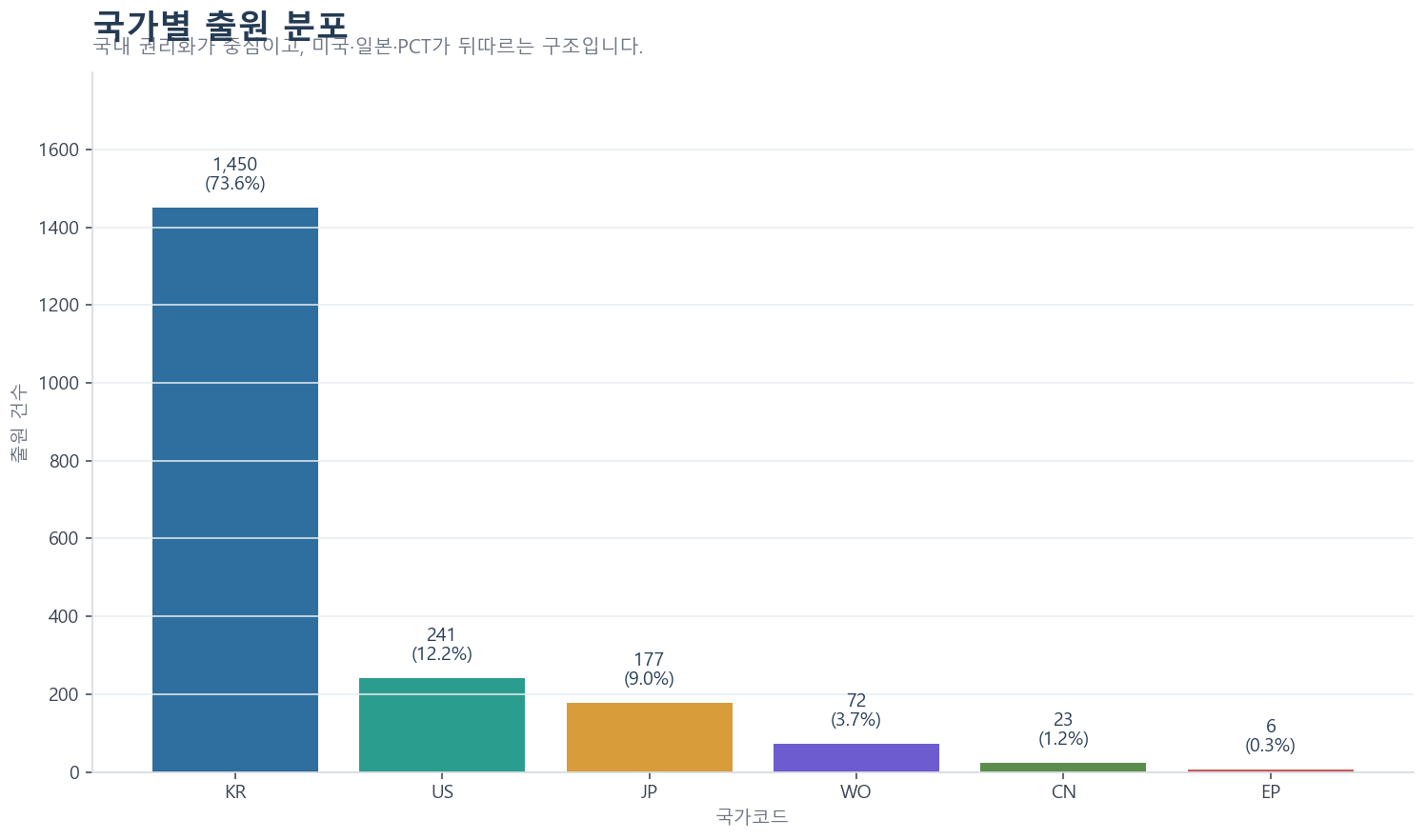
Korean records account for 1,450 applications, or 73.6% of the analytical set. The dataset also includes 241 United States records, 177 Japanese records, and 72 PCT publication records.
Jurisdiction counts identify where applications were recorded, but they do not establish current enforceability or commercial importance. A foreign-family review should identify the protected technology, the relationship between family members, the current legal status, and the scope of the independent claims in each jurisdiction.
Applicant groups
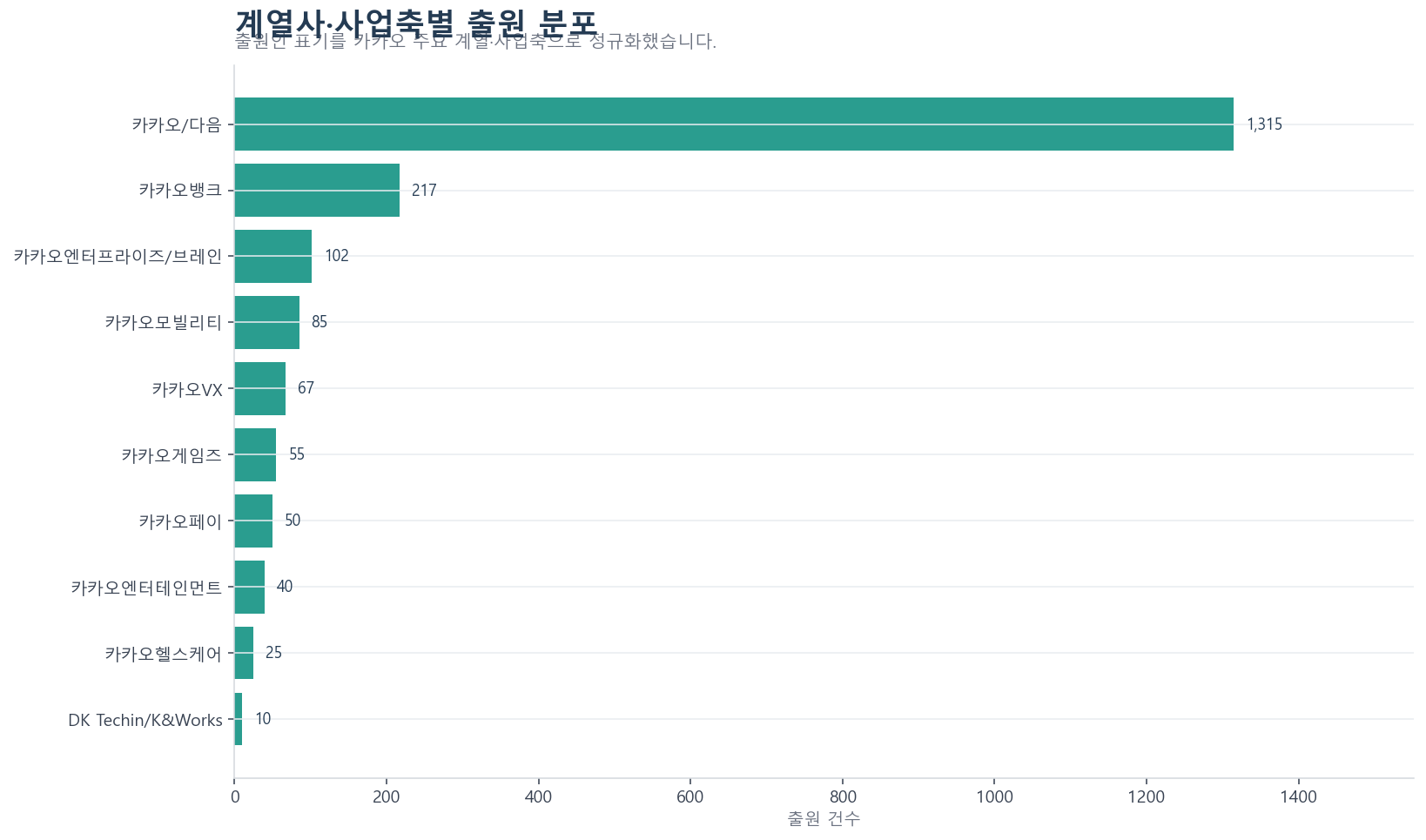
Kakao and Daum account for 1,315 records, or 66.8% of the set. The associated records concern KakaoTalk, Daum, portal services, advertising, content display, chat rooms, profiles, links, and messaging servers.
KakaoBank accounts for 217 records, Kakao Enterprise and Kakao Brain for 102, Kakao Mobility for 85, Kakao VX for 67, Kakao Games for 55, and KakaoPay for 50. KakaoBank records include identity verification, loans, transfers, fraud detection, and anomaly detection. Kakao Mobility records include location-based recommendations, dispatch, routing, and movement data. Kakao Enterprise and Kakao Brain records include artificial intelligence, workplace automation, search, recommendation, and conversational interfaces.
These descriptions are based on normalized applicant names and record subject matter. They do not establish that each listed entity currently owns every record assigned to its group.
G06Q business-process technologies
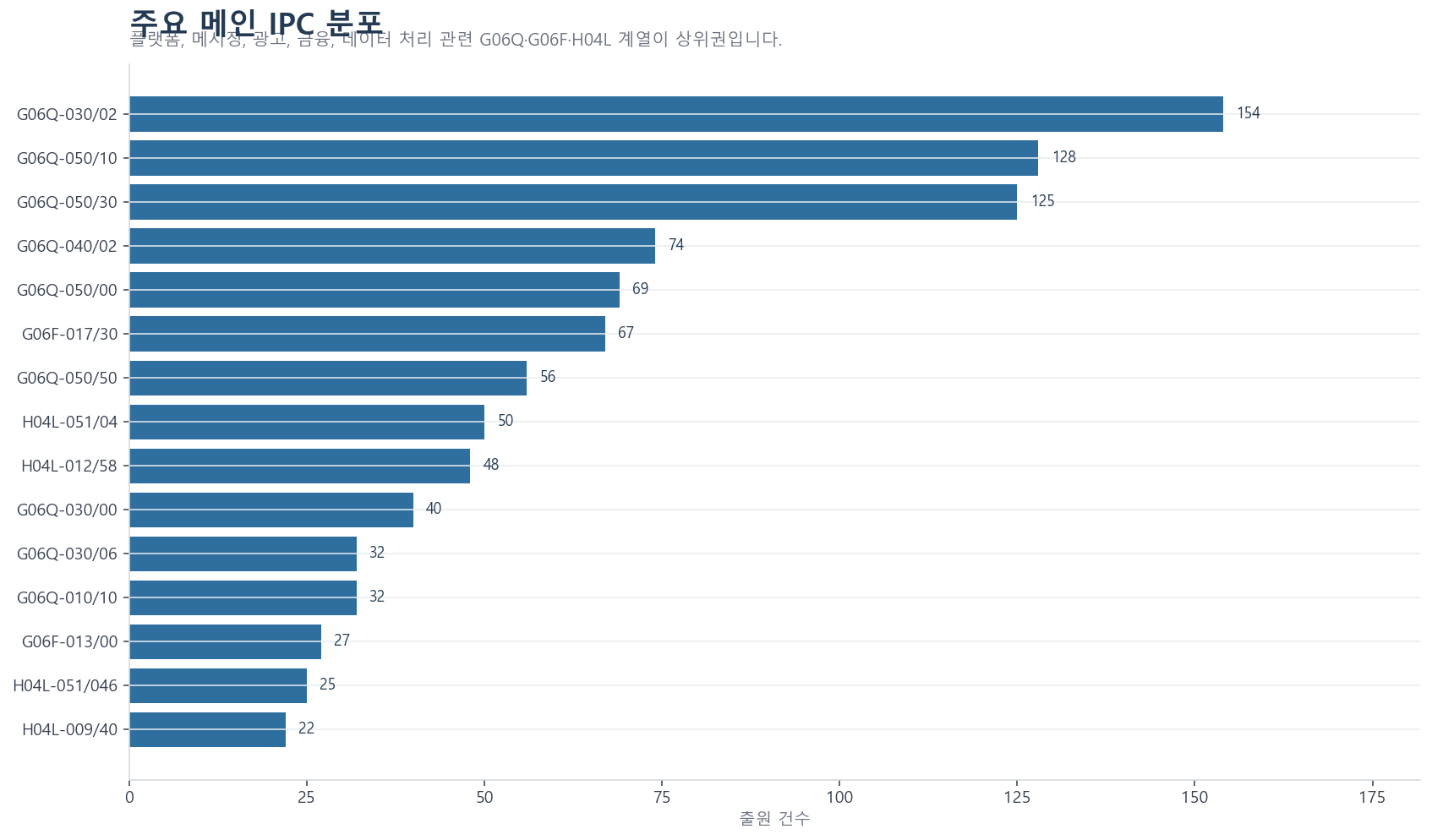
| G06Q 30/02 | 154 records |
|---|---|
| G06Q 50/10 | 128 records |
| G06Q 50/30 | 125 records |
| G06Q 40/02 | 74 records |
| G06Q 50/00 | 69 records |
| G06F 17/30 | 67 records |
G06Q covers information and communication technology adapted to administrative, commercial, financial, managerial, or supervisory purposes. G06Q 30/02 records in this dataset concern marketing, advertising, consumer behavior, and related commercial processing. G06Q 40/02 concerns banking and transaction processing. The G06Q 50 groups contain systems adapted to particular services and business sectors, including service delivery and communications-related processes under the IPC editions applied to the records.
The concentration in G06Q is consistent with inventions that use server processing, user data, transaction data, and interfaces to implement a commercial or service process. The code alone does not define claim scope. The independent claims must be reviewed to determine which data inputs, processing steps, actors, verification conditions, and outputs are required.
H04L communications and G06F data processing
H04L 51/04, H04L 12/58, and H04L 51/046 also appear frequently. Records assigned to these groups concern messaging sessions, message transmission, chat-room functions, profiles, links, content sharing, and notifications. G06F 17/30, an information-retrieval and database code used in earlier IPC editions, appears in 67 records. G06F 16/332 and related codes concern query processing, retrieval, and natural-language interaction.
The dataset spans several IPC editions. Historical codes may have been revised, transferred, or replaced. A current prior-art or freedom-to-operate search should include successor classifications, keyword concepts, cited documents, and the claims and descriptions of the identified records.
Records dated 2022 through 2024
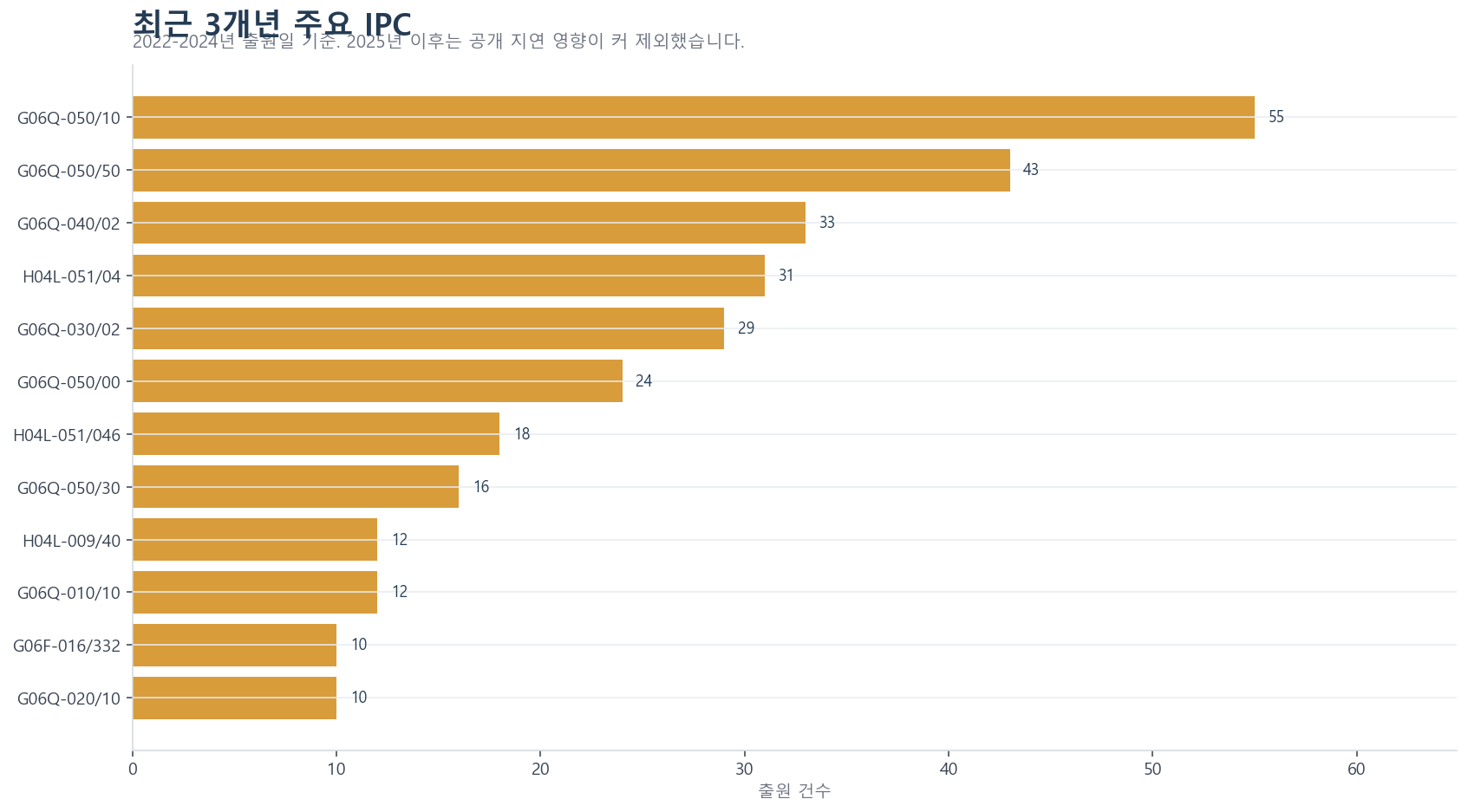
In the 2022-2024 subset, G06Q 50/10 appears in 55 records, G06Q 50/50 in 43, G06Q 40/02 in 33, H04L 51/04 in 31, and G06Q 30/02 in 29. The subject matter includes service delivery, social communication, banking, payment, messaging, and marketing processes.
Published examples attributed to KakaoBank concern digital wills, image-based transfers, prioritization of identity-document inspection, and detection of anomalous facial images. Examples attributed to Kakao concern chat-message display, combined content, location-based place recommendations, link and channel interfaces, profile management, and chat-room posting. For legal analysis, the relevant issue is the sequence and allocation of server operations, device operations, data processing, authentication, and interface output stated in the claims.
Legal status
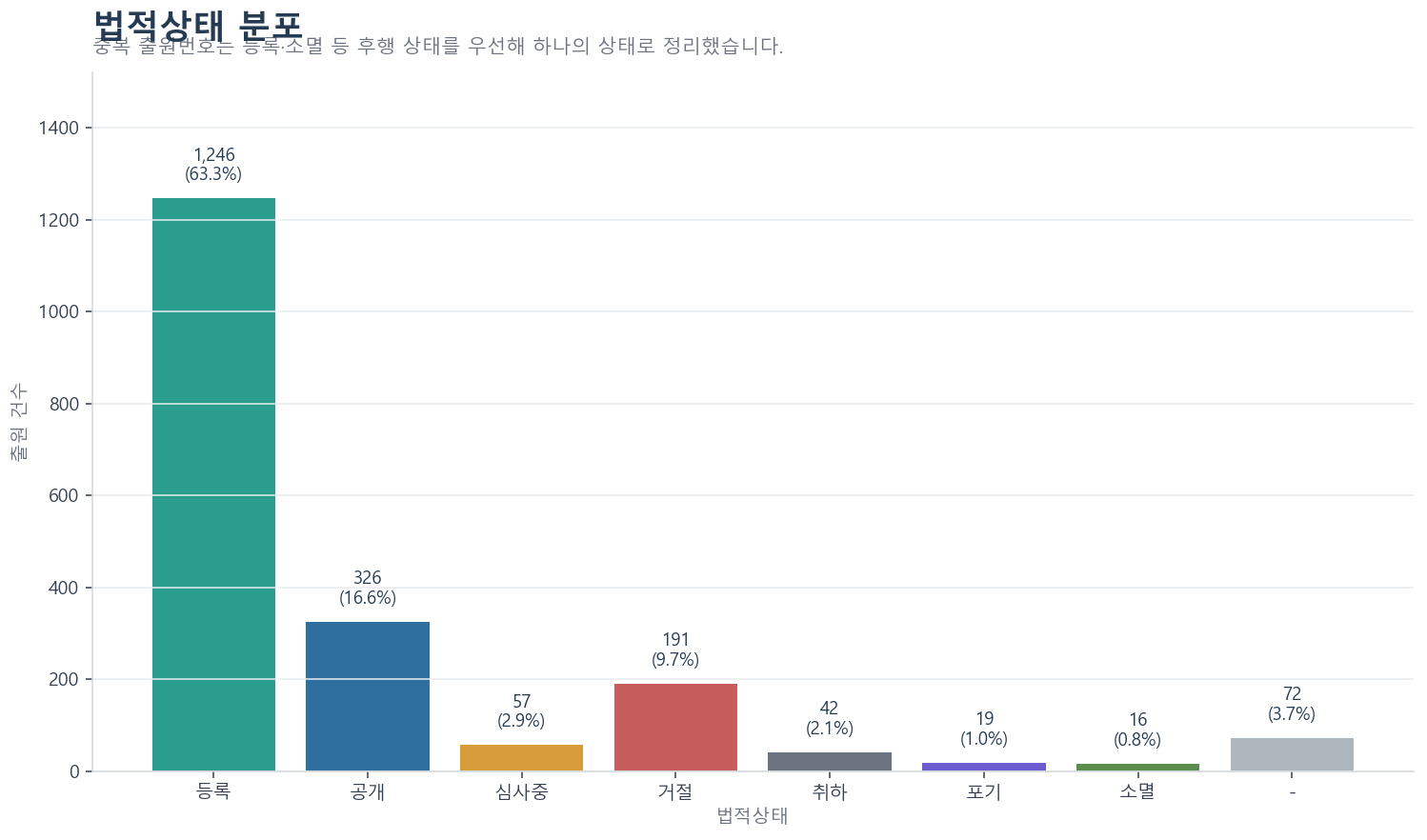
The dataset identifies 1,246 registered records, 326 published records, 191 rejected records, 57 pending records, 42 withdrawn records, 19 abandoned records, and 16 expired records. Registered records represent approximately 63.3% of the set.
A registered label does not establish that the right remains in force or that its claims cover a current service. Rejection, withdrawal, abandonment, and expiry labels likewise do not state the legal or commercial reason for the outcome. Official status, fee history, ownership, family members, and claim scope must be checked at the individual-record level.
Use in clearance and monitoring
A clearance search for chat, channel, profile, link, content-sharing, or messaging-interface features should combine the relevant H04L, G06Q, and G06F classifications with functional keywords and applicant or inventor searches. Financial-service review should separately address transfers, remote identity verification, anomaly detection, loan processing, and image-based financial interfaces.
Claims directed to artificial intelligence or data processing should be evaluated for their required input data, model or rule operations, verification conditions, and output. A result such as recommending or determining does not by itself disclose which technical steps are claimed.
The 2025 and 2026 publication set should be refreshed after sufficient publication time has elapsed. Monitoring should compare newly published claims, affiliate names, foreign family members, and status changes rather than relying only on annual counts.
IPC descriptions in this analysis follow the WIPO International Patent Classification.