
What Did Netlist’s Settlements Actually Pay For?
Semiconductor patent disputes are often remembered for large settlements. Netlist’s disputes with Samsung and Micron, however, require reading the post-settlement judgments too. Samsung settled on August 4, 2026, and Micron on October 5. On November 13, the Federal Circuit affirmed the PTAB’s obviousness determinations for claim 16 of US 7,619,912 and all claims of US 11,093,417 and US 9,858,215.
The ’912 and ’417 patents had featured in the $445 million jury verdict against Micron in 2024. Micron’s 2026 agreement provides $600 million for a five-year licence to Netlist’s worldwide patent portfolio. A substantial verdict, a comprehensive settlement and the failure to defend key claims’ validity thus occurred within the same dispute.
Who bears the loss when an individual patent falls?
The sequence invites the question whether waiting might have saved settlement money. Assessing the choice at the time requires examining other patents and proceedings, supply risks and the contractual allocation of losing a validity challenge. Samsung and Netlist’s public agreement addresses that risk expressly.
Section 8.10 of their patent cross-licence states that consideration was negotiated for the licensed portfolio as a whole rather than patent by patent. Invalidity, non-infringement, expiration or abandonment of one or more patents or claims does not, on that basis, reduce, recalculate or refund royalties or diminish payment obligations. Section 5.4 also disclaims warranties including patent validity.
On the public wording, these invalidity findings do not automatically reduce Samsung’s royalties. Amid uncertainty over which patents would survive, the parties priced continued operation within an agreed field and resolution of disputes, without repricing for an individual patent’s later fate. Validity risk therefore needs to be reflected adequately before settlement.
This does not mean every adjustment or refund is excluded. Netlist’s disclosures mention certain adjustment and refund rights for Samsung’s quarterly payments, and parts of the contract are confidential. But a disclosed refund right does not establish a refund upon invalidity. The public section 8.10 specifically excludes individual patent invalidity and similar events as grounds for reductions or refunds.
Micron requires a separate assessment. Disclosures establish a portfolio licence with twenty quarterly payments of $30 million over five years. They do not establish that its invalidity-risk allocation matches Samsung’s. Agreements with the same patent owner need not have identical legal effects.
Samsung and Micron withdrew from the relevant appeals after settlement, and the USPTO did not participate. The court nevertheless continued because a dispute over patentability remained. Netlist still needed to overturn adverse PTAB decisions even after resolving payment relationships with its opponents.
Sections 2.2 and 2.3 of Samsung’s separate settlement agreement anticipated this. They allowed Netlist to continue proceedings to preserve its rights after Samsung’s withdrawal and left proceedings and appeals concerning invalidity or unpatentability outstanding. The contract did not assume that settlement would erase every judicial determination.
This exposes a limit of portfolio transactions. A royalty agreement with one party does not settle enforceability against others. Contractually stabilized income and the strength of rights exercisable across the market require separate assessment. Treating settlement success as proof of every patent’s strength, or an appellate defeat as destruction of the whole transaction’s value, misses that distinction.
One signal missing from the initial disclosure
The ’912 priority analysis offers a lasting drafting lesson. The patent concerns a memory module that makes multiple lower-capacity devices operate as fewer higher-capacity devices. Netlist claimed earlier filing dates, but the court upheld the finding that necessary features of claim 16 lacked adequate disclosure. The decision is designated nonprecedential.
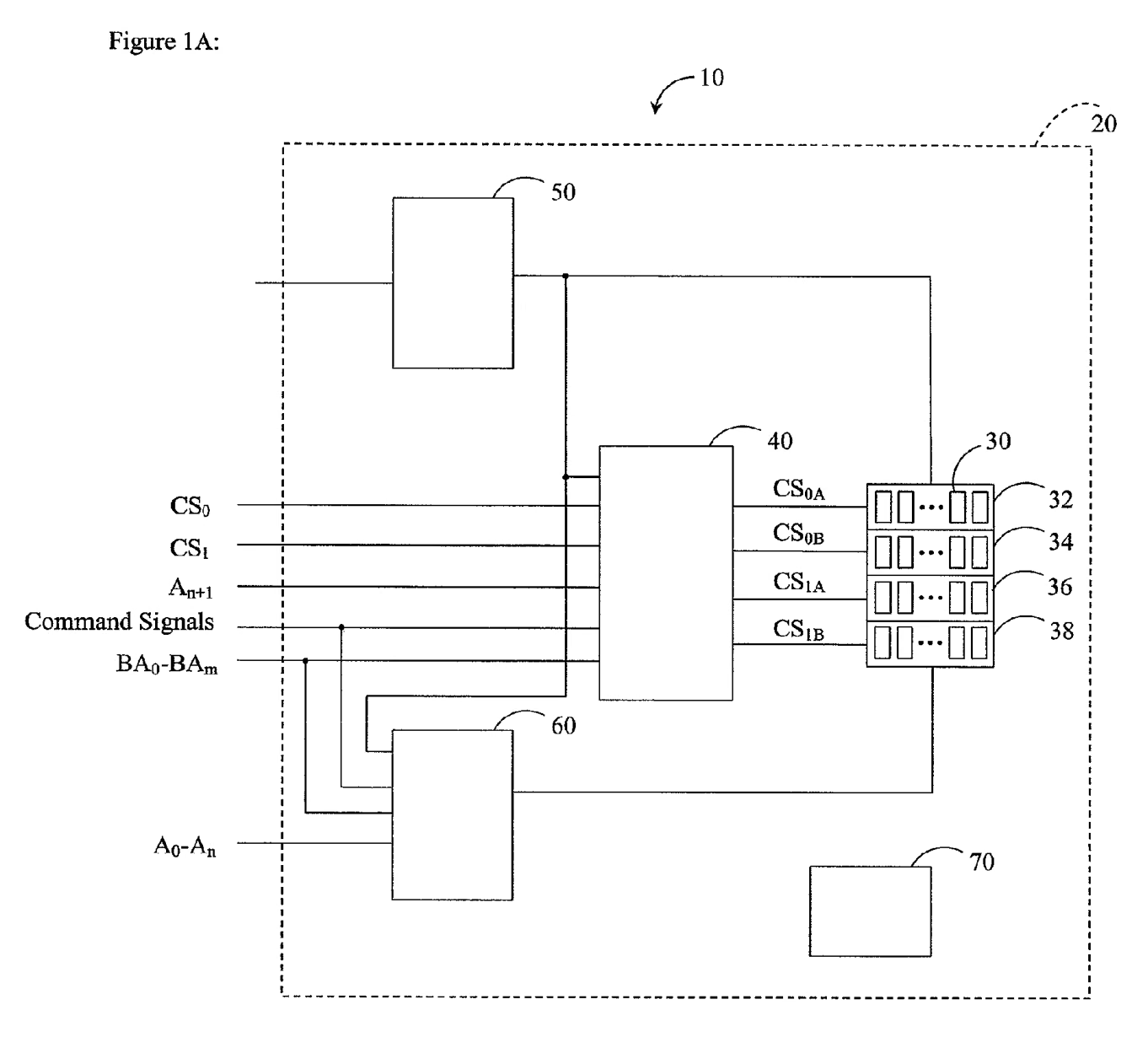
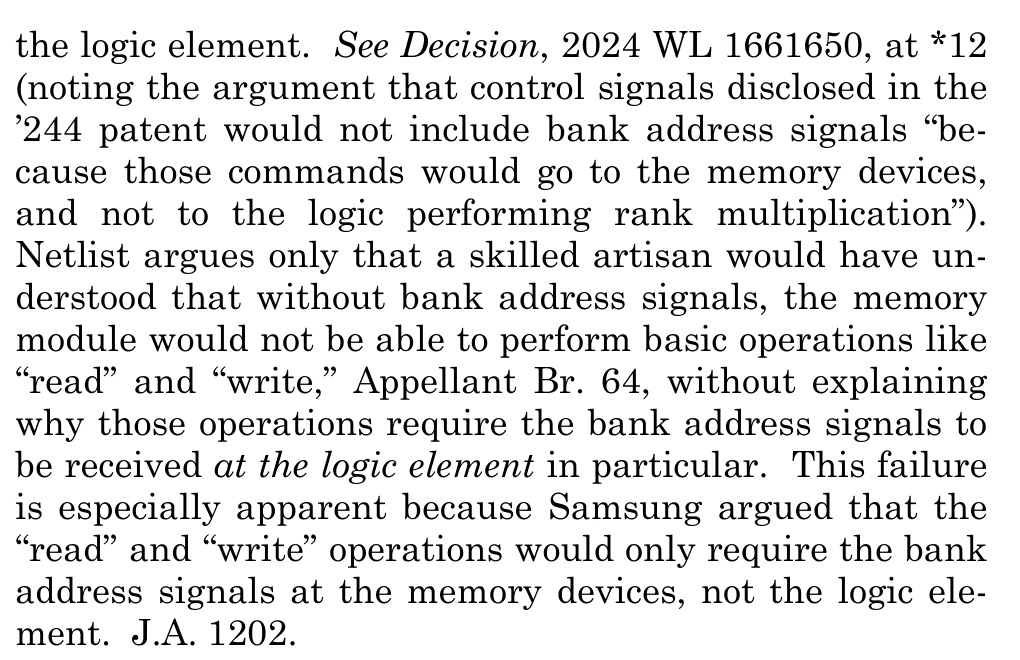
One earlier application did not adequately disclose the claimed register. The need to store state for sequential logic did not show that the claimed register necessarily performed that storage. A provisional application also failed adequately to support bank-address signals being received by the particular logic circuit. The fact that memory reading and writing need those signals did not establish that specific connection. Netlist therefore lost the earlier date and could not defeat the obviousness finding based on Ellsberry.
The comparison drawings in the PTAB’s final written decision show the distinction. Petitioners placed Figure 1A of the granted patent beside Figure 1 of the earlier provisional and identified the bank-address signal indications.
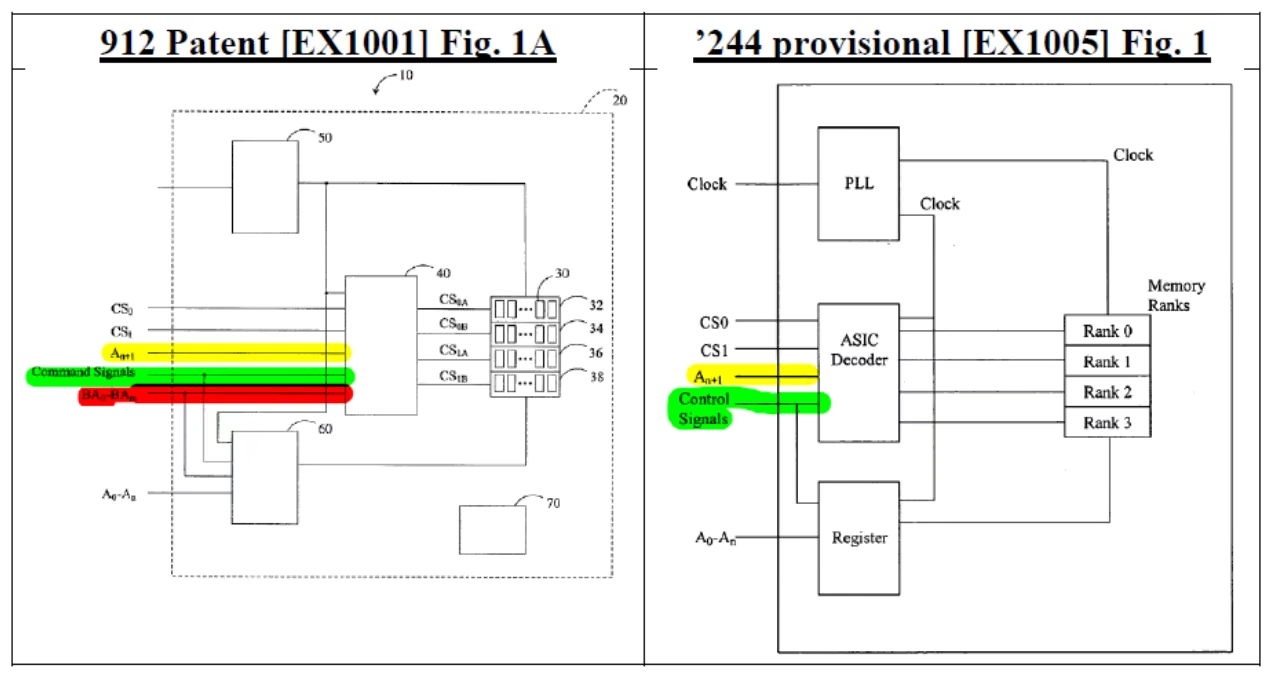
This is especially important for electronic circuits. Engineers naturally fill gaps when reading diagrams. Whether the original filing disclosed the connection later used to distinguish a claim is a separate inquiry. US disclosure requirements address both enablement and whether the filing demonstrates possession of the claimed invention. A skilled person’s ability to implement a circuit cannot fill every original disclosure gap.
Suppose an initial document says only that a controller controls memory, while a later filing centres on a buffer controller receiving a particular address signal and activating only a selected memory path. Even if the later configuration is inventive, its entitlement to the first date must be checked. The benefit of a US provisional filing likewise depends on support and enablement for the later-claimed invention.
Reviewing an initial filing therefore requires more than checking component names. Match drawings and description for where the central signal enters, under what conditions it is transformed and where it goes. Separate features added during later development. Otherwise the strategy of securing an early date may diverge from the protection actually obtained.
The argument that a prior-art advantage would be lost
The same-day ’417 and ’215 decision illustrates obviousness-response strategy. The issue was motivation to combine Perego with the JEDEC DDR2 standard. Netlist argued that the combination would defeat the Rambus system’s purpose and backward-compatibility advantage. On appeal, it challenged motivation, not disclosure of the claim elements.
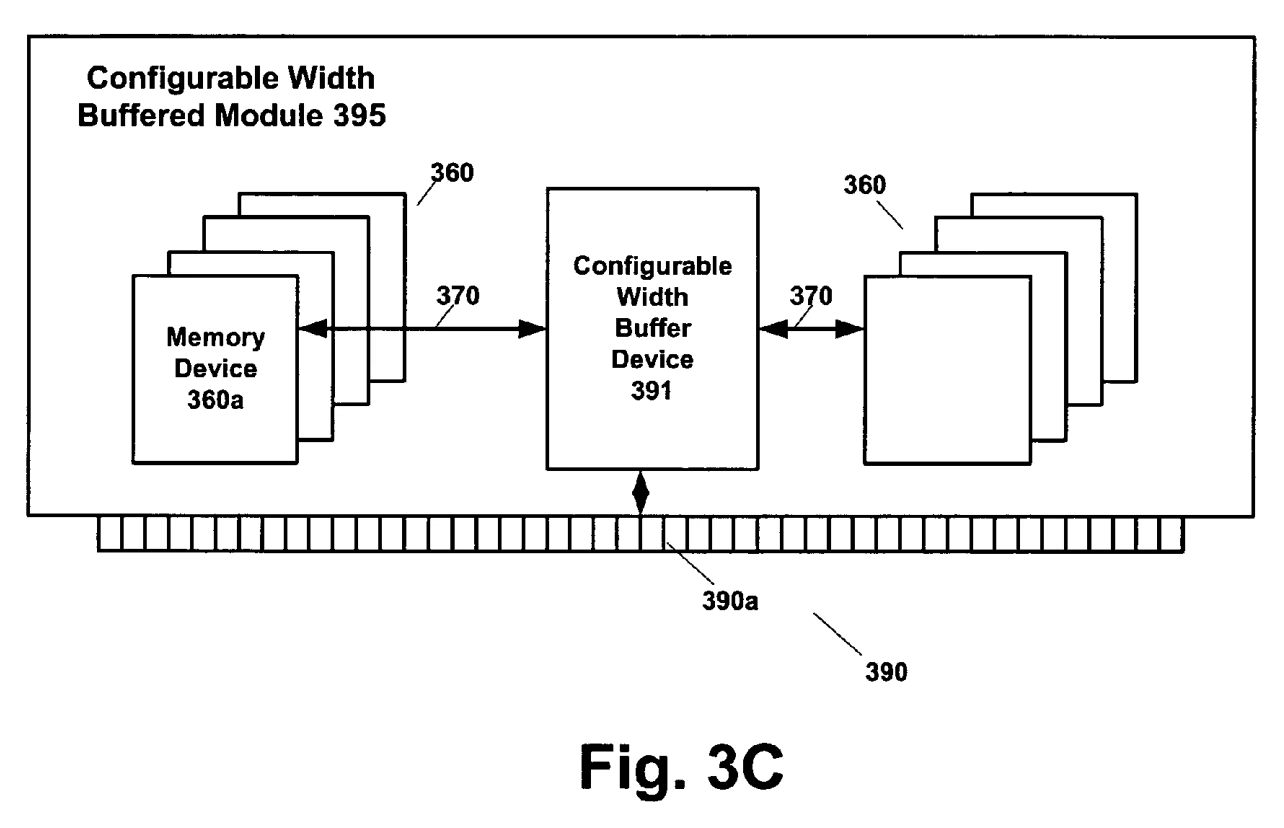
The court did not require preservation of Rambus compatibility where the claims did not require it. The question was why a skilled person would make the claimed combination, supported by JEDEC’s market position and the references. The court nevertheless recognized that loss of an original function can matter where that very function supplies the asserted reason to combine and the modification defeats it.
In practice, an objection that a change destroys a reference’s advantage needs another step. Identify the asserted reason to combine and explain why the change contradicts that reason. Distinguish a design trade-off sacrificing one advantage from destruction of the premise that makes the proposed combination work.
For circuits, analyse signal timing, electrical loads and conflicting control sequences to determine whether the combined system performs as claimed. This yields testable arguments rather than repeated assertions of different purposes or fields. A challenger likewise must do more than assemble components with hindsight; evidence should explain why a skilled person would have chosen the change at the relevant time.
Business risks included in the settlement price
Why could substantial settlements coexist with these weaknesses? Public materials do not reveal the parties’ internal valuations. But the choice was not limited to the ultimate outcome for one claim. With other patents and proceedings pending, supply risks and defence costs, companies compare continued litigation with the price of comprehensive resolution.
In September 2026, the ITC instituted a separate Netlist investigation involving Micron, HPE, Lenovo and Super Micro, among others. Netlist sought exclusionary relief. Institution did not establish infringement or an import ban; it showed that the dispute extended to both memory suppliers and downstream users. Update: the ITC terminated Investigation 337-TA-1523 following settlement by a determination issued November 19 and published November 24, 2026.
Risk assessment must therefore include redesign and customer requalification time as well as potential damages. Even a likely eventual court victory does not ensure customers will tolerate supply uncertainty until then. Public information does not permit allocation of a specific share of these settlements to such risks.
Samsung’s transaction also included supply and cooperation agreements. The former enabled Netlist to purchase DRAM and NAND products; the latter concerned provision of certain information and materials for future ITC proceedings against third parties. Their combined economic significance cannot readily be reduced to damages in one infringement action.
The amounts also differ in character. On a Netlist-receipts basis, Samsung agreed to $200 million upfront and up to $27.5 million for each of twenty quarters, subject to a sales formula and possible adjustments. Samsung’s burden including tax gross-ups is not identical to Netlist’s receipts. Comparing these figures directly with Micron’s $600 million treats transactions with different scopes, terms and conditions as equivalent.
From the first specification to the final agreement
The central warning for patent strategy is not to translate portfolio size directly into bargaining power. Multiple patents relying on the same initial disclosure and similar claims can be undermined together by the same defect or prior art. A large count does not by itself establish diversification.
Map the claims that restrict core product functions to the earliest filings that actually support them. Then examine infringement evidence and design-around difficulty. Even a sound priority date may deliver less bargaining value if infringement cannot be proven or a commercially acceptable change readily avoids the claims.
Settlement negotiations should decide when invalidity risk affects price. The parties can discount a fixed price upfront or provide adjustments triggered by later findings on specified key claims. The latter requires agreement on the claims, procedural stage triggering adjustment and calculation for partial invalidity. Leaving matters merely for future discussion can turn a settlement into the source of another dispute.
Licensees need certainty about covered products and future technologies. Patent owners need to know which payments survive losses in individual cases. The public Samsung agreement illustrates a negotiated allocation that separates individual patent failure from portfolio pricing.
The two documents worth returning to are the earliest specification and the final agreement. The former supports later-asserted scope; the latter assigns the economic burden when that scope fails. Connecting protection secured during prosecution with consideration promised in negotiation reveals both the achievements and limits behind a large settlement.