
Samsung Electro-Mechanics Patent Records: Jurisdictions, IPCs, and Status
This analysis covers 60,838 Samsung Electro-Mechanics-related patent records after deduplication of 60,906 source rows by jurisdiction code and application number. It examines application-year counts, jurisdictions, IPC classifications, records dated 2022 through 2024, and legal-status labels.
Samsung Electro-Mechanics or an equivalent Korean or English applicant form appears in 59,756 records, or 98.2% of the analytical set. The remaining records include joint applicants, related entities, naming variants, or records captured during collection. Applicant identity, ownership, legal status, claim scope, and remaining term require confirmation in the official record before legal use.
| Item | Data point | Methodological significance |
|---|---|---|
| Source size | 60,906 rows | The dataset includes publication, registration, and jurisdiction-level family records. |
| Analytical set | 60,838 records | Deduplicated by jurisdiction code and application number. |
| Samsung Electro-Mechanics-related records | 59,756 records (98.2%) | Korean and English applicant variants were normalized into one applicant group. |
| Annual-count period used | 1979-2024 | Records dated 2025 and 2026 were excluded from annual-trend interpretation because of publication delay. |
| Recent IPC period | 2022-2024; 5,774 records | The latest three complete application years used for the IPC comparison. |
Records by application year
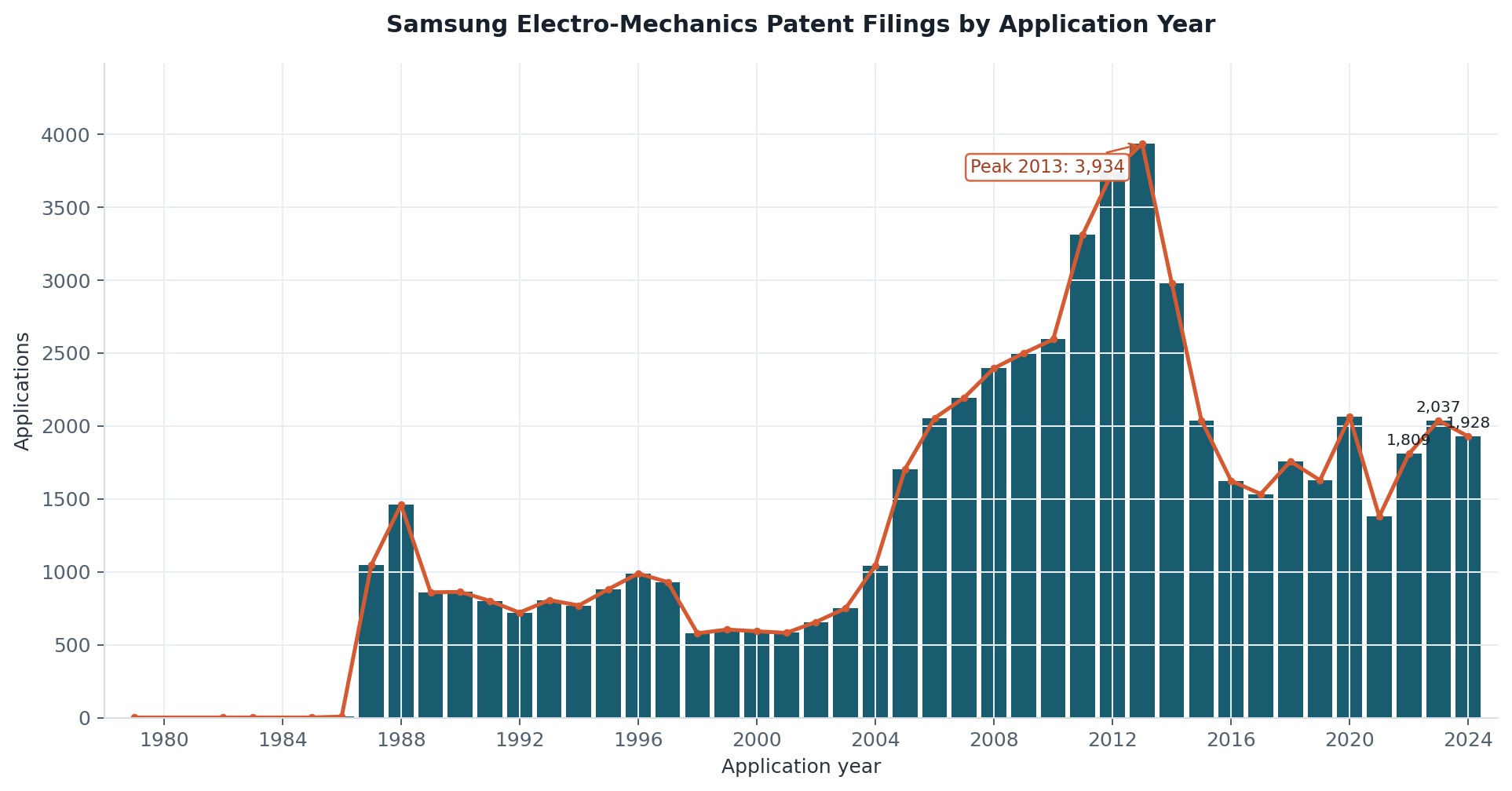
The annual count increased after 2005 and reached 3,313 records in 2011, 3,742 in 2012, 3,934 in 2013, and 2,978 in 2014. The 2013 count is the largest in the dataset. Records from this period include multilayer ceramic capacitors, substrates, camera modules, and optical components.
Later annual counts remain substantial: 2,061 records in 2020, 1,809 in 2022, 2,037 in 2023, and 1,928 in 2024. These data establish the number and subject matter of records in the dataset. They do not establish research expenditure, product adoption, or the commercial reason for a change in filing volume.
Records from the late 1980s concern early electronic components. The 2005-2014 records show broader filings in multiple component categories. Records dated 2022 through 2024 continue to concern passive components, optical systems, packages and substrates, inductors, and camera stabilization.
Jurisdictions
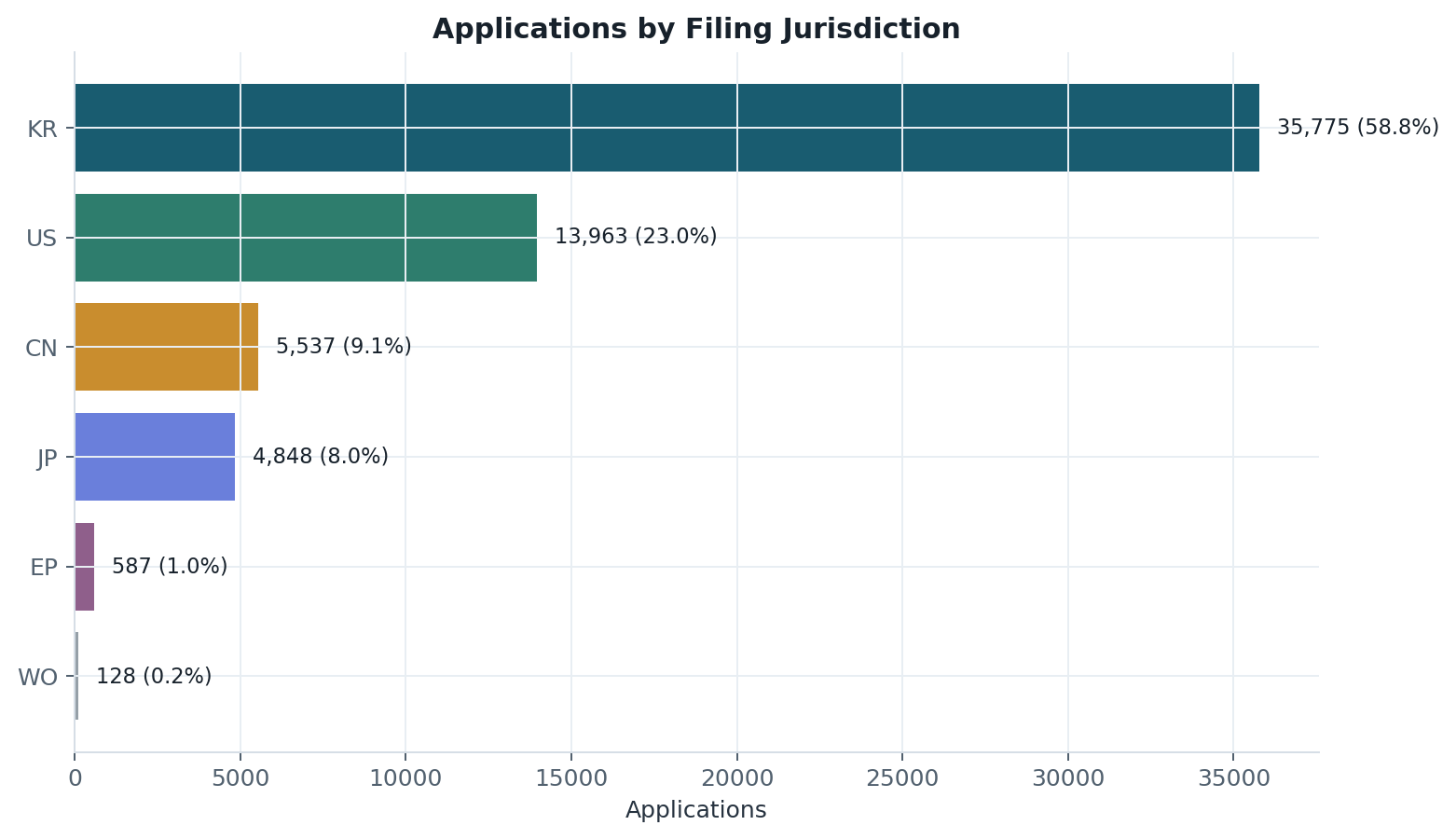
The analytical set contains 35,775 Korean records, 13,963 United States records, 5,537 Chinese records, 4,848 Japanese records, 587 European records, and 128 PCT publication records. Korea represents 58.8%, the United States 23.0%, China 9.1%, and Japan 8.0%.
The median number of jurisdictions recorded for a family is three. Multi-jurisdiction families represent 63.8% of the relevant family data, and families recorded in five or more jurisdictions represent 5.6%. These figures describe geographic coverage in the source data. They do not identify which members are pending or in force, and they do not establish the relative value of a family.
Capacitor classifications
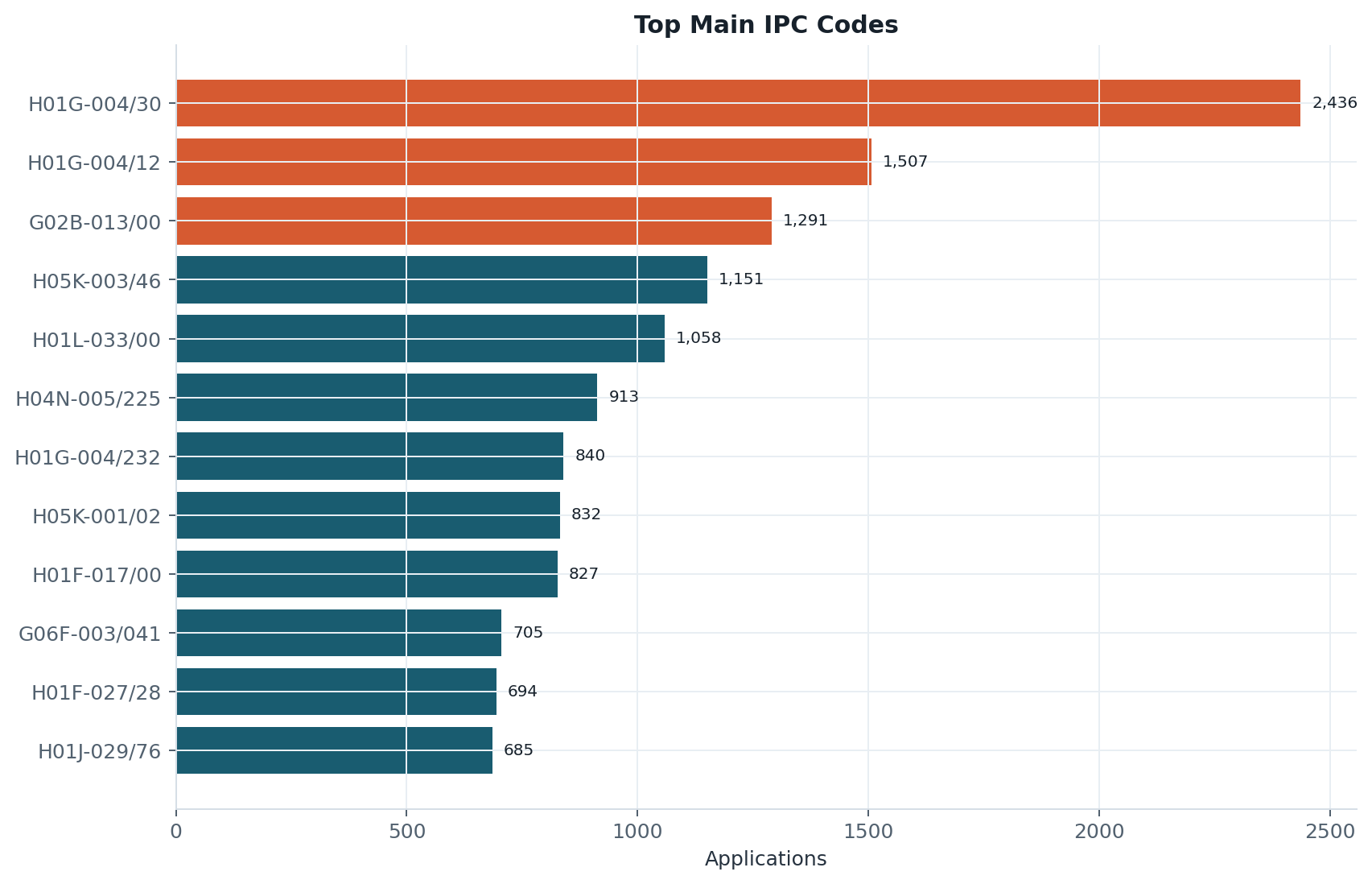
H01G 4/30 is the most frequent main IPC code, with 2,436 records. H01G 4/12 appears in 1,507 records, and H01G 4/232 appears in 840. These groups concern fixed capacitors, ceramic dielectrics, multilayer structures, and terminal arrangements. The records include structures, electrode configurations, dielectric materials, manufacturing methods, and reliability measures relevant to multilayer ceramic capacitors.
An IPC count does not state the scope of an individual claim. A clearance or validity review must identify the relevant independent claims, priority dates, prosecution history, and current legal status.
Optical systems and camera modules
G02B 13/00 appears in 1,291 records and concerns optical objectives or lens systems. H04N 5/225 appears in 913 records and includes image-pickup and camera arrangements under the applicable IPC editions. The associated records address lens configurations, image sensors, module structures, focus and stabilization mechanisms, and optical performance.
These classifications identify technical subject matter but do not show whether a claim reads on a particular camera module. Product-level analysis requires the claims and the physical or functional features of the relevant module.
Substrates, packages, and interconnections
H05K 3/46 appears in 1,151 records, H05K 1/02 in 832, and H05K 1/11 in 503. These groups include manufacture of multilayer circuits, printed-circuit structural details, and conductive connections. Records in these groups concern multilayer boards, package substrates, wiring and via structures, thermal performance, electrical connection, miniaturization, and reliability.
The broader IPC distribution also includes H01L semiconductor-device and package technologies, H01F inductor and magnetic-component technologies, and H04N imaging technologies. The portfolio data therefore covers several component categories rather than one product line.
IPC records dated 2022 through 2024
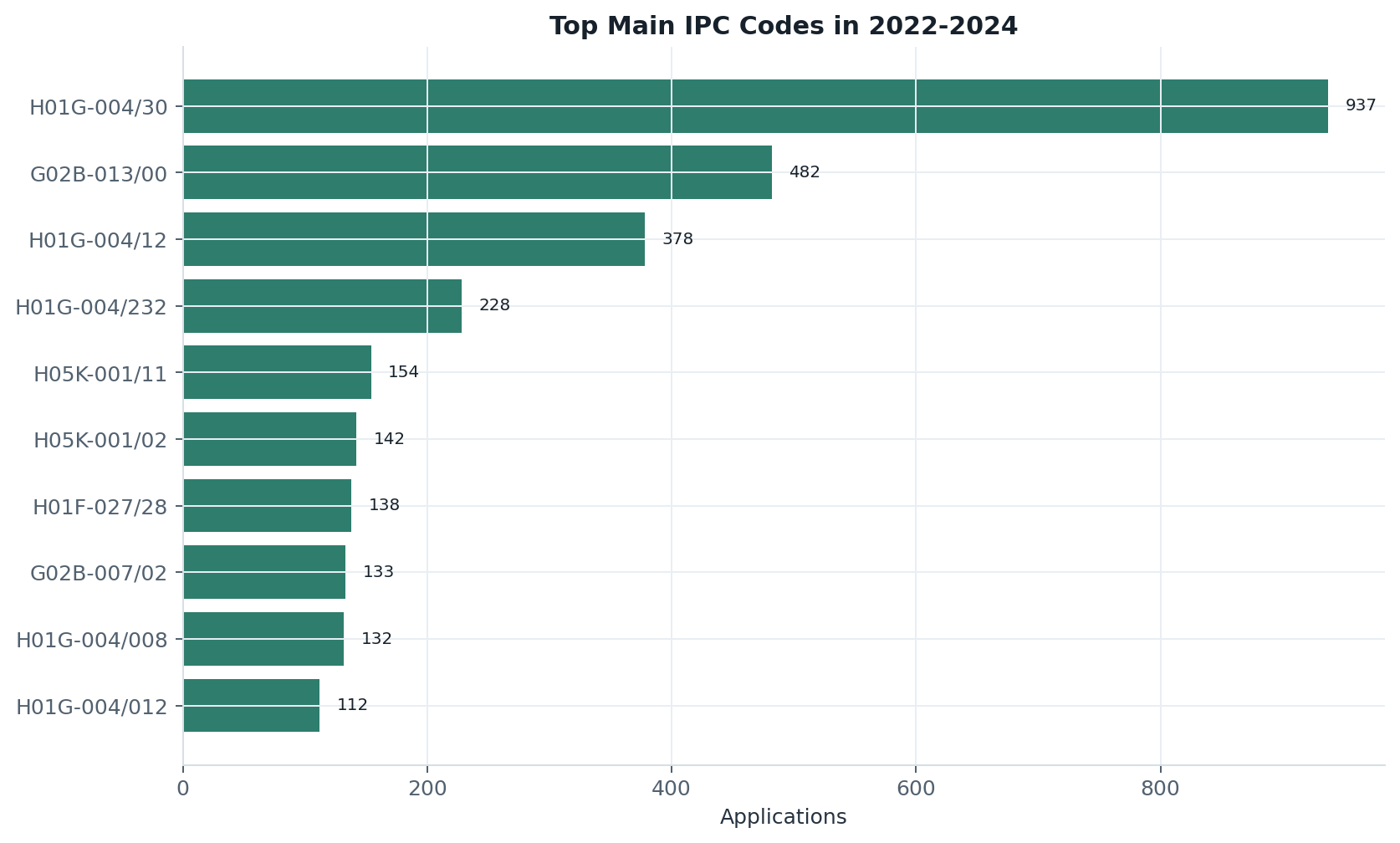
The 2022-2024 subset contains 5,774 records. H01G 4/30 appears in 937, G02B 13/00 in 482, H01G 4/12 in 378, and H01G 4/232 in 228. Capacitor and optical-system classifications therefore remain frequent in this recent complete-period subset.
H05K 1/11 appears in 154 records, H05K 1/02 in 142, H01F 27/28 in 138, G02B 7/02 in 133, and H04N 23/68 in 96. The classified subject matter includes substrate connections, circuit-board structures, coil windings, lens mounting, and camera stabilization or image stabilization.
These counts establish continuing patent activity in materials, structures, manufacturing processes, and component modules. They do not establish that software-related inventions are absent, that one component category is more commercially important than another, or that a counted record covers a current product.
Legal-status distribution
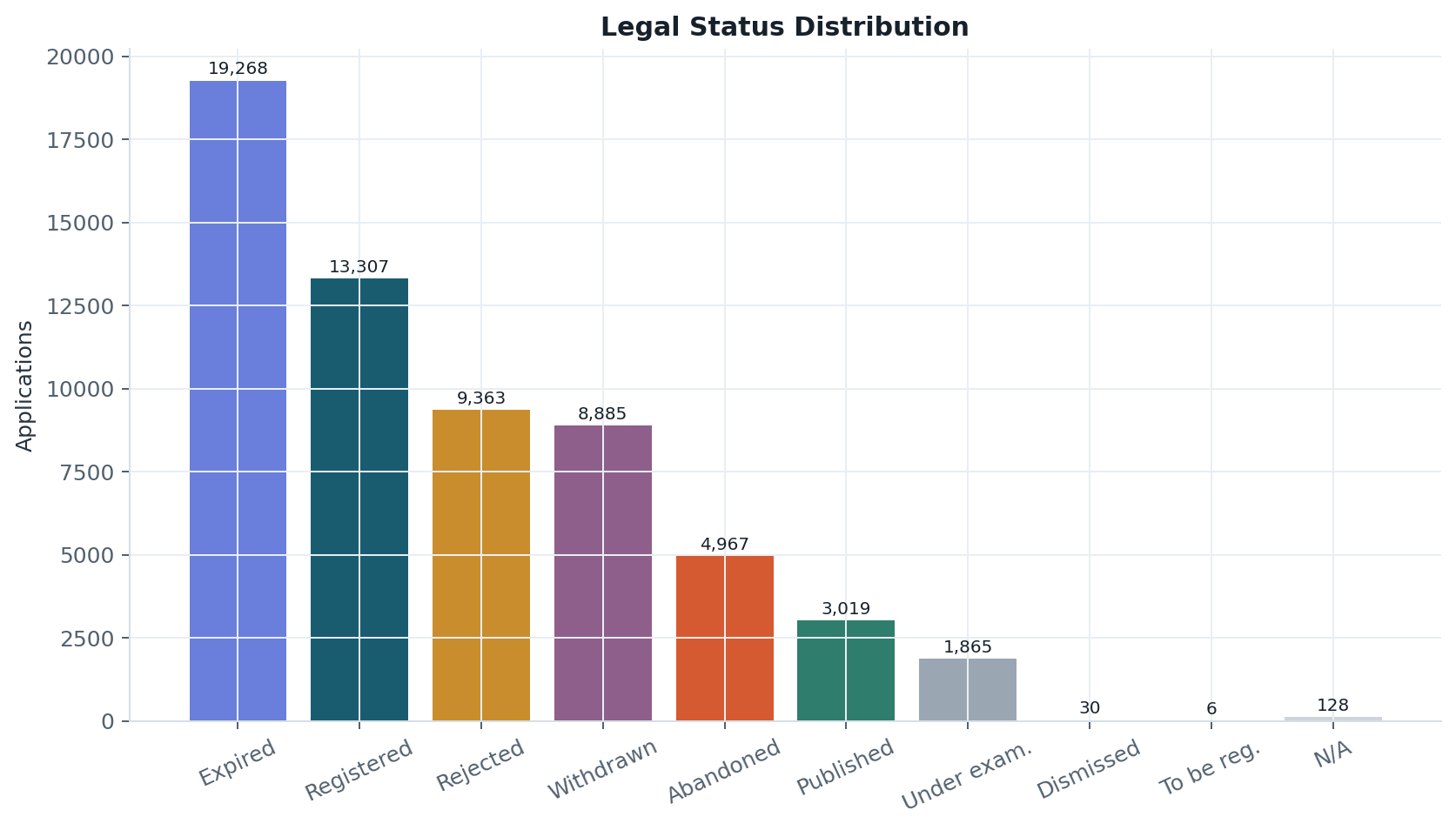
The dataset contains 19,268 expired records, 13,307 registered records, 9,363 rejected records, 8,885 withdrawn records, 4,967 abandoned records, 3,019 published records, and 1,865 records identified as under examination.
The large expired count is consistent with a dataset extending to 1979, but the status label does not state whether expiry resulted from the end of the patent term, non-payment, or another event. A registered label likewise does not establish that the patent remains in force or covers a current product. Remaining term, fee history, family status, divisional or continuation relationships, and claim scope must be checked separately.
Expired patents may be relevant as prior art and as technical disclosures available for further development, subject to any later improvement patents and other rights. Pending and in-force claims should be examined for freedom-to-operate work directed to a specific product and jurisdiction.
Portfolio review by technical feature
Business labels such as MLCC, substrate, camera module, and inductor are useful for portfolio administration, but claim analysis should be organized around the technical features that create legal scope. Those features may include material composition, electrode placement, multilayer configuration, thermal limits, reliability conditions, manufacturing steps, module fastening, optical arrangement, and control logic.
Foreign-filing review should consider the location of customers, manufacturing, competitor sales, and potential enforcement. Disclosure and foreign-entry deadlines should be docketed before sample delivery, joint development disclosure, trade-show disclosure, or production testing.
A periodic status review should distinguish rights that cover current products from rights directed to discontinued structures or processes. It should also identify pending matters in which a divisional, continuation, or follow-on filing may be available and justified by the product record.
Basis of analysis: pinepat1_concat_2026_07_07.xlsx provided on July 7, 2026. The source data may include publication and registration records, jurisdiction-level family records, duplicate records, and applicant-name variants. The figures in this article apply deduplication by jurisdiction code and application number and applicant-name normalization for analytical purposes. Claim scope, ownership, legal status, and validity require separate official-record review.