
From AFCP 2.0 Basics to Practical Strategies
Obtaining a 'Final Office Action' (Final OA) from an examiner during the U.S. patent application process is a challenge faced by many applicants. This means the examiner is expressing that it is no longer possible to accept new claims, and applicants typically face the crossroads of either applying for a reexamination (RCE) with additional costs and time, applying for an appeal under greater pressure, or unfortunately having to abandon the application.
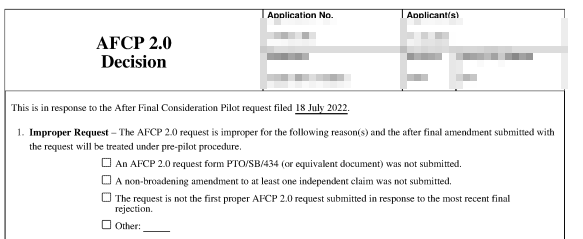
However, at this critical crossroads, the After Final Consideration Pilot 2.0 (AFCP 2.0) program offered by the United States Patent and Trademark Office (USPTO) can be a highly useful strategic card that, if used wisely, can be a highly useful strategic card to explore registration possibilities without RCE or appeal, saving both costs and time.
In this column, we comprehensively analyze everything needed to effectively utilize this system, from the basics of AFCP 2.0 to in-depth strategic insights based on the many years of practical experience accumulated by Pine IP Firm.
1. What is AFCP 2.0?
AFCP 2.0 allows applicants who have received a Final OA to submit a response including amendments to at least one independent claim at no additional cost to the examiner. Limited time (up to 3 hours for general patents, 1 hour for design patents) This is a pilot program that provides the opportunity to review the amendment and conduct an interview with the applicant (or representative).
Its core goal is Without going through the formal RCE procedure, we quickly converted final rejected applications into registerable status through relatively simple amendments and direct communication with examiners.It's about making them do it.
2. Basic Requirements for Using AFCP 2.0 - Checklist
To receive the benefits of AFCP 2.0, you must meet the following essential requirements.
- Period: You must submit a final rejection decision (Final OA) and submit a response (37 CFR 1.116 regulation) after receiving it.
- Calibration target: In the response form you submit, Correction for at least one independent claimmust be included. (Not allowed for adjustments to dependent ports)
- Calibration Range: The scope of the amended claims It must not be broader than the scope of existing claims. (No broadening)
- Examiner's judgment (very important):
- The submitted amendment proposal It should not require further search or substantial new consideration. It is so.
- Within the allotted time (3 hours / 1 hour), the examiner reviews amendments, searches additionally if necessary, prepares and conducts interviews, etc. Judged that everything can be completedIt must be done.
-> Core: The last two requirements are entirely at the discretion of the examinerIt should be kept in mind that it depends on the system.
3. Opportunities of AFCP 2.0: Advantages and Possibilities
When successfully utilized, AFCP 2.0 offers the following benefits.
- Cost savings: You can save significant fees incurred when applying for RCE (currently $1,370 or $2,050, Small/Micro Entity deductions).
- Time savings: You can quickly communicate with examiners without going through the RCE queue to expedite your registration decision.
- Critical interview opportunities: If the AFCP 2.0 request is approved, an examiner interview is strongly recommended. This is a crucial strategic opportunity to clearly explain the purpose of the correction, identify the examiner's hidden concerns, and make final coordination for registration.
4. In-depth Analysis 1: The Examiner's Perspective and the Reality of 'Simple Correction'
To increase the success rate of AFCP 2.0 beyond simply meeting the requirements, it is essential to understand the system from the examiner's perspective and grasp the true meaning of 'simple correction.'
- Understanding the Examiner's 'Count' System: USPTO examiners operate under a performance evaluation ('Count') system based on the number of cases processed. A successful AFCP 2.0 process (concluded with a registration decision) can provide examiners with an efficient opportunity to achieve 'Disposal' Count. Therefore, If it is determined that registration can be done with a minor correction,, Examiners may be more motivated to close cases through AFCP 2.0 rather than wait for RCE. On the other hand, if calibration requires even a bit more time and effort, the examiner may prefer to secure a new Count through RCE.
- The substantive meaning of 'simple correction': 'Simple' doesn't just mean less calibration.
- Clarity/Directness: Key Issues in the Reason for Rejection Resolve directly and clearlyIt must be done. Corrections that leave ambiguity or room for new interpretations are highly likely to fail.
- Hidden Complexity Boundaries: Even if adding certain terms may seem simple, if the term implies a comprehensive review of the specification or new searchability, it may be considered 'not simple.'
- Persuasive Opinion: You need to logically explain in your Remarks why this correction overcomes the reasons for rejection and why a new search/review is unnecessary.
5. In-depth Analysis 2: Maximizing Interview Utilization and Strategic Timing
AFCP 2.0 interviews are not just briefing sessions, but can serve as strategic negotiation venues to maximize your chances of registration.
- Maximizing Interview Utilization:
- Pre-alignment attempts: In some cases, it may be worth considering contacting the examiner before submitting your response to seek informal feedback on the direction of correction.
- Prepare for key questions: Prepare questions that confirm the examiner's final stance, such as "Did this correction address any concerns?", "Is there anything more needed for registration?"
- Flexible on-site response: If there are any shortcomings during the interview, flexibility is needed to suggest acceptable additional revisions on the spot and seek consent.
- Strategic Timing:
- 'When I'm almost there': It is most effective when there was positive interaction during the review process, the remaining issues are clear, and simple corrections can resolve the issue.
- After a failed Pre-Appeal: If you failed to clearly point out the error in a pre-appeal but can be resolved with some compromise, it is useful as a last attempt before RCE/appeal.
6. Practical Procedures and Expected Outcomes
- Final OA Analysis and Strategy: After analyzing the reasons for rejection, we determine whether a simple correction can resolve the issue and whether AFCP 2.0 is appropriate.
- Preparation of amendments and submission of response form: Formally request participation in AFCP 2.0 using the USPTO form (recommended PTO/SB/434) along with response 37 CFR 1.116, including independent port corrections, Be sure to request an interviewIt is so.
- Examiner's Decision and Follow-up:
- Approval: After reviewing the amendments, the examiner conducts the interview. The outcome is either a Notice of Allowance or an Advisory Action (if there is still an issue or a time out).
- Decline: Notify you of reasons why AFCP 2.0 is not possible through Advisory Action. In such cases, follow-up actions such as RCE and appeals must be taken within the deadline.
7. Final advice for successful AFCP 2.0 utilization
- Proactive Response: By predicting the possibility of final rejection during the review and preparing a 'simple correction' scenario or fallback position in advance, you can respond quickly and effectively.
- Realistic expectations: AFCP 2.0 is not a cure-all. Be aware that the success rate may not be high, and if you fail, you should have a plan to immediately switch to RCE or appeal (Plan B).
- Comparison with alternatives: It is essential to clearly understand the objectives and pros and cons of AFCP 2.0 (Resolution of Minor Issues/Cost Savings), RCE (Opportunity for Substantive Correction/Reexamination), and Appeal (Challenge of Principles/Facts), and choose the optimal strategy suited to the current situation.
A strategic choice beyond simple procedures
AFCP 2.0 is undoubtedly an attractive system that saves costs and time in the challenging situation of final refusal decisions while exploring enrollment possibilities. However, beyond simply following procedures, it is important to understand the examiner's perspective, objectively assess the actual effectiveness of corrections, and strategically utilize interviews. Advanced practical knowledge and strategic judgmentThis is required.
Pine IP Firm takes into account these complex and subtle aspects to provide optimal U.S. patent strategy consulting, including the use of AFCP 2.0, to ensure the best outcomes for your valuable invention. If you are struggling before a final decision to reject the decision, please do not hesitate any longer and knock on the door of our Pine IP Firm. With extensive experience and deep insights, we will help you secure your successful rights