
K-Discovery: What is changing is not the 'litigation system,' but 'evidence governance'
The essence of Korean-style discovery, or KR Discovery, is not the import of American-style extensive pre-trial discoveries. Rather, it is closer to a restrictive, purpose-based evidence collection device controlled by the court. The Intellectual Property Office also explained in past explanatory materials that the "American-style Discovery," where litigants mutually disclose evidence and information, differs from the Korean evidence collection system, and that discussions have focused on strengthening German-style expert evidence investigations and existing data submission orders.
This difference is very important for patent attorneys. KR Discovery is not a system that allows more access to the other party's data, but rather a management risk institutionalization where internal technical documents, design documents, source code, process data, transaction data, meeting minutes, emails, and test reports can be called up as legal issues at any time.
1. Patent Law Is Not Yet 'Before Full Introduction'; Win-Win Cooperation Law 'First'
First, you need to accurately distinguish the state. Currently, the Patent Law already requires Obligation to Present the Content, Method, and Form of the Specific Actexists. A party who denies the specific content, method, or form of the infringing act claimed by the patent holder, etc., must present the specific content, method, or form of their act, and if not presented without justifiable reason, the court may recognize the rights holder's claim as true. Additionally, Article 132 of the Patent Act imposes requirements for submitting materials necessary for proof of infringement or calculating damages, restrictions on the scope of inspection of trade secret materials, and sanctions for recognizing facts if the order is not accepted. Furthermore, for intentional patent infringement, a structure is already in place that allows compensation amounts up to five times the recognized damages.
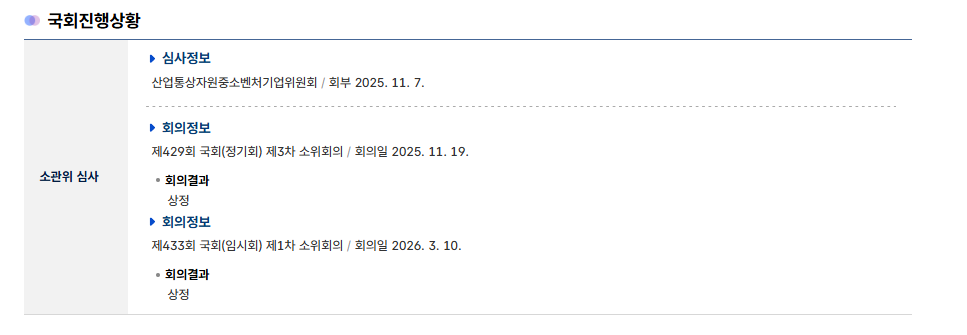
However, the core package of the "KR Discovery" that Inhouse refers to, Expert fact-finding, recording statements outside the courtroom, order to preserve materialsis not yet a system officially enforced under the Patent Act, but falls within the scope of the introduced legislation. The partial amendment bill to the Patent Act, proposed on November 6, 2025, mainly includes orders to preserve materials, court examinations, expert fact-finding investigations, exclusion of legal documents from investigations, and improvements to submission and confidentiality orders. It is confirmed to be submitted to the National Assembly subcommittee on March 10, 2026.
On the other hand, Win-Win Cooperation Actthe KR Discovery-type system was first legislated. The Ministry of SMEs and Startups announced that on January 29, 2026, the amendment to the Win-Win Cooperation Act passed the National Assembly plenary session, and that a three-part package has been prepared: expert fact-finding, questioning of the parties involved, and order to preserve materials. According to the National Law Information Center, the relevant partially amended law is marked as promulgated on February 19, 2026, and as effective February 20, 2028. In other words, while the full introduction of the Patent Act still requires legislative tracking, the direction for disputes over technology theft and misuse of technical data has already been set.
2. The oldest bottleneck in patent infringement lawsuits is that 'infringers have evidence'
The biggest challenge plaintiffs face in patent infringement lawsuits lies more in facts than legal principles. Especially in areas where it is difficult to directly observe the infringement structure from outside, such as B2B products, software, manufacturing methods, semiconductor and display processes, and bio-manufacturing processes, key evidence of infringement and damage is concentrated within the defendant. The Office of Intellectual Property explains that most evidence of infringement and damages in patent infringement lawsuits is pervasive to the infringer, and that B2B product, software, and manufacturing method patents are difficult to prove unless the infringer voluntarily submits materials.
More importantly, statistics already show dissatisfaction on the corporate floor. According to data from the Intellectual Property Office, 73% of companies experienced patent infringement lawsuits faced difficulties in securing evidence during litigation, and 96.7% responded that improvements to the evidence disclosure system are necessary. No matter how much the damages system is strengthened, if evidence proving the amount of damages and the infringement is not presented in court, the system remains a mere declaration. KR Discovery targets this gap.
3. Structure of the Patent Law Amendment Proposal
There are three main points in the proposed patent law amendment.
First, Expert Fact-Findingc. A structure where experts designated by judges collect and investigate data at the infringement site under certain conditions, and the results can be used as evidence. The requirements explained by the Intellectual Property Office in the amendment are potential infringement, necessity of investigation, degree of burden on the counterparty, and subsidiarity. Expert candidates include technical psychologists, expert psychologists, lawyers, and patent attorneys. Violations of the duty to cooperate with investigations will result in fines of up to 100 million won for corporations and up to 50 million won for individuals, along with recognition of fact penalties.
Second, Recording of statements from outside courtc. To clarify the issues and evidence of the lawsuit, statements between parties are recorded and recorded under the supervision of court staff, and the results are used as evidence. Under the proposed structure, the court can determine the scope, method, and location of questioning upon request by the parties, and for smooth proceedings, an order to appoint a lawyer is also planned.
Third, Data Preservation Order. This system requires the court to preserve materials necessary for proof of infringement or calculation of damages to prevent the loss, damage, or use of evidence. The amendment sets a retention period for materials within one year when infringement lawsuits or injunctions have been filed, or where a lawsuit is highly likely, and in cases of material damage, a finding of fact and criminal sanctions are planned.
All three devices differ from American-style discovery in that they are not "extensive document exchanges" but rather "case-by-case evidence collection controlled by the courts." However, the tension within the company is by no means small.
4. The role of patent attorneys shifts from 'litigation support' to 'evidence design'
In the KR Discovery era, patent attorneys are not simply those who hand over patent specifications, opinion submission notices, registration notifications, or prior art to external agents. Now, patent attorneys must be the owners of the following four questions.
First, are our rights designed to be evidence-friendly?
Manufacturing Method·Server Internal Processing· For inventions that are difficult to observe externally, such as AI models and semiconductor processes, it is necessary to consider from the rights acquisition stage "which materials will be key to proving infringement in future lawsuits." The claims should be broad, but at the same time, there must be links to prove infringement. A portfolio strategy that leaves traceable points such as product appearance, logs, test reports, specification documents, certification materials, delivery specifications, user manuals, API documentation, and process outputs becomes important.
Second, in attack cases, the 'need for investigation' comes before 'infringement claims.'
Applying for an expert fact-finding is not enough with mere suspicion. The amendment must pass the premise of possible infringement, the need for investigation, the burden on the other party, and subsidiarity. Therefore, before litigation, in-house parties must document not only the claim chart but also "why this material must be inside the other party," "why it is difficult to prove by other means," and "how to minimize the scope of investigation." Going forward, a good breach analysis opinion should include not only a claim response table but also an evidence collection roadmap.
Third, in defense cases, 'document guidance' comes before 'submission of materials.'
From the defendant company's perspective, it is necessary to identify in advance what materials are located where, who has access them, what retention periods they have, and whether they contain trade secrets, personal information, or third-party secrets. R&D servers, PLM, ERP, MES, Git, Jira, email, messengers, test equipment logs, quality documentation, and partner portals all serve as potential evidence repositories. Only after a data preservation order is issued can IT, security, and If you call R&D, it's too late.
Fourth, patent attorneys must provide technical language for trade secret defense.
The revision discussions include measures reflecting industry concerns, such as excluding legal documents, exclusion or recusal of experts, objections to investigation decisions, restrictions on viewing documents containing trade secrets, and confidentiality orders. However, in actual cases, the question of "what constitutes a trade secret," "which parts are necessary for infringement determination," and "in what form masking, summarization, or alternative submission is possible" lacks persuasiveness without explanations from patent attorneys who understand the technology.
5. Six things to prepare now within your company
From the patent attorney's perspective, KR Discovery's response is not a post-litigation project but ongoing compliance.
- IP Litigation Hold Protocol
If specific triggers occur, such as receiving a violation warning letter, requesting an appraisal report, analyzing competitors' products, failing license negotiations, or reporting technology theft, procedures must be implemented to stop automatic deletion, overwriting, or destruction of related materials. - Log management of receipt and provision of technical documents
In particular, joint development, PoC, OEM· In ODM, contract manufacturing, sample evaluation, and NDA meetings, it is necessary to record who received which materials and under what purpose and conditions. Since the amendment to the Win-Win Cooperation Act will first take effect in disputes over the misuse of technical data, records of the receipt, storage, and use of partner companies' technical data serve as defensive evidence. - Product and Process Explanation Package for Patent Infringement Defense
When sued, the claim "We are different" must be regularly organized with non-infringement documentation, design change history, alternative process data, and specification change approval documents that can technically explain the claim "We are different." - Trade Secret Classification and Submission Strategies
Claiming all materials as "trade secrets" weakens persuasiveness. Core process conditions, costs, customer information, algorithms, source code, production yield, supply chain data, and other factors should be graded, and the possibility of restricting viewers, allowing external experts to view, masking, or submitting summaries should be reviewed in advance. - External Agent-In-House-Engineer Communication Rules
Even if legal documents are designed to be excluded from investigation, conflicts arise if technical review memos and legal advisory memos are mixed. There need to establish document preparation rules that separate communication for legal review purposes, purely technical review, and business decision documents. - Incorporating evidence strategies at the portfolio stage
From the filing stage, a set of claims that can prove infringement in the future, dependent claims that can be connected by indirect evidence, and a combination of claims for products, processes, systems, and recording media must be designed. KR Discovery is not a system to remedy inadequate claims, but rather a mechanism to enhance the effectiveness of well-designed rights.
6. The Advantages and Disadvantages of the System
KR Discovery can clearly be a powerful tool for patent holders. In particular, in cases where evidence of infringement is within the defendant, such as manufacturing methods, software, process inventions, or B2B components, the possibility of substantive remedies increases. The Office of Intellectual Property presents expected effects of introducing the system as realistic compensation amounts, shorter litigation periods, and increased winning rates for patent holders.
However, the defendant company's burden is also realistic. As the scope of expert fact-finding investigations expands, concerns about trade secret leaks, investigation response costs, forensic costs, and employee testimony risks increase. The Legal Newspaper also reported that if the system is fully implemented, foreign companies or patent giants may engage in lawsuits against Korean firms, and that there is a need for a comprehensive review of compliance and evidence management systems.
Therefore, patent attorneys should not be viewed merely as "rights holder-friendly reforms," but as an opportunity to change the evidence management structure across their entire business divisions. Companies exercising patent rights will eventually become defendants. Offensive and defensive strategies stand on the same governance framework.
Conclusion
KR Discovery is highly likely to change the grammar of Korean patent litigation. In the past, there were many cases where suspected violations were abandoned because they could not access internal data. In the future, if the court recognizes necessity and scope, experts may access the site, materials will be preserved, and party statements may be recorded.
However, this system is only an opportunity for prepared companies. The rights holder must prepare a framework of evidence to persuade the need for investigation, and the defendant must prepare a map of materials and logic to defend trade secrets to control the scope of the investigation.
From the perspective of Pine IP Firm, the core competency in the KR Discovery era is not "the ability to respond when litigation occurs." The core is The ability to design technology, patents, records, trade secrets, partner documents, and legal advice as a single evidentiary governance system even before litigation occurs.. In future patent disputes, companies that have both good claims and effective evidence management systems will prevail.