
Patent Invalidation Trials in Korea: Grounds, Procedure, and Case Strategy
A Korean patent invalidation trial determines whether an issued patent should be invalidated on a statutory ground. It is an inter partes proceeding before the Intellectual Property Trial and Appeal Board (IPTAB), not an infringement action in a civil court.

An invalidation petition may be filed in response to an infringement allegation, but it is also used to address a blocking patent before product launch, licensing, or investment. The filing decision should be based on a claim-specific validity analysis rather than the existence of a commercial dispute alone.
Legal basis and effect

Article 133 of the Korean Patent Act permits an interested party or an examiner to petition for invalidation. For a patent with multiple claims, invalidation may be requested claim by claim. A petition may also be filed after the patent has expired.
When a decision invalidating a patent becomes final and conclusive, the patent is generally deemed never to have existed. Article 133 provides an exception for specified grounds that arise after grant: in those cases, the right is deemed not to have existed from the time the ground arose. The final decision's effect must therefore be analyzed by claim and by invalidity ground.
Invalidation and infringement address different issues. An invalidation trial concerns the legal existence of the patent claim. An infringement action concerns acts within the claim's scope, available defenses, and remedies. The proceedings may affect each other, but filing an invalidation petition does not automatically resolve or stay every related civil action.
Standing and scope of the petition
The petitioner ordinarily must be an interested party. Standing should be supported by the commercial or legal relationship to the patent, such as an infringement allegation, competing product, license negotiation, or other concrete effect. For certain entitlement grounds, Article 133 limits the petitioner to the person holding the right to obtain the patent.
The petition must identify the challenged patent and claims, each statutory ground, the supporting facts, and the evidence. A broad assertion that the patent lacks inventive step is insufficient. Each challenged claim should be mapped to the relied-on evidence and legal test.
Frequently asserted invalidity grounds
Lack of novelty
Under Article 29(1), a claim lacks novelty when a single item of prior art discloses every claimed element or step as required by the applicable test. The petitioner must establish the reference's public availability before the relevant filing or priority date and show the claimed correspondence. Foreign documents require a reliable translation and a clear record of publication or public use.
Lack of inventive step
Article 29(2) applies when a person having ordinary skill in the art could readily have made the claimed invention from the prior art. The analysis should define the skilled person and common general knowledge, identify the closest or principal reference, state the differences, and explain why the proposed modification or combination would have been made. The patent owner should address both the asserted motivation and the technical effect of the differences.
Specification and claim defects
Article 42 grounds include failure to describe the invention clearly and sufficiently for a skilled person to carry it out and failure of the claims to satisfy applicable support and clarity requirements. The analysis depends on the technology's predictability, the breadth of the claim, working examples, definitions, and the level of experimentation required.
Entitlement, first-to-file, and added matter
Article 133 also covers specified defects concerning entitlement to the patent, joint applications, first-to-file requirements, prohibited subject matter, treaty obligations, and amendments or divisional or converted applications that exceed the permitted scope. The available petitioner and evidence may differ by ground.
Unity of invention is not listed in Article 133 as a general post-grant invalidity ground. A prosecution objection should not be carried into an invalidation petition without confirming that the Patent Act expressly makes it a ground for invalidity.
Procedure before the IPTAB
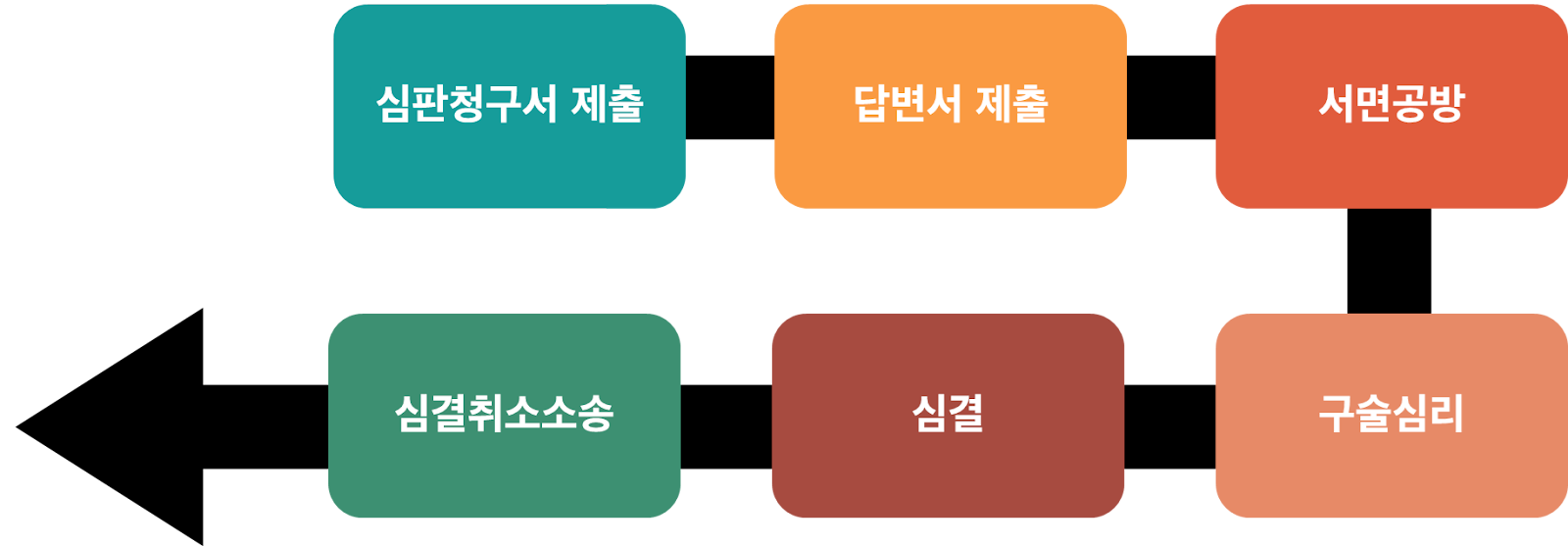
- Petition. The petitioner files a written request identifying the claims, grounds, facts, and evidence.
- Service and response. The IPTAB serves the petition on the patent owner and sets a period for a response.
- Correction request. Under Article 133-2, the patent owner may request correction during the invalidation trial within the designated period and for the purposes permitted by the correction provisions. A correction may narrow a claim, correct an error, or clarify an unclear statement, but it may not introduce impermissible new matter or improperly broaden the claim.
- Written submissions and evidence. The parties address claim construction, technical facts, prior-art status, expert opinions, experiments, and the effect of any proposed correction.
- Oral hearing. The panel may hold an oral hearing. The presentation should follow the claim chart and identify the points that require technical explanation or evidentiary findings.
- Decision. The panel decides the challenged claims and the asserted grounds. A claim may survive even when another claim in the same patent is invalidated.
Patent Court and Supreme Court review
A party seeking cancellation of an IPTAB decision must file an action in the Patent Court within 30 days after service of the certified copy of the decision. Under Patent Act Article 186, this is an invariable statutory period, subject only to an additional period set under the statute for specified circumstances. A Patent Court judgment may be appealed to the Supreme Court.
The Patent Court action reviews the legality of the IPTAB decision. The trial record should therefore identify the claim construction, evidence, objections, and alternative positions that may later require judicial review.
Petitioner's case preparation
- Confirm the commercial objective. Invalidation may remove one patent, but it does not establish freedom to operate against other patents or regulatory rights.
- Search by claim limitation. A search should cover each limitation, alternative terminology, prosecution history, family members, cited references, products, and non-patent literature.
- Prove the date and content of evidence. Web materials, catalogues, demonstrations, and public-use evidence require authentication and a reliable timeline.
- Prepare separate novelty and inventive-step analyses. The legal tests and evidentiary burdens are different.
- Anticipate correction. Assess narrower claims that the patent owner may propose and locate evidence addressing those fallbacks.
- Coordinate related proceedings. Claim construction and technical positions should remain consistent across invalidation, infringement, customs, licensing, and foreign proceedings.
Patent owner's response
- challenge the petitioner's standing where there is a factual basis;
- contest the publication date, admissibility, translation, or technical content of the evidence;
- identify missing claim elements and unsupported combinations;
- submit evidence of technical prejudice, unexpected effects, or other relevant objective considerations;
- evaluate correction early and preserve support for each proposed amendment; and
- manage admissions consistently with related infringement and foreign proceedings.
Official sources
- IPTAB guidance on inter partes trials and invalidation
- Korean Patent Act, National Law Information Center
This article provides general information. Standing, grounds, correction options, evidence, deadlines, and coordination with infringement proceedings should be assessed on the facts of the specific dispute.