
Generative AI Patents Nearly Tripled in Two Years: AI Patent Strategy Through WIPO’s 2026 Data
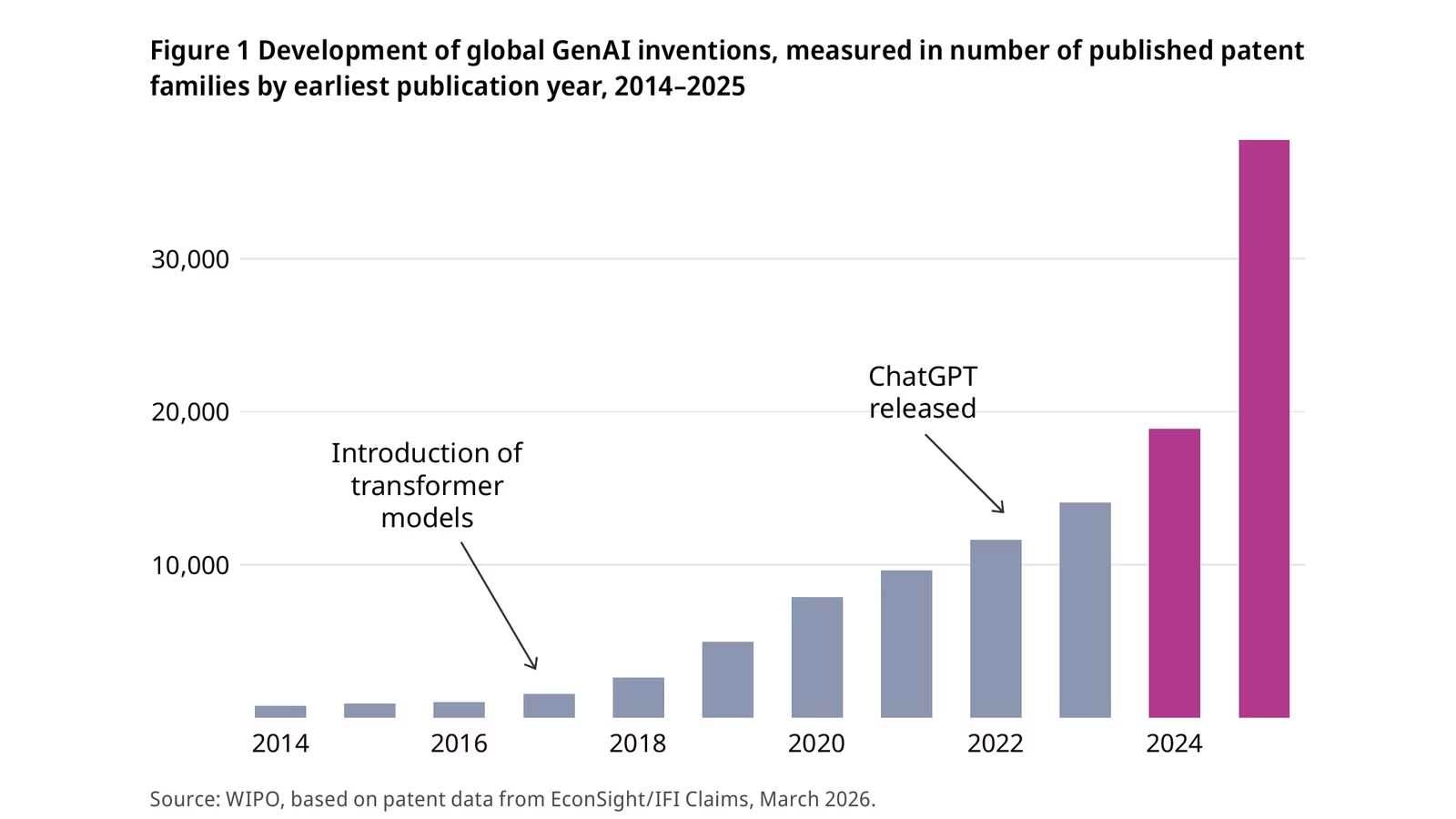
Figure 1. Worldwide trend in published generative AI patent families. Source: WIPO, Patent Trends Update in GenAI (2026), Figure 1.
Competition in the generative AI market is shifting from a race to launch services into a race to secure patents first.
According to the latest data published by the World Intellectual Property Organization (WIPO) in 2026, the number of published generative AI (GenAI) patent families worldwide increased from about 14,000 in 2023 to 37,808 in 2025—roughly 2.7 times higher in only two years.
Another figure deserves even more attention. More than 56,000 GenAI patent families were published in 2024 and 2025 alone, exceeding the total published during the ten years from 2014 through 2023. GenAI’s share of all AI patent families also rose from 4.2% in 2017 and 6.1% in 2023 to 8.7% in 2025.
This is more than a simple increase in the number of “AI patents.”
Pine IP Firm is particularly focused on the fact that companies are rapidly seeking protection not only for core GenAI technologies, but also for the ways in which GenAI is applied to real businesses and industries. This shift is likely to affect the AI patent strategies of Korean startups and companies directly.
1. Why did generative AI patents suddenly surge?
One point is essential when reading patent statistics.
WIPO’s figures count published patent families, not individual patent applications. When the same or closely related invention is filed in several countries, those filings are grouped as one family of inventions.
Patents are also not generally published immediately after filing.
WIPO emphasizes the usual lag of about 18 months between patent filing and publication. In other words, much of the explosive growth visible in 2024–2025 patent data can be understood as the delayed appearance of R&D and patent filings that companies began in earnest after ChatGPT emerged in late 2022.
The current statistics are therefore both a record of past activity and a leading indicator of future competition.
The center of gravity in GenAI is also moving beyond simple text generation. The range of applications is expanding rapidly into multimodal AI, reasoning AI, AI agents, code generation, image and video generation, and industry-specific AI. WIPO identifies agentic AI—systems that plan tasks and carry out multiple steps autonomously—as a defining trend of 2025, and reports early patent activity by companies including Alphabet and Nvidia.
Patent competition is no longer just about who can build a better AI model.
It is expanding into a contest over who can connect AI to actual work, products, and processes more effectively—and who can patent those connections first.
2. Why SoftBank, not OpenAI, leads the GenAI patent ranking
One of the most interesting parts of WIPO’s report is its ranking of patent owners.
On a cumulative publication basis for 2014–2025, Japan’s SoftBank ranked first worldwide with 2,985 GenAI patent families. Virtually all of them were filed in 2023 and published in 2025.
Chinese companies such as Tencent, Ping An, and Baidu followed, while U.S. companies including Alphabet (Google), Microsoft, and IBM also ranked near the top.
There is an important point here.
OpenAI, one of the world’s best-known generative AI companies, is not the overwhelming leader by patent count.
WIPO’s analysis puts OpenAI’s global patent filings at about 35 as of the end of 2025, far below the scale of Alphabet, Microsoft, Tencent, and others. WIPO reports that OpenAI’s patents focus on particular product-level technologies, including multimodal interfaces, code generation, image generation, and text editing.
This offers an important lesson for AI companies’ intellectual-property strategy.
Not every company protects its competitive advantage in the same way. For some technologies, publication in exchange for exclusive patent rights is advantageous. For technologies that are difficult to reverse engineer—such as model parameters or data-processing know-how—trade-secret protection may be more suitable.
The GenAI era therefore calls for more than a simple strategy of filing as many patents as possible. It makes IP portfolio design that separates technologies to be patented from technologies to remain trade secrets increasingly important.
3. China’s lead, Japan’s rapid rise—and Korea
Country-level patent data shows the pace of competition even more clearly.
More than 43,000 GenAI patent families attributed to inventors in China were published during 2024–2025, placing China far ahead of every other country.
Recent growth rates, however, reveal another shift. According to WIPO, the compound annual growth rate (CAGR) of GenAI patent families from 2023 to 2025 was 64% for China and 92% for the United States, while Japan recorded an extraordinary 210%.
Japan consequently overtook Korea to rank third by inventor location. South Korea, by contrast, recorded a CAGR of about 21% during the same period and fell from third to fourth place.
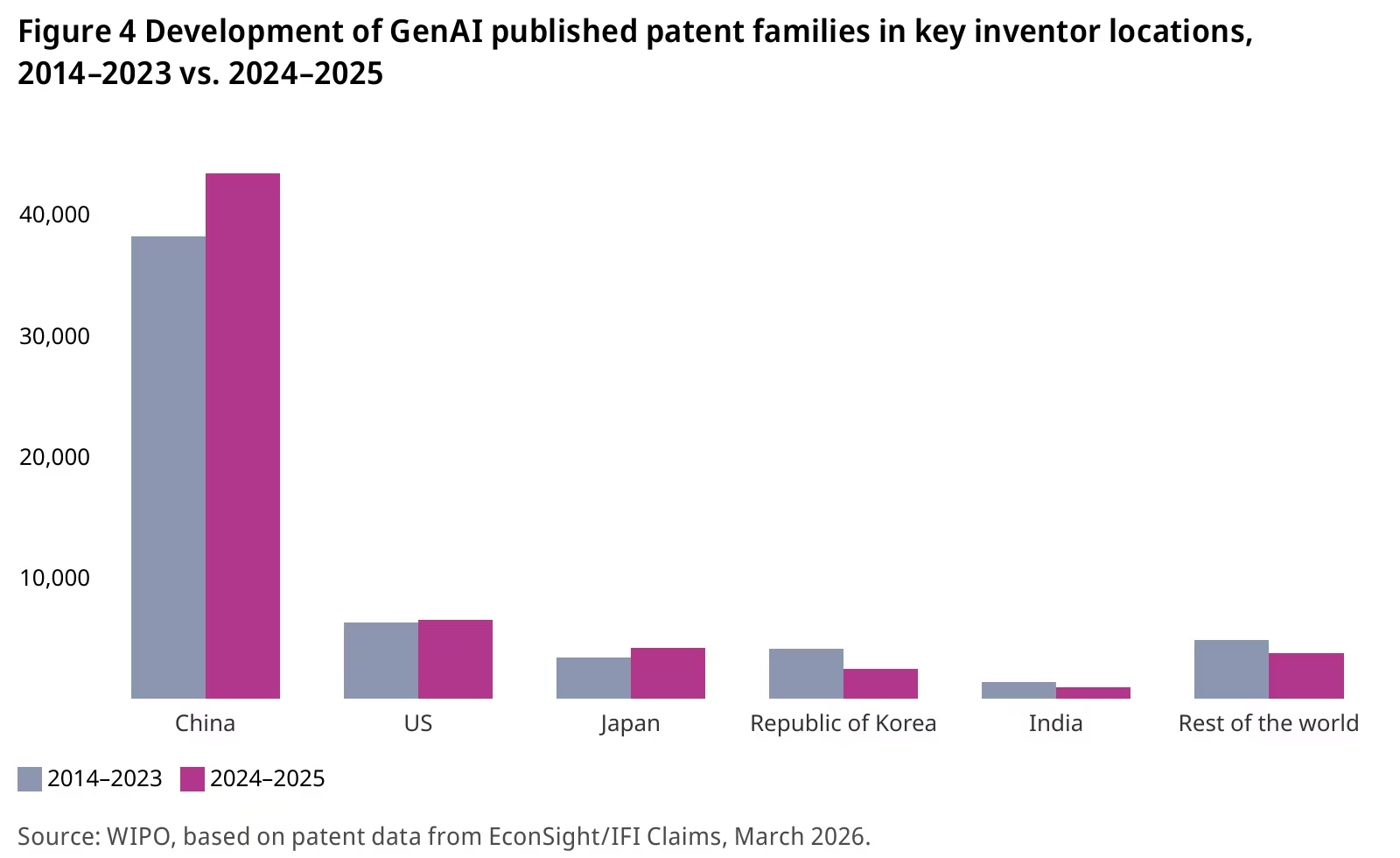
Figure 2. GenAI patent families by major inventor location. Source: WIPO (2026), Figure 4.
These figures should not be oversimplified as evidence that Korea’s AI capabilities have sharply declined.
Japan’s surge was driven heavily by SoftBank’s publication of about 3,000 GenAI patent families in 2024–2025. WIPO itself notes that Japan’s growth would look substantially different without SoftBank.
The more important issue is not the ranking itself, but the pace at which patent rights are being secured.
Prior patents in GenAI are accumulating every day. If a company that has delayed filing for two or three years later seeks protection for an important technology, a large body of similar prior patents may already exist, narrowing the scope it can obtain.
This is precisely why AI companies should not treat product development and patent filing as separate processes.
4. The center of AI patents has shifted decisively from GANs to LLMs
One of the report’s most important technical changes is the rapid growth of LLM patents.
Generative adversarial networks (GANs) once accounted for a substantial share of GenAI patents. The position has now reversed.
For 2014–2025, WIPO identified about 20,900 LLM-related patent families, compared with about 18,800 for GANs.
The gap is much larger when 2025 is considered alone:
- LLM-related patent families: about 14,100
- GAN-related patent families: about 5,245
LLM patent families increased to almost three times the number for GANs. Diffusion-model patents also grew rapidly, from 441 in 2023 to about 4,000 in 2025.
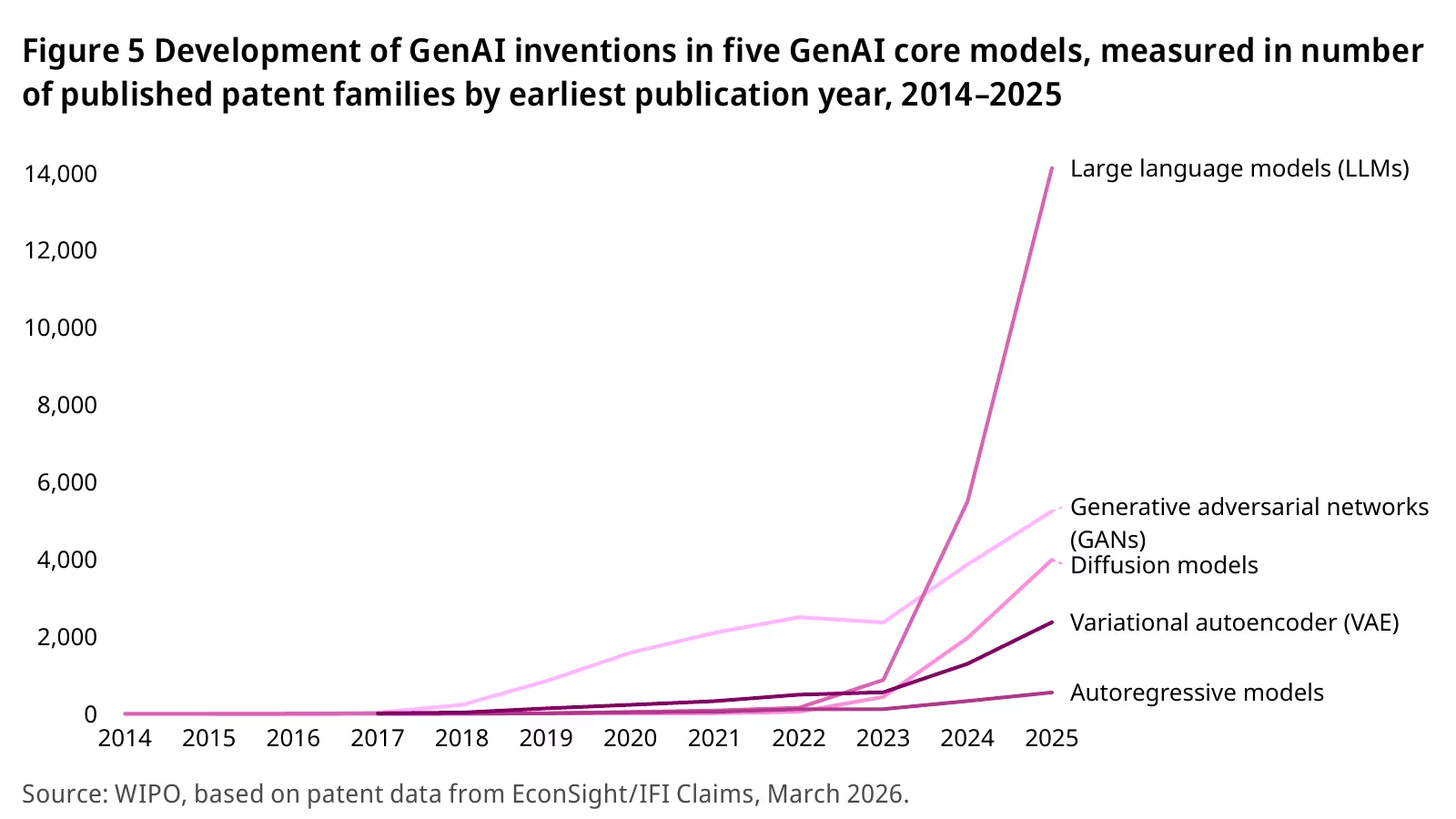
Figure 3. GenAI patent-family trends by core model. Source: WIPO (2026), Figure 5.
Corporate AI patent strategy must change accordingly.
Specific model architectures were once central patent targets. Today, even when a company uses an LLM or an existing foundation model, important patentable aspects may lie in how inputs are generated, how models are selected, how outputs are verified and processed, and how a technical problem in a specific industry is solved.
5. Merely “using ChatGPT” does not make an invention patentable
This is where many companies need to be most careful.
The use of generative AI does not itself establish patentability.
Korea’s 2026 Examination Practice Guide for AI makes this point quite clearly.
Under the Korea Intellectual Property Office’s examination practice, merely using generative AI without a specific technical feature that distinguishes the invention from existing technology may be regarded as an ordinary design modification and found obvious.
Conversely, inventiveness may be recognized where there is a specific difference in a mechanism for generating query data, an instruction, or a prompt supplied to the generative AI, and that difference produces a technical effect.
This is central to a GenAI patent application.
There is a fundamental difference between describing an invention merely as “using an LLM to generate an expert answer” and describing a structure that:
- Analyzes the user’s condition;
- Selects a specialized model based on the result;
- Constructs input data according to the user’s characteristics; and
- Verifies and post-processes the generated output to achieve a particular technical effect.
In patent practice, what matters is not simply that AI is used, but how it is used.
6. Which GenAI technologies should be patented?
When reviewing a potential GenAI patent filing, Pine IP Firm recommends decomposing the entire process rather than treating the technology as a single undifferentiated “AI service.”
The following points may provide patent opportunities.
First, input-data generation and preprocessing
Technical differentiation may lie in which data is selected, how it is transformed, normalized, or classified, and how it is placed into a form suitable for GenAI processing.
Korean AI examination practice also indicates that specific data-preprocessing techniques and superior technical effects resulting from them can be relevant to an inventive-step analysis.
Second, model selection, linkage, and routing
If a system does not send every request to one LLM, but instead selects an appropriate model from several AI models according to the request or data characteristics—or connects multiple models sequentially—the structure may deserve separate consideration as an invention.
Third, specific logic for generating prompts or instructions
This does not mean that a well-written prompt sentence is itself necessarily patentable.
What matters is a mechanism that technically generates or changes a prompt according to a user state, input data, or system condition, and the technical effect produced by that mechanism.
Fourth, verification and post-processing of AI output
If generated results are not presented to the user as-is, but undergo accuracy assessment, error checking, data conversion, or post-processing for a particular industrial system, those steps can also become important technical elements.
Fifth, applying AI to solve a technical problem in a specific industry
In manufacturing, semiconductors, healthcare, finance, energy, robotics, and autonomous driving, a concrete technical configuration that improves the accuracy, processing time, resource efficiency, or safety of an existing industrial process is much more significant than simple text generation.
7. “AI × industry” patents may matter more than patents on AI itself
WIPO’s data is particularly notable for the expansion of GenAI patent ownership beyond traditional IT companies.
The leading applicants now include companies in finance, telecommunications, infrastructure, power, and industry, as well as internet businesses. China’s State Grid Corporation and China Southern Power Grid, and Germany’s Bosch, are representative examples.
WIPO likewise notes that GenAI is expanding into finance, telecommunications, infrastructure, and other digital-service companies, and may increasingly combine with healthcare, manufacturing, finance, energy, and many other fields.
This change is highly relevant to Korean companies.
A company does not need to develop a large language model itself to obtain important AI patents. Even when existing LLMs are used, substantial opportunities may exist in technologies that solve industry-specific problems, such as:
- Generative AI that optimizes semiconductor processes
- Generative AI that analyzes manufacturing-equipment anomalies
- AI that supports decision-making using medical data
- Generative AI that automates architecture and design
- Generative AI that analyzes financial risk
- AI that generates robot action plans
Competitive advantage ultimately comes not from the word “AI,” but from a concrete technical configuration that solves an industry problem.
8. Text- and code-generation patents are growing rapidly after image and video
Patent data also reveals clear trends in GenAI application modes.
On a cumulative basis for 2014–2025, image and video accounted for the largest share, at about 40,000 patent families.
Text, however, has shown especially rapid recent growth. Text-related patent families more than tripled in two years, from about 3,400 in 2023 to about 11,800 in 2025.
Code-generation patent families rose from 339 in 2023 to 1,616 in 2025. 3D image modeling increased from 908 to 2,484 over the same period.
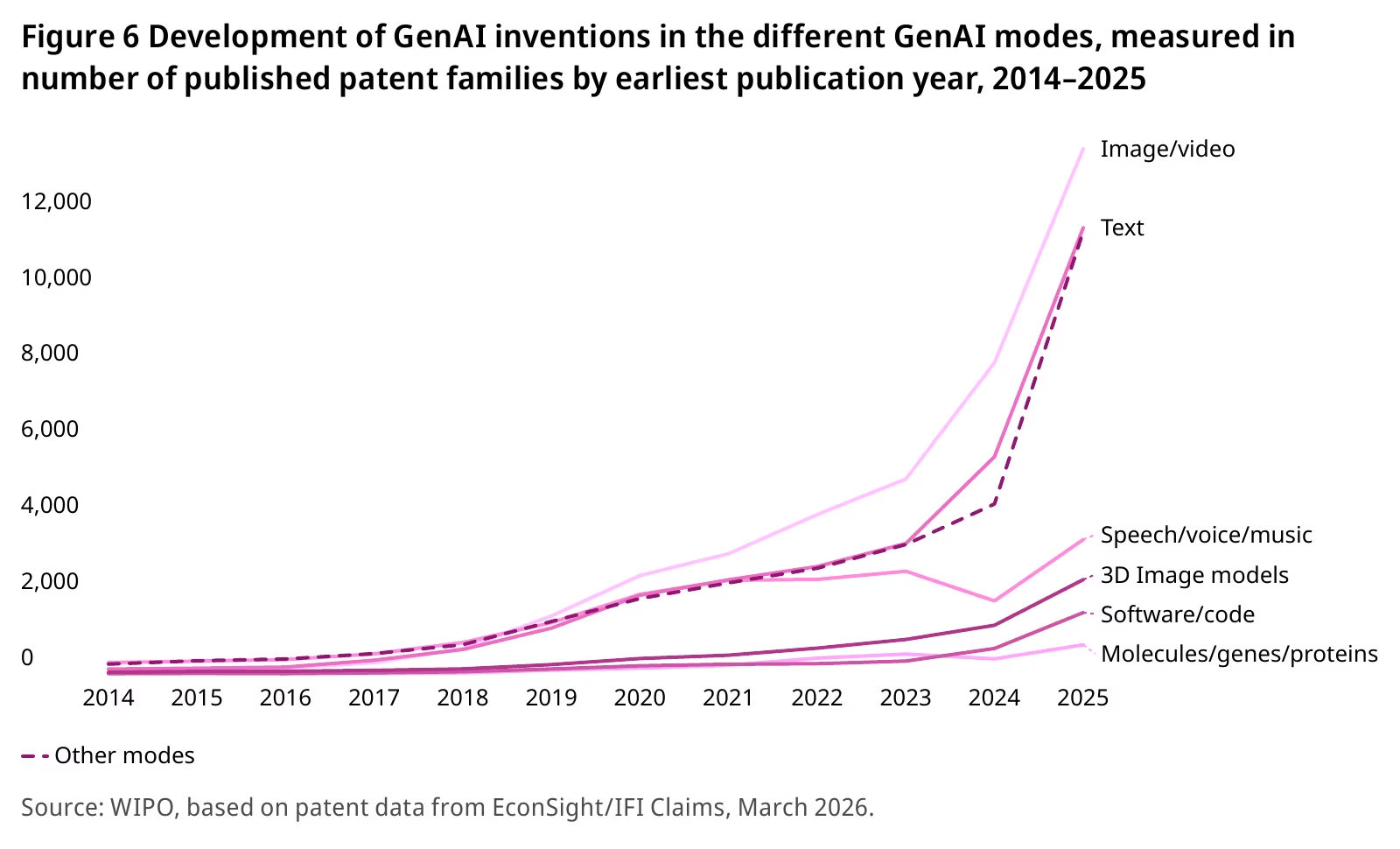
Figure 4. GenAI patent-family trends by application mode. Source: WIPO (2026), Figure 6.
These figures suggest that patent portfolios will move beyond simple chatbot functions into AI coding, design automation, multimodal processing, 3D content, workflow automation, and AI agents.
9. Five patent strategies every GenAI company should review now
WIPO’s statistics translate into five practical patent-strategy priorities.
① Identify patent opportunities during development, not after launch
Both technology and patent publication move quickly in AI.
If a company waits until development is complete and the product has proven itself in the market before reviewing patents, similar prior art may already have appeared. Invention harvesting and prior-art searches should proceed alongside planning, proof of concept, development, and launch.
② Claim technical differentiation—not merely “using AI”
Simply attaching GenAI to an existing process is unlikely to produce a strong patent.
Companies should identify specific structures and effects that differ from existing technology in input-data processing, prompt generation, model selection, training and inference architecture, output verification, and post-processing. Korean examination practice likewise distinguishes simple use of GenAI from concrete technical differences.
③ Build a portfolio instead of putting everything into one patent
A single core service may contain several inventions.
Within one AI service, data preprocessing, model routing, generation, verification, user interface, and industry-specific application may each be separate candidates for protection.
For an important service, companies should therefore move beyond a single application and design a structured portfolio of core and surrounding technologies.
④ Decide overseas markets from the outset, not only the Korean filing
WIPO notes that the current share of internationally extended patent families in GenAI remains relatively small and that global protection is likely to expand as markets and business models mature.
Companies planning business in the United States, China, Japan, Europe, or other overseas markets should decide where protection is needed at the initial-filing stage, rather than considering foreign filings only later.
⑤ When AI contributes to an invention, document the human contribution
This is an issue that the Korean IP Office emphasized in 2026.
Under current Korean practice, AI itself is not recognized as an inventor. A human must make a substantive contribution to the creative process.
KIPO advises that, where legitimate inventorship is in doubt during examination, it may request R&D notebooks, inventor declarations, or other records showing the human contribution.
Companies that actively use GenAI in R&D should therefore establish an inventorship-management process that records who defined the technical problem and which human selections and validations completed the invention.
10. Caution is also required when AI is used to draft patent specifications
In the GenAI era, AI may be used not only to create inventions, but also to draft patent specifications. The convenience comes with significant risks.
In guidance issued in June 2026, the Korea Intellectual Property Office warned that generative AI hallucinations can produce nonexistent technical content or false effects. Applicants and their representatives must therefore verify the factual accuracy of specifications and office-action responses and the feasibility of the invention.
This is especially sensitive in pharmaceuticals and advanced materials, where experimental results and reproducibility are important. AI-generated test results must not be presented as results of actual experiments.
Confidentiality is another concern.
Entering an unpublished invention into an external generative AI service can transmit a company’s technical information outside the organization. KIPO also expressly warns users to protect core technology and trade secrets when entering information into AI systems.
AI may improve the efficiency of patent work, but verification and security cannot be delegated to AI.
11. The real GenAI patent race is only beginning
The most important figure in WIPO’s statistics may not be 37,808.
More significant is that the number of GenAI patents published in 2024 and 2025 already exceeded the cumulative total for the preceding ten years. The industry’s patent landscape is effectively being redrawn.
Nor is the shift centered on LLMs alone.
Patent competition is rapidly expanding into multimodal AI, diffusion models, code generation, AI agents, reasoning, efficient training and inference, and applications in manufacturing, finance, healthcare, and energy.
The question companies should ask is no longer, “Should we file one AI patent?”
The questions should be:
- Which technology in our service would we most want to block a competitor from copying?
- Apart from the AI model, what proprietary data-processing, input-generation, verification, and post-processing technologies do we have?
- Which technologies could competitors copy once disclosed, and which should remain trade secrets?
- How should we design today the patent portfolio that will protect our market three years from now?
Practical AI patent strategy begins with these questions.
Pine IP Firm’s view
A strong patent in the GenAI era is not created by simply adding the words “artificial intelligence,” “LLM,” or “generative AI” to a claim.
The key is to identify the invention’s structure: how data enters, what decision the AI makes, how components interact, and which technical effect arises compared with existing technology.
Because GenAI changes quickly, it is increasingly important to harvest inventions and design a patent portfolio continuously during R&D, instead of waiting to identify an invention after development is complete.
When reviewing generative AI and software technologies, Pine IP Firm asks not merely whether “AI is included,” but where the technical differentiation that can defend the actual business lies.
As AI technology advances, patents are becoming less of an administrative step taken after development and more of a competitive instrument to be designed alongside technology and business strategy.
Generative AI patent FAQ
Q1. Can a service using ChatGPT or an existing LLM be patented?
Potentially, yes. A company’s failure to develop its own LLM does not by itself prevent patent protection.
However, a simple application of GenAI to an existing service may be found obvious. What matters is whether there is specific technical differentiation and a resulting effect in input-data generation, data processing, model selection, prompt configuration, output verification, or post-processing.
Q2. Can a prompt be patented?
A prompt consisting of a particular phrase is not automatically patentable.
Korean GenAI examination practice nevertheless recognizes that inventiveness may exist where there is a difference in a specific technical mechanism that generates input data such as a query, instruction, or prompt, and that difference produces a technical effect. The invention must ultimately be assessed as a whole.
Q3. If GenAI created the idea, should AI be named as the inventor?
Not under current Korean practice.
KIPO advises that, even where AI is used, a human must make a substantive contribution to the creative process to qualify as the legitimate inventor. Merely entering a general instruction into AI and filing the result may create serious problems.
Q4. Should AI technology be protected by patents or trade secrets?
It depends on the technology.
Patents may be advantageous where implementation can be identified by analyzing a product, infringement by competitors can be detected, or a core architecture must block market entry over the long term.
Trade-secret protection may be more appropriate for training know-how, internal data-processing methods, and other techniques that outsiders cannot readily discover.
Rather than making one uniform choice between patents and trade secrets, companies should distinguish the appropriate IP strategy technology by technology.
References
- WIPO, Patent Trends Update in GenAI (2026)
- Korea Intellectual Property Office, Review AI patent examination cases in the Examination Practice Guide (Jan. 15, 2026)
- Korea Intellectual Property Office, AI-assisted inventions require human contribution for inventorship (June 9, 2026)
- Korea Intellectual Property Office, Patentability and disclosure requirements for AI inventions
The charts reproduced in this article were cropped from Figures 1, 4, 5, and 6 of WIPO (2026), Patent Trends Update in GenAI. The figures and chart text were not altered, and WIPO attribution and the CC BY 4.0 license are provided. The WIPO Secretariat assumes no liability or responsibility with regard to the transformation of the original content.