
SK hynix Patent Filing Data as of July 6, 2026
The SK hynix dataset covers semiconductor manufacturing processes, device structures, memory circuits, storage systems, and the newer H10B memory-device classifications. The analysis below separates filing volume from the jurisdiction, legal-status, and main-IPC distributions.
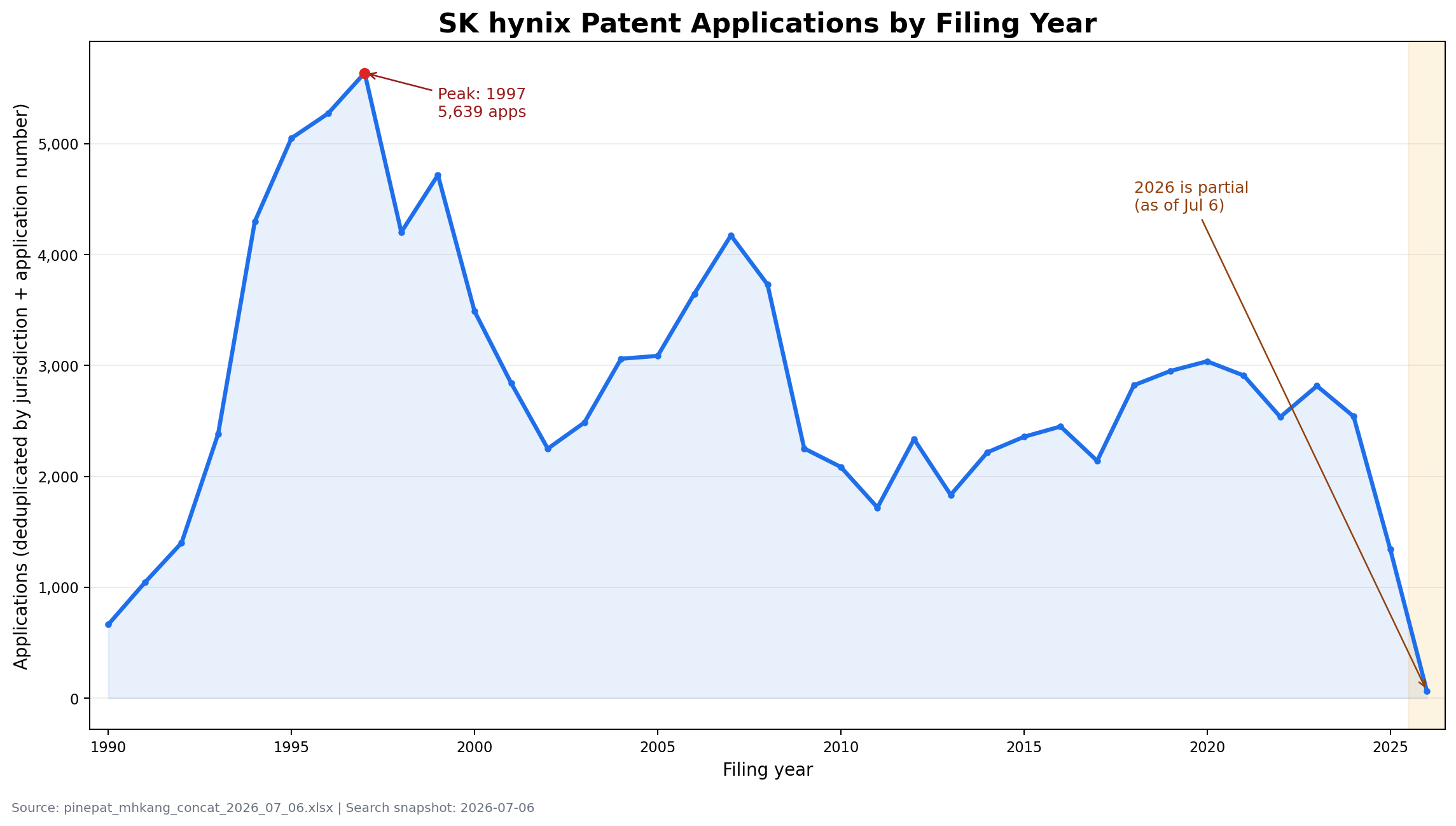
This column is based on the search and collection snapshot dated July 6, 2026 from pinepat_mhkang_concat_2026_07_06.xlsx. The concat sheet contains 148,463 raw document records. Because one application can appear as multiple publication or grant records, filing-year trends and jurisdiction shares are analyzed mainly on 104,342 deduplicated application records, using jurisdiction code plus application number as the deduplication key.
| Search snapshot | 2026-07-06 |
|---|---|
| Raw document records | 148,463 rows |
| Deduplicated applications | 104,342 records |
| Filing-year coverage | 1985-2026 |
| 2026 data | Partial count as of July 6 |
Filing-year distribution
On the deduplicated basis, the highest annual count is 5,639 applications in 1997. Filings from 1995-1999 include semiconductor manufacturing processes, memory cells, DRAM structures, and fabrication methods. Counts also increased during 2006-2008, when the records include process scaling, gate structures, flash and DRAM fabrication, and memory-circuit control.
Since 2016, annual filings have generally stayed in the mid-2,000 to roughly 3,000 range. The lower numbers for 2025 and 2026 should not be read as a simple decline in research activity. Patent databases lag recent filing activity because many applications are not published immediately after filing. As of the July 6, 2026 search snapshot, the most recent years are therefore an incomplete publication window.
Jurisdiction distribution
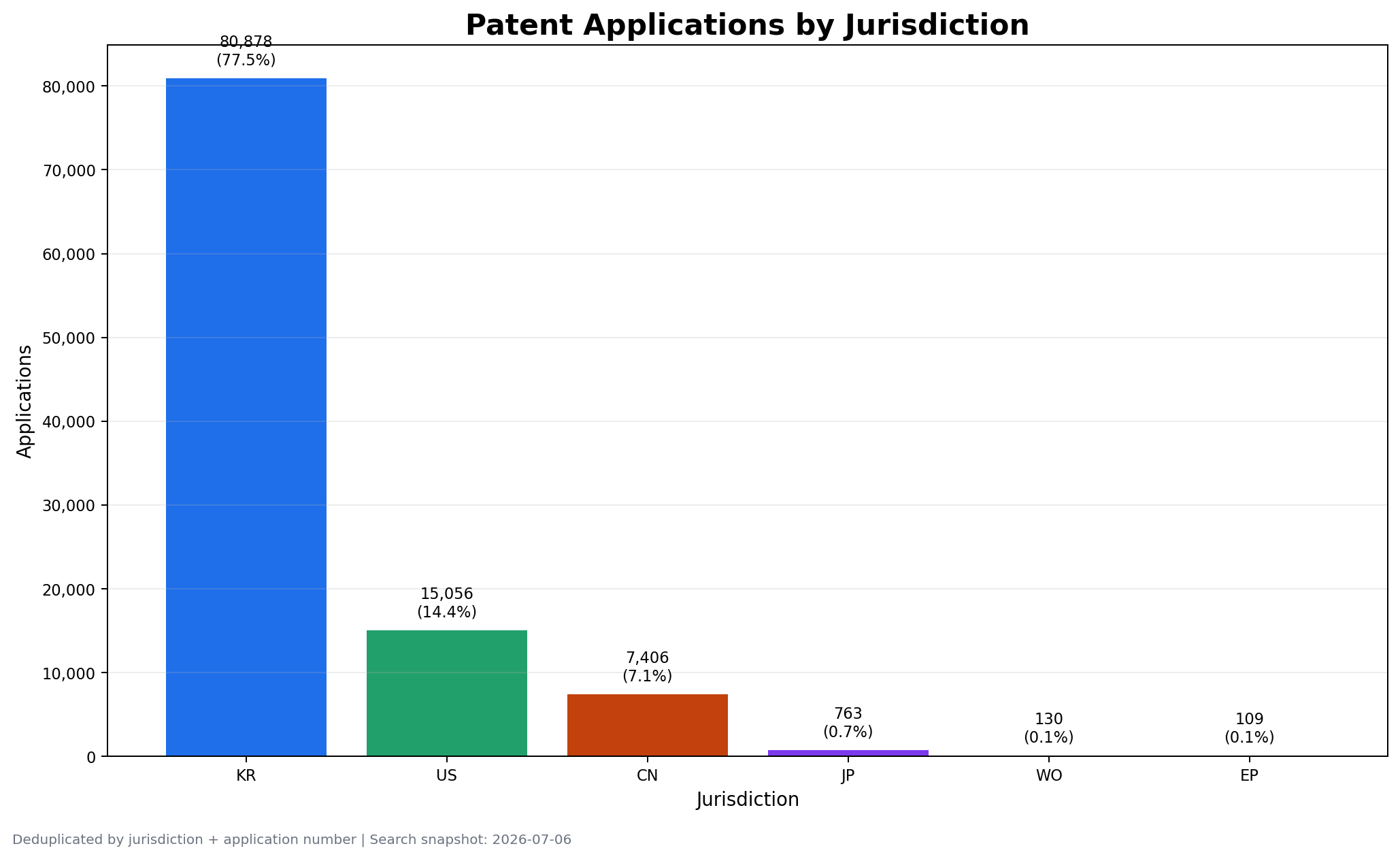
Korea accounts for 80,878 applications, or 77.5% of the deduplicated set. The United States has 15,056 applications and China has 7,406. The data source contains fewer records for Japan, WO, and EP.
Jurisdiction counts should be assessed together with family membership, claim scope, product relevance, and current legal status. The counts alone do not establish the commercial importance of a jurisdiction.
Legal-status distribution
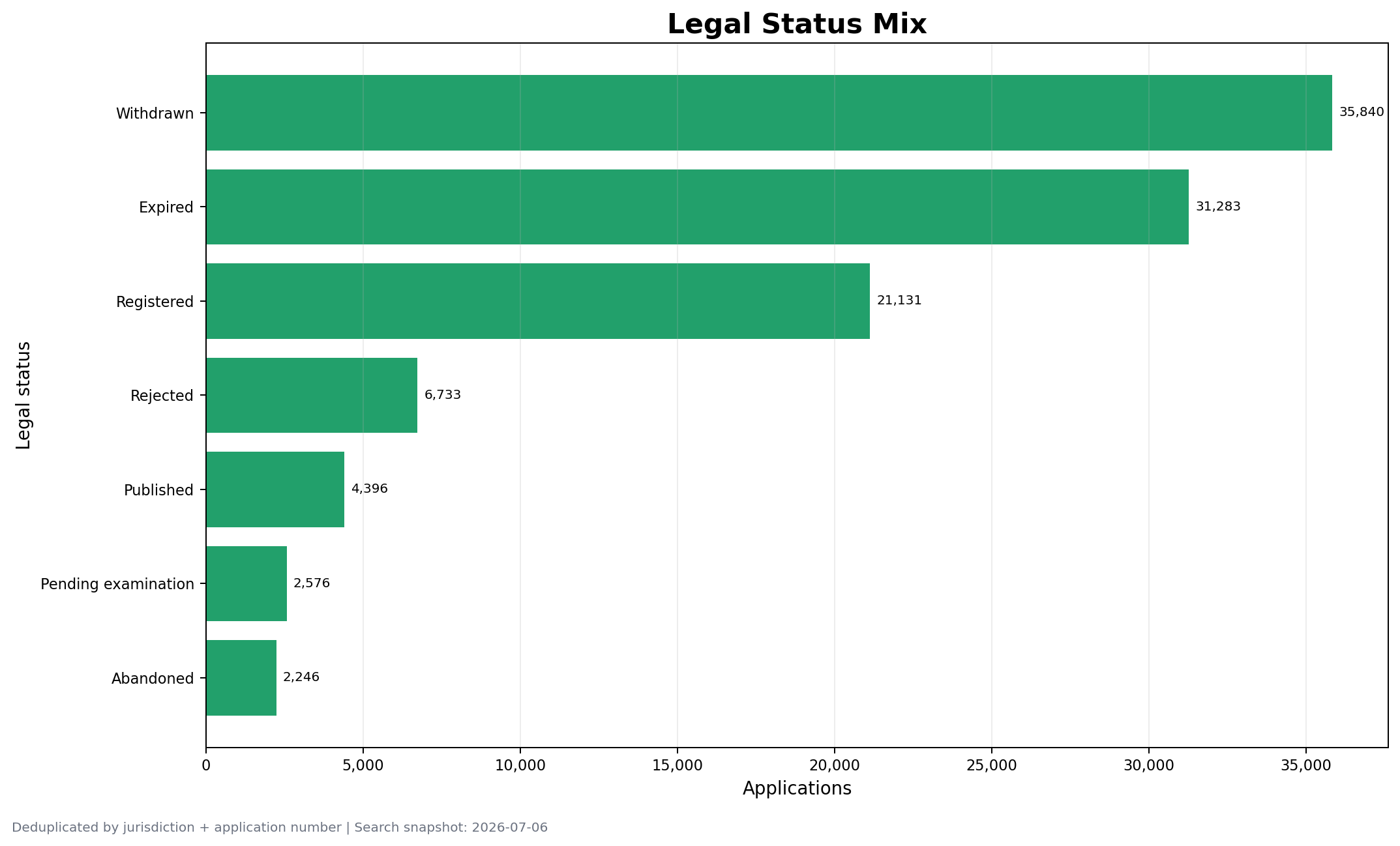
The deduplicated status mix shows 35,840 withdrawn applications, 31,283 expired rights, 21,131 registered rights, 6,733 rejected records, 4,396 published applications, and 2,576 pending cases. Many older rights have reached the end of their term. The dataset does not establish the reason for each withdrawal or rejection.
For current-product technologies such as memory systems, controllers, error correction, 3D memory structures, and storage management, claim scope and foreign-family status are more informative than the aggregate status count.
Main IPC groups: H01L, G11C, G06F, and H10B
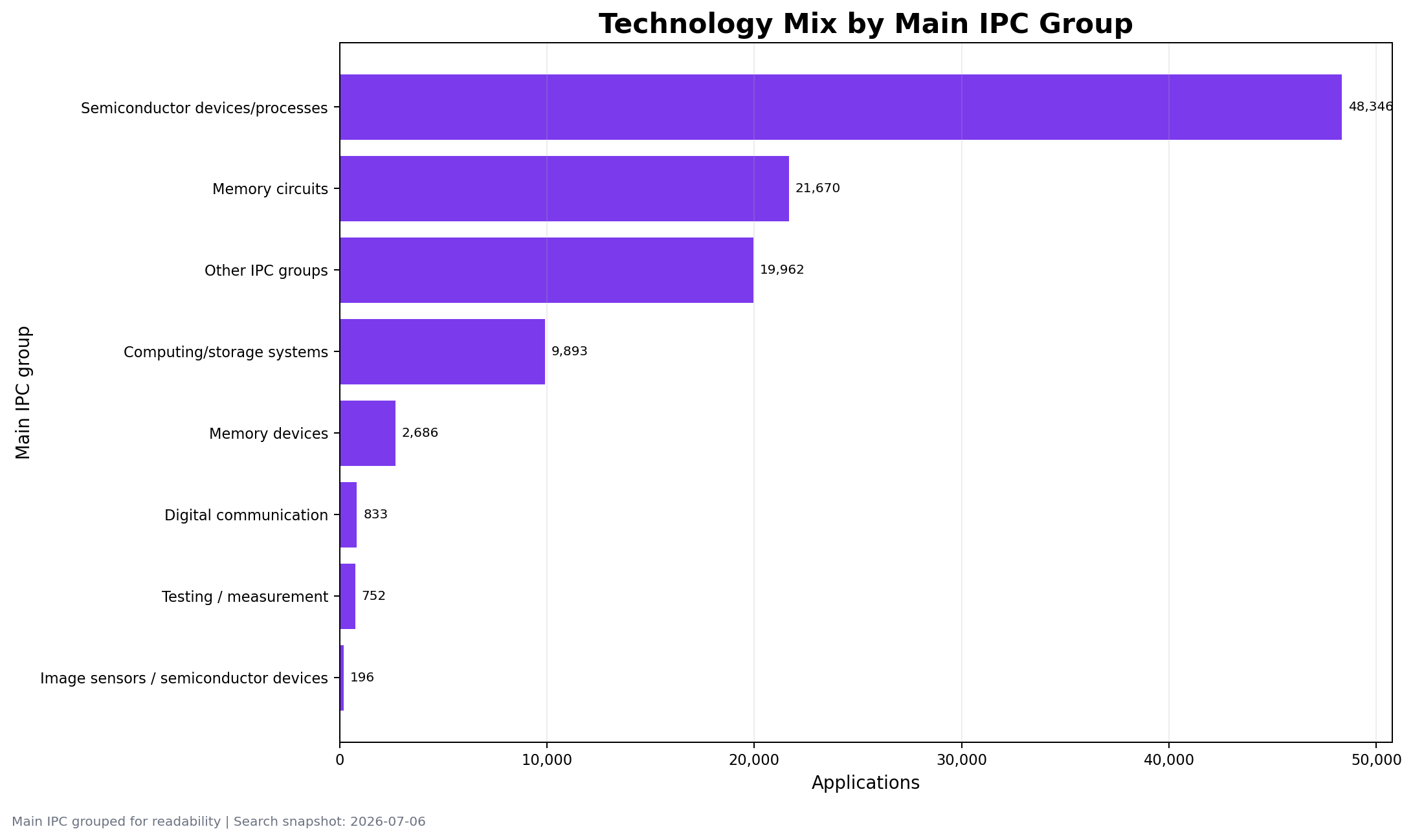
Grouped by main IPC, H01L semiconductor devices and processes account for 48,346 applications. G11C memory circuits account for 21,670, G06F computing and storage systems for 9,893, and H10B memory-device classifications for 2,686. These groups cover wafer processing, cell structures, memory operation, testing, error control, and storage-system architecture.
| Top main IPC 1 | H01L-021/28: 5,563 applications |
|---|---|
| Top main IPC 2 | H01L-021/027: 3,829 applications |
| Top main IPC 3 | G06F-003/06: 3,229 applications |
| Top main IPC 4 | H01L-021/336: 3,181 applications |
| Top main IPC 5 | H01L-027/108: 3,023 applications |
| Top main IPC 6 | H01L-027/115: 2,528 applications |
H01L-021/28, H01L-021/027, and H01L-021/336 concern fabrication and structural formation. G06F-003/06 may cover storage-device I/O, data placement, memory-system control, and related product functions. A search or freedom-to-operate review should therefore consider G11C, G06F, and H10B together with H01L.
Main IPC distribution for 2024-2026
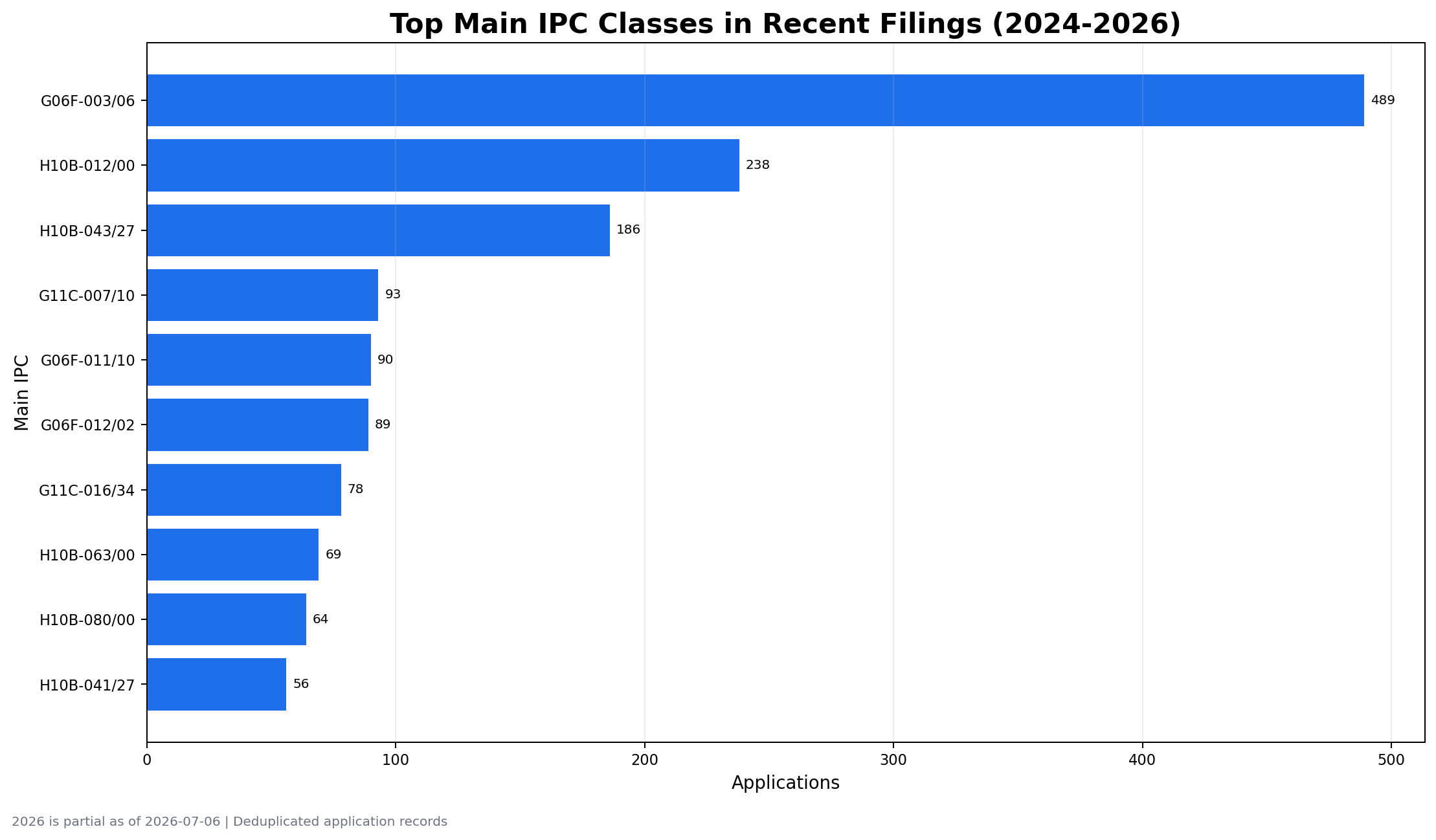
In the 2024-2026 window, G06F-003/06 accounts for 489 applications, followed by H10B-012/00 with 238 and H10B-043/27 with 186. G06F-011/10, G06F-012/02, and G11C-016/34 are also frequent in the dataset. These records concern storage systems, error correction, data management, and device structures.
The H10B counts partly reflect IPC classification changes and the more specific classification of 3D memory, nonvolatile memory, and other memory-device structures. Searches limited to older H01L and G11C terms may omit recent filings.
Review considerations
- FTO review: Do not stop at memory cells and fabrication. Controller, storage-operation, error-correction, and data-placement claims under G06F and G11C must be reviewed together.
- Competitor monitoring: The recent period has a publication lag, so newly published cases should be watched monthly, with G06F and H10B classes treated as separate watchlists.
- Filing strategy: Process improvements should be claimed under H01L, while product-performance inventions should be supported with G11C, G06F, and H10B claim sets.
- Foreign protection: Even when the portfolio is Korea-heavy, U.S. and Chinese family coverage often determines practical defensive value.
Scope of continuing review
The July 6, 2026 snapshot shows substantial H01L manufacturing-process filings and significant G11C, G06F, and H10B records. Continuing review should track newly published applications, foreign-family coverage, current legal status, and system- and device-level claims. Recent-year counts remain incomplete because of publication delay.