
7 Key Factors for Pre-Investment IP Due Diligence
Investors do not invest simply because a technology is good. They verify whether the technology belongs to the company, if competitors can easily copy it, if the rights remain with the company even if key personnel leave, and if it infringes on external rights. Intellectual property is the area most frequently examined during this process.
Early-stage startups often mistakenly think that IP due diligence is a procedure only for large corporate M&As. However, even at the seed, pre-A, and Series A stages, investors look for minimal IP risks. Especially for AI, SaaS, healthcare, manufacturing, robotics, semiconductor, battery, content, and platform companies, IP organization can directly affect investment speed and terms.
Before raising investment, the following seven points should be checked first.
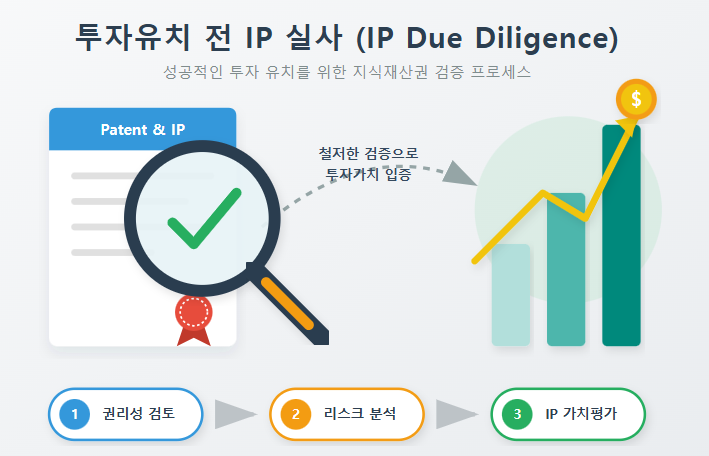
1. Is the Core Technology Owned by the Company?
The first thing to look at is ownership of rights. It's important to confirm who created the technology and whether those rights have been transferred to the company.
The following situations frequently become issues during due diligence.
- If co-founders did not transfer code or drawings created before company incorporation to the company
- If the outsourcing development contract does not include a clause transferring copyrights and patents to the company
- If the technology originated from university, research institute, or previous employer projects is mixed in
- If an employee managed core code on a personal GitHub account or personal equipment
- If the ownership and usage conditions of government project deliverables were not confirmed
Investors first look at “can the company sell this technology?” rather than how excellent the technology is. Therefore, it is advisable to prepare separate assignment agreements or confirmations for developments made before company incorporation, outsourced deliverables, and co-development results.
2. Are Patents Connected to the Business Model?
A large number of patents does not necessarily mean a good portfolio. Investors look at whether patents are connected to the actual business.
Key points to check:
- Do the patent claims actually cover the functions of the core product?
- Are the claims phrased in a way that is easy for competitors to circumvent?
- Are only past ideas unrelated to current revenue-generating products filed?
- Is there a PCT or national phase filing strategy tailored to the countries planned for overseas expansion?
- Was the application filed before public papers, IR materials, or exhibition presentations?
- Was not only registrability but also the possibility of proving infringement considered?
Investors are more curious about “what does this patent mean for revenue and defensive strength?” rather than simply “there are patents.” Therefore, it is advisable to include a mapping table connecting product functions and patent claims in investment materials, rather than just a list of patents.
3. Are Trademarks and Brands Preempted?
Even technology companies should not take trademarks lightly. If product names, service names, app names, or platform names are already being used in marketing but trademarks have not been filed, or if similar trademarks already exist, rebranding costs may arise.
Questions examined during due diligence:
- Are the company name and product name filed in major countries?
- Do the domain name, app store name, and SNS account names align with the trademark strategy?
- Are there identical or similar brands in the countries planned for overseas expansion?
- Are there any trademarks filed under the personal name of a co-founder?
- Was copyright transferred in the outsourcing contract for logo creation?
Trademarks can become a business risk faster than patents. Brand rights should be organized before significant advertising spending after investment.
4. Are Open Source and External Code Risks Managed?
For SaaS and AI companies, open-source usage history is central to due diligence. Even if investors do not directly review the entire source code, they can verify the list of open-source components used, licenses, notification obligations, and the use of strong copyleft licenses.
The following, in particular, are high-risk signals:
- No open-source usage list
- Unaware of GPL, AGPL usage
- No license notice provided when offering installable packages to customers
- Did not receive open-source usage details for code delivered by the outsourcing company
- Licenses for AI models, datasets, and prompt templates are not managed separately from the code
Before investment, at a minimum, a product-specific open-source list and license classification table should be created.
5. Is Trade Secret Management Actually Functioning?
Not all technologies can be patented. Datasets, recipes, manufacturing conditions, customer-specific tuning values, pricing logic, labeling standards, and experimental failure data may be better managed as trade secrets.
However, trade secrets are not protected merely by thinking they are “secret.” Actual management measures must be in place.
Checklist items:
- Is access to core data restricted?
- Is an NDA signed when sharing externally?
- Are files, documents, and repositories marked as confidential?
- Are ex-employee accounts recovered and data exfiltration checked?
- Is the scope of confidential information clear during co-development with partners?
- Is core know-how not excessively disclosed in customer proposals?
Investors look not only at how well the company has developed its technology but also whether it has a system in place to prevent losing that technology.
6. Have Potential Disputes and Freedom-to-Operate Been Considered?
Possessing a patent does not automatically grant the freedom to sell a product. A company's patent is a “right to prevent others from copying,” while FTO (Freedom-to-Operate) is a review to determine “whether we can operate without infringing on others' rights.”
Before investment, the following issues should be checked:
- Have major competitor patents been searched?
- Has infringement risk been reviewed in the product launch countries?
- Is there a history of warning letters, oppositions, trials, or lawsuits?
- Is there a possibility of a rights dispute with a previous employer or co-research institution?
- Are patent infringement warranty clauses excessively included in customer supply contracts?
Especially in manufacturing, medical devices, robotics, batteries, semiconductor equipment, telecommunications, and security sectors, FTO review can become crucial in investment due diligence.
7. Can IP Be Used for Future Fundraising and Commercialization?
IP can serve as a basis for fundraising and commercialization, not just a cost item. WIPO also explains that intellectual property and intangible assets are becoming more important in corporate fundraising. However, for IP to be used for fundraising, its rights status, business relevance, marketability, feasibility of implementation, and licensing potential must be well-organized.
From an investor's perspective, good IP materials demonstrate the following:
- Status of rights protection for each core product
- Differentiation points compared to competitors
- Overseas filing strategy
- Trade secret management system
- Review of third-party rights infringement risk
- Future filing roadmap
- Technology transfer and licensing potential
A table connecting products, technology, rights, and markets is far more persuasive than a simple list of patents.
IP Data Room to Prepare Before Investment
It is advisable to prepare the following documents in folders before investment due diligence.
- List of patent, trademark, design, and copyright registrations/applications
- Owner, status, country, and estimated expiration date for each right
- Patent mapping table by product
- Rights assignment agreements for co-founders, employees, and outsourcing companies
- NDA, co-development agreements, license agreements
- Open-source usage list and notice files
- Trade secret management regulations and access control policy
- Competitor patent/FTO review summary
- History of disputes, warning letters, oppositions, trials
- IP roadmap for the next 12-24 months
Frequently Asked Questions
Do patents necessarily have to be registered before investment?
They do not necessarily have to be registered. However, it is important whether at least an application has been filed for core technologies, whether it was filed before public disclosure, and whether the claims are connected to the product. For early-stage companies, filing timing and the direction of rights are often more important than registration.
Is it disadvantageous for investment if there are no patents?
It can be disadvantageous for technology companies. However, not all companies need to be patent-centric. Some businesses prioritize data, brands, trade secrets, software copyrights, or contractual exclusive rights. The important thing is to be able to explain “why there are no patents, and what is used for defense instead.”
What is the biggest problem investors dislike in IP due diligence?
It is when the ownership of rights is unclear. Core code created by an outsourcing company, patents under a co-founder's personal name, commingling with technology from a previous employer, or unauthorized use of university research results can delay transactions or worsen terms.
Pine IP Firm's Practical Proposal
Startups preparing for investment should not only look at patent filing status but also organize rights ownership, trade secrets, open source, trademarks, FTO, and contracts. If IP due diligence is rushed just before investment, unfixable problems may emerge.
Pine IP Firm organizes materials that can answer investors' questions through pre-investment IP checks, patent portfolio diagnostics, product-specific rights mapping, and open-source/outsourcing contract risk reviews.