
Patent Court 2025Heo10293: Changed Claim-to-Prior-Art Mapping as a New Ground for Rejection
On February 12, 2026, the Korean Patent Court revoked the Intellectual Property Trial and Appeal Board's decision in Case No. 2025Heo10293. The Board had relied on the same prior-art reference cited during examination but mapped two claim elements to different parts of that reference. The court held that the changed mapping was a new ground for rejection because it changed the differences to be addressed and the applicant's available amendment strategy.
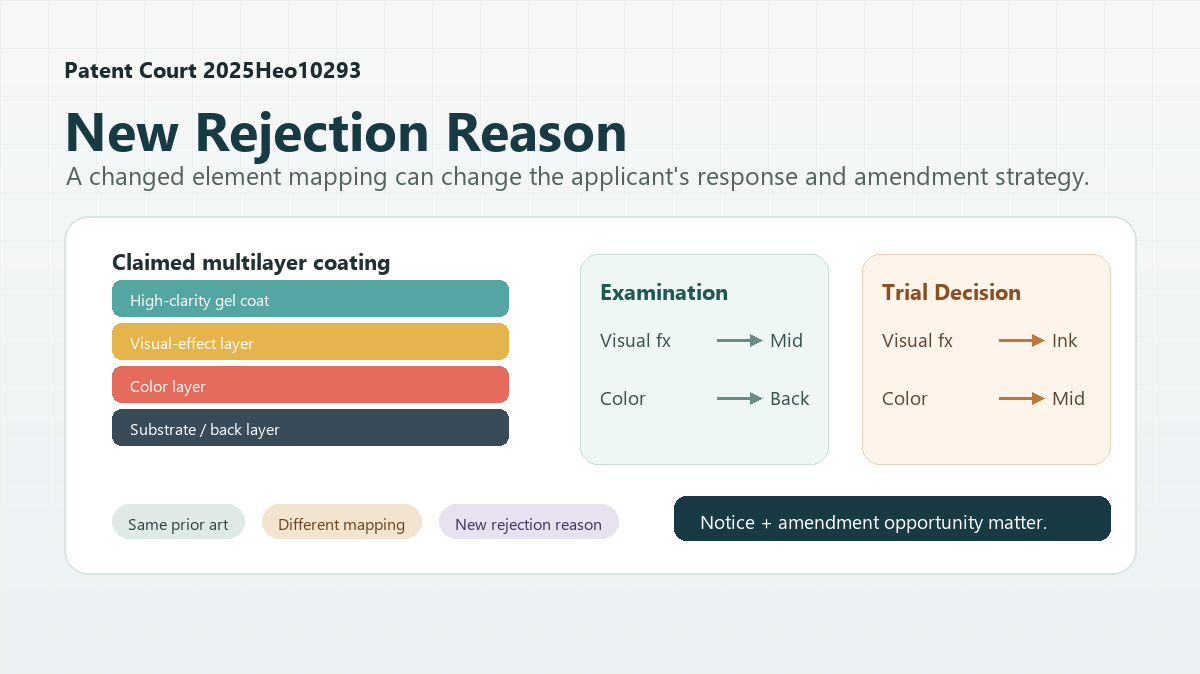
Claim and prior art
The application concerned a multilayer coating that produced a visual effect. Claim 1 included a high-clarity gel-coat layer, a visual-effect layer, and a color layer. Prior Art 1 was a Japanese unexamined patent publication concerning an ink composition and a resin-molded article.
During examination, the examiner used the following correspondence:
| Claim 1 element | Prior Art 1 element identified during examination |
|---|---|
| High-clarity gel-coat layer | Gel-coat layer |
| Visual-effect layer | Intermediate layer |
| Color layer | White layer |
The applicant's opinion and amendments responded to that mapping, including the asserted relationship between the visual-effect layer and the prior art's intermediate layer.
Mapping used in the appeal decision
In dismissing the appeal from the refusal, the Board continued to rely on Prior Art 1 but used a different correspondence:
| Claim 1 element | Prior Art 1 element identified by the Board |
|---|---|
| High-clarity gel-coat layer | Gel-coat layer |
| Visual-effect layer | Ink-composition layer |
| Color layer | Intermediate layer |
The cited document did not change, but the technical comparison did. The ink-composition layer, intermediate layer, and white layer served different functions in Prior Art 1. Mapping the claimed visual-effect layer to the ink-composition layer therefore presented a different issue from mapping it to the intermediate layer.
Patent Court's analysis
The court treated claim-to-prior-art mapping as a central part of the inventive-step analysis. That analysis requires identification of corresponding elements, determination of similarities and differences, and an assessment of whether a skilled person could readily overcome the differences.
A changed mapping does not automatically create a new ground for rejection. The relevant inquiry is whether the change materially affects:
- the similarities and differences identified between the claim and the prior art;
- the substance of the inventive-step analysis;
- the applicant's technical response; or
- the amendments reasonably available to the applicant.
The court found those effects in this case. If the ink-composition-layer mapping had been notified during examination, the applicant could have argued that the prior-art layer contained ordinary pigments rather than visual-effect pigments. It also could have considered an amendment directed to particle size or other properties of the visual-effect pigment. The examination-stage notice did not give the applicant an opportunity to make those submissions.
The court accordingly held that the Board's reasoning did not correspond in its main thrust to the previously notified ground for rejection. The Board was required to notify the new ground and provide an opportunity to submit an opinion and amendment.
Effect of the procedural defect
In the revocation action, the Commissioner argued that the examination-stage inventive-step reasoning still supported the refusal. The court rejected that argument as a basis for preserving the Board's decision. The absence of the required opportunity to respond was a procedural defect in the decision under review; a later argument that a different rejection rationale was substantively correct did not cure it.
Articles 63 and 170 of the Korean Patent Act protect the applicant's opportunity to address a ground for rejection before an adverse decision is made. That opportunity includes both legal and technical argument and, where permitted, amendment of the claims.
Prosecution record and appeal practice
- Record the element mapping. An opinion should state which part of each reference the examiner maps to each claim element. A table is often the clearest record.
- Compare reasoning, not document numbers. Use of the same reference does not establish that the notified and final grounds are the same. Review the mapped elements, identified differences, technical problem, motivation, and proposed modification.
- Identify the lost response opportunity. A procedural objection should explain the argument or amendment that would have been available if the changed reasoning had been notified.
- Address procedure and substance separately. When feasible, preserve the objection to a new ground while also explaining why the changed mapping does not establish lack of inventive step.
- Maintain fallback amendments. Numerical, material, functional, and relational limitations may address different mappings. The specification should support those alternatives from filing.
Case No. 2025Heo10293 does not prohibit the Board from refining an inventive-step analysis. It requires a new notice when the refinement changes the substance of the comparison and the applicant's response or amendment options.