
Jinseong Park of PNJ IP Law Gives a Training Session on Functional Claims and §112(f) at Pine IP Firm
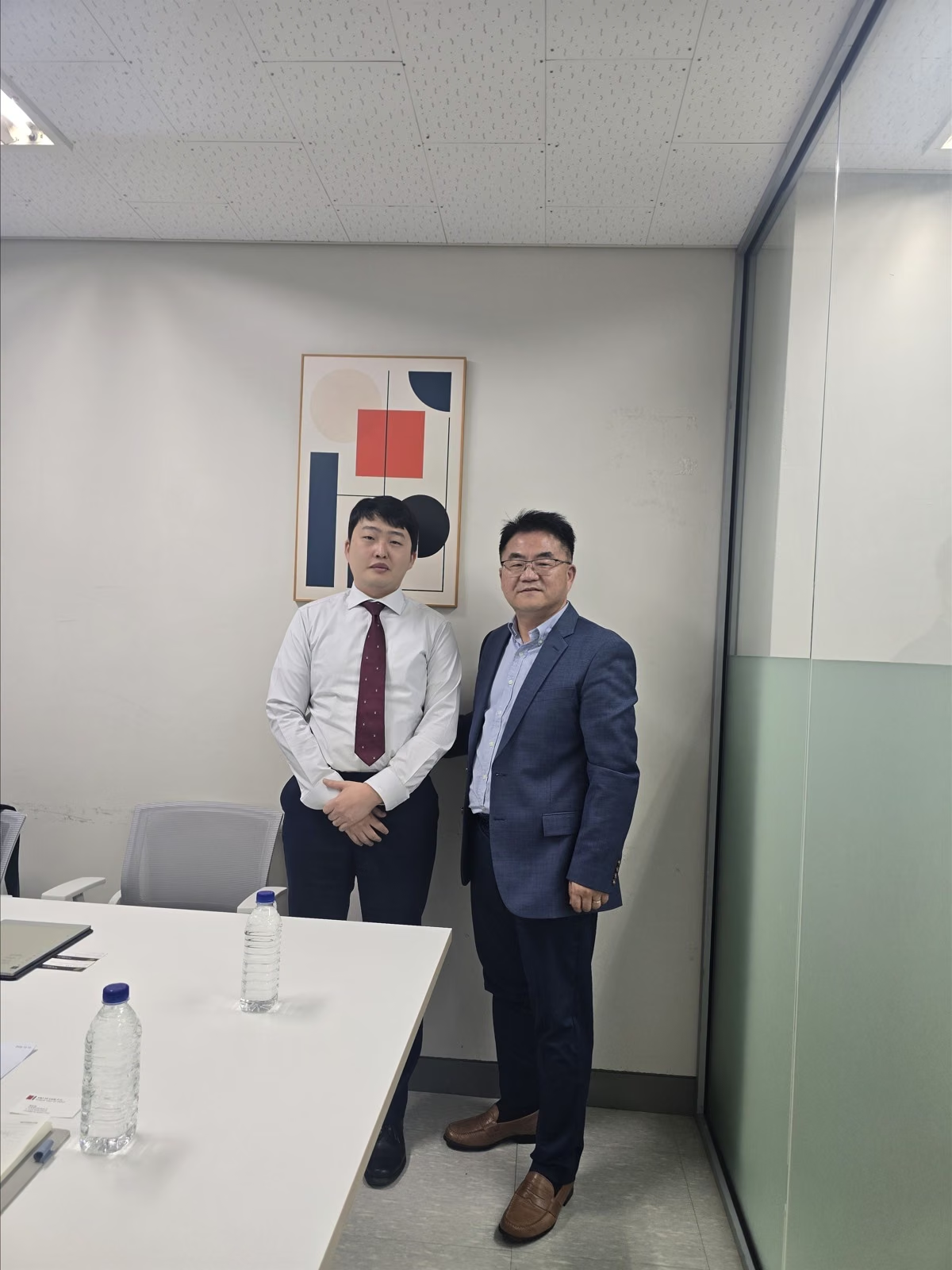
At 5 p.m. on October 14, 2026, Jinseong Park, a U.S. patent attorney at PNJ IP Law P.C., visited Pine IP Firm’s Pangyo office. Our team attended his training session on functional claim language and 35 U.S.C. §112(f), learning about issues to consider when preparing U.S. applications from Korean specifications and claims.
“Configured to” and functional claim interpretation
Using his presentation, “Configured To,” Mr. Park explained how functional claim language is interpreted during U.S. examination. Through examples, he showed why terms such as “unit” and “member,” together with expressions such as “configured to,” need to be assessed for the structure they convey in context.
When §112(f) applies, a claim limitation is construed by reference to the corresponding structure, material or acts disclosed in the specification and their equivalents. Omitting “means” or replacing “for” with “configured to” does not, by itself, determine whether the provision applies. Insufficient supporting disclosure can also raise definiteness issues.
Key topics covered in the training
- Component names and functions: Consider what structure a term conveys to a skilled person and whether the claim clearly relates that structure to its function.
- Support in the specification and drawings: Check for the structures and operations that implement the claimed function, including flowcharts or specific examples where needed.
- Technical limitations and intended use: Distinguish language that limits an apparatus’s actual capabilities or configuration from language that merely describes a desired use or result when comparing the claim with prior art.
The examples helped our team understand why preparing a U.S. application involves reviewing the claims and description together, alongside translating the Korean text.
Our thanks for sharing practical experience
Mr. Park draws on technical and patent experience in semiconductors and displays in his U.S. prosecution practice and works with Korean law firms through PNJ IP Law. The session gave our team an opportunity to learn from his experience and deepen our understanding of U.S. claim interpretation.
Jung Jae-yeol, Managing Patent Attorney at Pine IP Firm, expresses his appreciation: “We thank Mr. Park for visiting us and sharing his practical experience during his busy trip to Korea. His concrete examples made this a valuable opportunity to learn about points that deserve attention in U.S. patent practice.”
Pine IP Firm will draw on the lessons from this session in its work and continue seeking opportunities to learn from practitioners overseas.
Further reading: USPTO MPEP §2181 · USPTO MPEP §2114